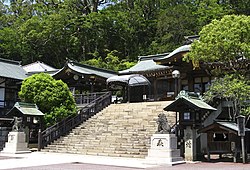
Every year from October seventh to ninth, this hillside becomes a stage. The Nagasaki Kunchi was originally celebrated on the ninth day of the ninth lunar month, and it now keeps fixed dates. It is counted among the three major festivals of Japan, and its votive dances are designated as an important intangible folk cultural property. What makes it unforgettable is its mix of cultures. Nagasaki was the only place in Japan with an open port, so it was considered essential to impress Dutch and Chinese traders with Japanese culture. The result is a festival with snake dances, Chinese dragons and the parading of large wooden boats, blending Japanese tradition with influences from China, the Netherlands and Portugal. The festival's roots are tied to the shrine's early days. One reading holds that it also served as a way to identify hidden Christians who would not take part. Then, beginning in 1638, major Noh performances were held at the shrine at the direct command of the shogun. When you stand in these grounds, imagine them filled with dancers, music and crowds of spectators.