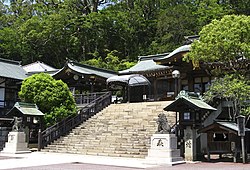
Now look at the buildings, because their journey is part of the story. The red entrance gate is called the Ryugamon, the Gate of the Dragon Palace. Painted a bright red, it is a rare example of South China architecture from the Ming dynasty. Further in is the original entrance, the Dai-ipponmon gate, the Inner Gate. It was built in China in 1644, shipped to Nagasaki, and reassembled at the temple in 1695. The main Buddha Hall followed a similar path. Its pieces were designed and cut in China, shipped across, and erected here in 1646. The Inner Gate and the Buddha Hall are both said to have been made in the Chinese port city of Ningbo, taken apart, and put back together in Nagasaki. This is why visitors often say Soufukuji Temple is one of the best surviving examples of Ming dynasty temple architecture, even when compared with China itself. Think of it as a flat-pack temple, only the pieces were fitted by master carpenters and carried by ship. Higher up the hillside, you may also see the temple bell, which dates to 1647.