


Gion: how long is the free audio guide?
About 7 minutes of listening in 5 sections: “Welcome to Gion”, “The World of Geiko and Maiko”, “Architecture of the Eel Beds”, “The Guardian of the District”, and “The Magic of Twilight”.
Quick answer. Yes. Mappu’s Gion audio guide (Kyoto, Japan) is free in your browser: 5 sections and about 7 minutes of listening, in 8 languages. It covers “The World of Geiko and Maiko”, “Architecture of the Eel Beds” and “The Guardian of the District”. In the Mappu app, Walk Mode narrates the places around you as you move and answers your follow-up questions.
Mappu's own map of the place, with the paths and entrances OpenStreetMap shows around it.
Welcome to Gion, the historic heart of Kyoto and perhaps the most iconic neighborhood in all of Japan. You are standing in a place where time seems to have paused in the late fourteenth century. Originally, this district was built as a humble rest area to serve the weary pilgrims and travelers visiting the nearby Yasaka Shrine. As you walk these cobbled streets today, imagine the sounds of wooden sandals clicking against the stone and the soft glow of paper lanterns that have lit these alleys for hundreds of years. Gion is not just a destination; it is a living museum where the traditions of old Japan are still practiced every single day. Take a deep breath and let the scent of aged wood and incense ground you in this legendary district.
You are now in the center of Japan's most exclusive geisha district. In the local Kyoto dialect, fully trained geisha are known as Geiko, meaning 'woman of art', while their young apprentices are called Maiko. These women are high-level professionals who spend years mastering the traditional arts of Japanese dance, the three-stringed shamisen guitar, and the sophisticated art of conversation. You might see them gracefully hurrying toward a tea house, or Ochaya, for an evening performance. It is important to remember that these are not performers in a theme park, but working artists in their place of business. A crucial practical tip for your visit: please be respectful and never touch their expensive silk kimonos or block their path for a photo. In fact, many of the smaller private alleys off the main road have strict no-photography rules to protect their privacy, with fines of 10,000 yen for violators.
As you wander, look closely at the beautiful wooden buildings lining the streets. These are called Machiya, traditional merchant houses. You might notice they have very narrow facades, often only 5 or 6 meters wide, yet they stretch back nearly 20 meters into the block. Locals call them 'eel beds' because of this long, slim shape. This unique design was actually a clever way to save money: in the Edo period, property taxes were calculated based on the width of the house facing the street, rather than the total square footage. To keep the air fresh in such deep houses, many have a tiny but exquisite inner courtyard garden called a tsuboniwa. Notice the wooden lattices, or koshi, on the windows; they are designed so that people inside can see out, but passersby cannot see in, providing a delicate balance of light and privacy.
Dominating the eastern end of the district is the magnificent Yasaka Shrine, the spiritual guardian of Gion established over 1,300 years ago. This shrine is the reason Gion exists today. It is the home of the world-famous Gion Matsuri, a month-long festival held every July that dates back to the year 869. The festival originally began as a religious ritual to appease the gods and ward off a deadly plague that was ravaging the city. Today, it has evolved into one of Japan's most spectacular events, featuring massive wooden floats that weigh up to 12 tons and are pulled through the streets by pure human strength. Even if you are not here in July, you can feel the energy of the shrine, which is free to enter and stays open 24 hours a day, offering a peaceful sanctuary even after the sun sets.
As the sun begins to dip below the horizon, Gion undergoes a magical transformation. This is when the vermilion gates of the shrines glow brightest and the lanterns begin to flicker to life along the Shirakawa Canal. If you walk toward the canal area, you will find a quieter side of Gion, lined with willow trees and wooden bridges. Look for the small details: the tiny statues of the guardian deity Shoki on the rooftops, meant to ward off evil spirits, or the small red stickers on doors that signify a household supported by a specific shrine. There is always another hidden alleyway or a centuries-old tea shop waiting to be discovered just around the corner. As you continue your journey, keep your eyes open for the subtle shift from the busy modern world to the quiet, elegant spirit of ancient Kyoto.
AI-generated from 4 sources; checked automatically and last updated on June 3, 2026. Verify tickets and opening hours on the official site. Independent guide by Mappu. Not affiliated with or endorsed by the site or its managers.
This place is stop 3 of 3 of a self-guided walk: Kiyomizu-dera to Gion, Kyoto. About 1.9 km and 25 minutes on foot, plus about 20 minutes of listening.
Indicative route. While you walk, watch where you're going, mind the traffic and follow local signs and rules. The map is an aid, not a safety guide. Terms
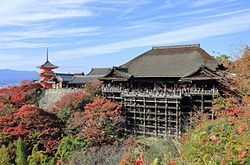 Kiyomizu-dera
about 1.0 km · about 14 min on foot
 Higashiyama
about 0.8 km · about 11 min on foot

GionThis guide
Walk Mode, in the free Mappu app: 2 hours for 50 credits (€4.99 Starter pack)
Planning a trip to Kyoto?
Mappu sketches your days free in the chat, no account needed. Then take the full plan with you:
Tickets, tours and practical extras for this trip, from Mappu's partners.
Partner links (Airalo, Amazon, Booking.com, GetYourGuide, Klook, Tiqets, Trip.com, Viator, Welcome Pickups): if you book or buy through them, Mappu may earn a commission, at no extra cost to you.
Plan your trip on a map and get an audio guide for almost any place nearby: just tap it on the Mappu map.
About 7 minutes of listening in 5 sections: “Welcome to Gion”, “The World of Geiko and Maiko”, “Architecture of the Eel Beds”, “The Guardian of the District”, and “The Magic of Twilight”.
You can ask follow-up questions such as “What is the historical connection between Yasaka Shrine and the development of Gion?” and keep asking in Mappu, with the guide connected to your map and trip plan.