Chion-in Audio Guide

Audio guide for Chion-in

Chion-in
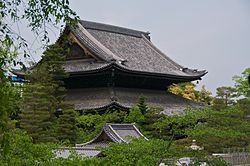
Photo by BriYYZ from Toronto, CanadaWikimedia CommonsCC BY-SA 2.0

6 min of listening · Section 1 of 5: Welcome to Chion-in

Prefer reading? The full guide is below

Here in person? Walk on with Mappu

This audio guide tells one place’s story. Walk Mode keeps going as you walk:

  • It knows where you are and talks about what’s in front of you, not only these chapters.
  • It takes you on to the next sight and follows what interests you.
  • Ask about anything you see, and it answers on the spot.
  • Your phone stays in your pocket.

A 2-hour live walk with Mappu, €4.99.

50 credits from the Starter pack. One-time purchase, no subscription.

Self-guided audio walk. No guide accompanies you. Not affiliated with the sites.

Keep exploring

Discover more places in Mappu.

Chion-in • Section 1 of 5

Chion-in: is there a free audio guide?

Quick answer. Yes. Mappu’s Chion-in audio guide (Kyoto, Japan) is free in your browser: 5 sections and about 6 minutes of listening, in 8 languages. It covers “From a Thatched Hut to a Head Temple at Chion-in”, “The Tokugawa Shoguns and the Great Halls of Chion-in” and “The Oldest Hall and the Gardens of Chion-in”. In the Mappu app, Walk Mode narrates the places around you as you move and answers your follow-up questions.

Chion-in map

Mappu's own map of the place, with the paths and entrances OpenStreetMap shows around it.

Chion-in mapThe place on the map, with the guide's point marked.

Chion-in: what does the audio guide cover?

  1. 01

    Welcome to Chion-in

    Welcome to Chion-in, written 知恩院 in Japanese, tucked against the wooded foothills of Higashiyama in eastern Kyoto. This is the head temple of the Jodo sect of Buddhism, the school founded by the monk Honen. Its mountain name is Kachozan, and its full formal name is Kachozan Chion Kyoin Otaniji, a mouthful that locals and visitors alike shorten happily to Chion-in. The first thing to grasp is how the grounds are laid out, because the temple climbs the hillside in three levels. At the bottom stands the magnificent Sanmon, the great main gate. In the middle sit the major halls, including the Mieido, which houses the image of Honen, and the Shuedo, the assembly hall. At the top, the mausoleum where Honen is enshrined. Many of these buildings are designated National Treasures or Important Cultural Properties. As we move through this guide, we will follow the story from a humble hut to a vast Tokugawa-era complex, and we will look at the hall at its heart, the oldest building on the hill, and the gardens. If you are planning your way here, a city bus numbered 206 from Kyoto Station stops at Chion-in-mae, and from there it is about five minutes on foot.

  2. 02

    From a Thatched Hut to a Head Temple at Chion-in

    Every great temple has an origin story, and this one begins modestly. Honen, born in 1133 in the province of Mimasaka, in present-day Okayama, climbed Mount Hiei at thirteen and was ordained at fifteen. He later founded the Jodo sect, whose central practice is chanting the nembutsu, the phrase Namu Amida Butsu. Around Higashiyama Yoshimizu, near where the Seishido stands today, he lived in a small thatched hermitage. That humble dwelling is the seed from which Chion-in grew. His teaching was not welcomed by everyone. In 1207, during the Jogen persecution, Honen was exiled to Sanuki province, in present-day Kagawa. Four years later, in 1211, he was pardoned and returned to the capital. His old hermitage had fallen into ruin, so he moved into the nearby Otani Zenbo, which is today's Seishido. He died there on the twenty-fifth day of the first month in 1212, aged 80. After his death, a mausoleum was built beside the Otani Zenbo, but monks from Enryakuji destroyed it in 1227. The story did not end there. In 1234, Honen's disciple Genchi revived the site, and Emperor Shijo bestowed the temple name Kachozan Chion Kyoin Otaniji. From that moment, a hermitage on a hillside began its long journey toward becoming the head temple of a whole school of Buddhism.

  3. 03

    The Tokugawa Shoguns and the Great Halls of Chion-in

    Now we leap forward to the age of the samurai. Roughly 369 years after the temple received its name in 1234, Tokugawa Ieyasu designated Chion-in as his family temple. With generous patronage from the Tokugawa shoguns, Ieyasu, Hidetada and Iemitsu among them, the temple grew and flourished, and the grand halls and gates you see today were raised in that era. The centerpiece is the Mieido, a National Treasure that enshrines the image of Honen. It is the largest hall on the grounds, which is why it is also called the Odono, the great hall. It was rebuilt under Tokugawa Iemitsu, and the work took six years. It measures roughly 45 meters across and 35 meters deep, and a veranda about 3 meters wide wraps around it. For followers of the nembutsu, it is a fundamental training hall, and its sheer size shows how deeply both the Tokugawa and the temple revered Honen. Patronage is never permanent, though. When the Meiji era arrived, protection from the Tokugawa family ended and the temple fell into financial crisis. The efforts of the monk Fukuda Gyokai and his colleagues carried it through, and in 2024 the temple marked the 800 and fiftieth anniversary of the founding of the Jodo sect.

  4. 04

    The Oldest Hall and the Gardens of Chion-in

    Among all the grandeur, look for something quieter. On the raised ground on the eastern side of the grounds, where Honen's dwelling once stood, is the Seishido. Built in 1530, it is the oldest building at Chion-in and an Important Cultural Property. It was originally built as a main hall. Today it enshrines a statue of Seishi Bosatsu, also an Important Cultural Property, regarded as Honen's honji-shin, his original embodiment. Standing there, you are close to the very spot where the temple began. The temple also has two gardens. One is the Yuzen-en, created to honor Miyazaki Yuzensai, the fan painter credited with devising the yuzen dyeing technique, one of Japan's traditional crafts. It is the garden to visit for autumn color. The other is the Hojo garden. In one of the temple's gardens, the view opens into a panorama over Kyoto and the surrounding area. The temple is also known for its tradition of seven wonders, long-told tales that make a lively way to explore the grounds.

  5. 05

    Before You Head Off from Chion-in

    As you linger here, hold on to the shape of the story. A thatched hermitage on a Higashiyama hillside. A teacher exiled and then pardoned. A tomb destroyed and then revived. And finally a sweeping complex rising level by level up the slope, under the care of the Tokugawa shoguns. Before you leave, try noticing the layers of the hill for yourself. Look up from the great gate at the bottom toward the halls in the middle, and imagine the mausoleum waiting above. Then think of the small seishido on the east side, the oldest building here, and how far this place has traveled from its first humble hut. And if you ever wonder what draws people here, listen for the nembutsu, the simple phrase Namu Amida Butsu, which Honen taught and which still lies at the heart of this temple. There is more to find on these grounds, including the seven wonders, so take your time and let your curiosity set the pace.

About this guide

AI-generated from 6 sources; checked automatically and last updated on October 31, 2026. Verify tickets and opening hours on the official site. Independent guide by Mappu. Not affiliated with or endorsed by the site or its managers.

Run a travel site or blog? Embed this audio guide for free.

Walk on from here

The nearest places with a Mappu audio guide, in walking order: about 1.7 km and 20 minutes on foot in all.

Route map: walking on from Chion-in5 numbered stops in walking order. Stop 1: Chion-in; Stop 2: Gion; Stop 3: Yasaka Shrine; Stop 4: Kōdai-ji; Stop 5: Hōkan Temple.Stop 1: Chion-in1Stop 2: Gion2Stop 3: Yasaka Shrine3Stop 4: Kōdai-ji4Stop 5: Hōkan Temple5
Distances are estimates: the straight line between places plus 30%.

Indicative route. While you walk, watch where you're going, mind the traffic and follow local signs and rules. The map is an aid, not a safety guide. Terms

  1. Chion-inThis guide

    about 0.6 km · about 8 min on foot

  2. Gion

    about 0.2 km · about 2 min on foot

  3. Yasaka Shrine

    about 0.5 km · about 7 min on foot

  4. Kōdai-ji

    about 0.4 km · about 5 min on foot

  5. Hōkan Temple
Photo attribution

Walk Mode, in the free Mappu app: 2 hours for 50 credits (€4.99 Starter pack)

Planning a trip to Kyoto?

Get your plan

Mappu sketches your days free in the chat, no account needed. Then take the full plan with you:

  • Weekend trip, €9.99: Your day-by-day plan plus 2 live walks
  • Save your trip’s free guides on your phone in the Mappu app: they play with no signal
See the trip packs

Already going? The 2-hour live walk in Kyoto is €4.99

Plan your trip on a map and get an audio guide for almost any place nearby: just tap it on the Mappu map.

Common questions

Chion-in: how long is the free audio guide?

About 6 minutes of listening in 5 sections: “Welcome to Chion-in”, “From a Thatched Hut to a Head Temple at Chion-in”, “The Tokugawa Shoguns and the Great Halls of Chion-in”, “The Oldest Hall and the Gardens of Chion-in”, and “Before You Head Off from Chion-in”.

Chion-in: what can I ask Mappu after the guide?

You can ask follow-up questions such as “How is the layout of Chion-in divided between the gate, the main halls and the mausoleum, and what can I see at each level?” and keep asking in Mappu, with the guide connected to your map and trip plan.