Tōdai-ji Audio Guide

Audio guide for Tōdai-ji

Tōdai-ji
Photo by 663highlandWikimedia CommonsCC BY 2.5

6 min of listening · Section 1 of 5: Welcome to Tōdai-ji

Prefer reading? The full guide is below

Here in person? Walk on with Mappu

This audio guide tells one place’s story. Walk Mode keeps going as you walk:

  • It knows where you are and talks about what’s in front of you, not only these chapters.
  • It takes you on to the next sight and follows what interests you.
  • Ask about anything you see, and it answers on the spot.
  • Your phone stays in your pocket.

A 2-hour live walk with Mappu, €4.99.

50 credits from the Starter pack. One-time purchase, no subscription.

Self-guided audio walk. No guide accompanies you. Not affiliated with the sites.

Keep exploring

Discover more places in Mappu.

Tōdai-ji • Section 1 of 5

Tōdai-ji: is there a free audio guide?

Quick answer. Yes. Mappu’s Tōdai-ji audio guide (Nara, Japan) is free in your browser: 5 sections and about 6 minutes of listening, in 8 languages. It covers “Tōdai-ji and the Dream of Emperor Shōmu”, “The Great Buddha and the Hall That Rose Again” and “Treasures, Gates and Rituals Across the Grounds”. In the Mappu app, Walk Mode narrates the places around you as you move and answers your follow-up questions.

Tōdai-ji map

Mappu's own map of the place, with the paths and entrances OpenStreetMap shows around it.

Tōdai-ji mapThe place on the map, with the guide's point marked.

Tōdai-ji: what does the audio guide cover?

  1. 01

    Welcome to Tōdai-ji

    Tōdai-ji: Construction at Tōdai-ji began in 745, and it took close to 40 years before the whole complex was more or less finished.

    Welcome to Tōdai-ji, written 東大寺 in Japanese and meaning the Eastern Great Temple. You are in the city of Nara, in the Zōshi-chō district, at one of the most celebrated Buddhist temples in Japan. It is the head temple of the Kegon school of Buddhism, and its heart is the colossal seated Buddha known as the Great Buddha of Nara. The temple was founded in the eighth century, in the Nara period, by Emperor Shōmu. He poured the strength of the nation into it. Its full formal name is a mouthful: Konkōmyō Shitennō Gokoku no Tera, the Temple of the Four Heavenly Kings Protecting the Nation. Tōdai-ji also stands at the center of a whole network of temples, because Shōmu had provincial temples built in the more than 60 provinces of Japan at the time, and this one was made their head. In the stories ahead we will look at how the temple was planned, how it survived fire and war, and what you can see on its grounds today. Along the way, keep an eye out for the contrast between the ancient and the rebuilt, because that tension is the secret of this place.

  2. 02

    Tōdai-ji and the Dream of Emperor Shōmu

    Tōdai-ji: After the Nara period, two wartime fires destroyed many of the temple's buildings.

    Picture Nara in the 740s. Construction at Tōdai-ji began in 745, and it took close to 40 years before the whole complex was more or less finished. That is a project that outlived the emperor who began it. The monk Rōben is remembered as the temple's founding priest, the first of its chief abbots. The layout was ambitious. Historians describe a straight line running north to south: the South Great Gate, then the Middle Gate, then the Golden Hall that housed the Great Buddha, then the Lecture Hall. North of the Lecture Hall, monks' quarters stood in a U shape, and to their east lay the refectory. Between the South Great Gate and the Middle Gate, two seven-story pagodas rose inside cloisters on the east and west sides. They are estimated to have stood more than 70 meters tall, taller than almost anything you will see in Nara today. The whole conception was an attempt to match the temples of Tang dynasty China, which Japan greatly admired. Yet Tōdai-ji was not tied to a single doctrine. In the Nara period, the so-called six schools of Buddhism were more like schools of study than separate denominations, and Tōdai-ji was a temple where all six were studied. Inside the Great Buddha Hall there was even a cabinet holding the scriptures of each school.

  3. 03

    The Great Buddha and the Hall That Rose Again

    Tōdai-ji: Many of the items show influence from foreign cultures that reached Japan along the Silk Road, which makes them precious evidence of exchange between East and West.

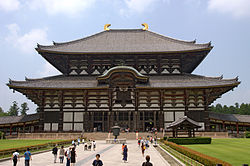
    At the heart of Tōdai-ji sits Rushana-butsu, the seated Buddha that Japanese people affectionately call the Great Buddha of Nara. The statue is a National Treasure. But here is the twist: it is not entirely what the eighth century made. Over the centuries the Buddha has been repaired many times, and only parts, such as sections of the lotus pedestal, still preserve the original work. The building that shelters it has a story of loss too. After the Nara period, two wartime fires destroyed many of the temple's buildings. The hall you see today was rebuilt in 1709, in the middle of the Edo period, and at a smaller scale than the original. Even so, it is counted among the largest wooden buildings in the world, so you can imagine how enormous the first one must have been. The temple has kept that rebuilding spirit alive. It carried out major repairs on the Great Buddha Hall at the start of the twentieth century and again in the 1970s, striving to preserve the vast compound and its structures. What you are standing in front of is a living act of care, generation after generation, not a frozen relic.

  4. 04

    Treasures, Gates and Rituals Across the Grounds

    Tōdai-ji: Look up at the Great Buddha Hall and ask yourself how much bigger it once was, and imagine two towering pagodas standing in front of it.

    Tōdai-ji is not only one hall. Nine of its buildings are designated National Treasures: the South Great Gate, the Hokke-dō, the bell tower, the Great Buddha Hall, the Founder's Hall, the Tegai Gate, the Honbō sutra repository, the Shōsōin storehouse, and the Nigatsu-dō. They span the ages. The Tegai Gate, the Honbō sutra repository and the Shōsōin storehouse come from the Nara period itself, while the South Great Gate, the bell tower and the Founder's Hall are from the Kamakura period, and the Great Buddha Hall and Nigatsu-dō are from the Edo period. The Shōsōin is the one to linger over. It holds treasures that Emperor Shōmu cherished, and it is built in the azekura style, a log-cabin construction with ingenious features that help protect objects more than 1,300 years old from moisture. Many of the items show influence from foreign cultures that reached Japan along the Silk Road, which makes them precious evidence of exchange between East and West. And Tōdai-ji is also a house of living tradition. Rituals such as the Shuni-e are still held at the Nigatsu-dō. To the east of the grounds you will find Tamukeyama Hachiman Shrine, founded as the temple's guardian shrine. In 1998, Tōdai-ji was inscribed on the UNESCO World Heritage list as part of the Historic Monuments of Ancient Nara.

  5. 05

    Before You Head Off

    As you walk the grounds of Tōdai-ji, try reading them like a timeline. A gate from the Nara period, a hall from the Kamakura period, a great hall from the Edo period: each tells you a different chapter of survival and renewal. The same building can be both a masterpiece and an act of rebuilding. Look up at the Great Buddha Hall and ask yourself how much bigger it once was, and imagine two towering pagodas standing in front of it. Then notice the quieter things, such as the storehouse built to keep out moisture and the shrine standing guard to the east. There is plenty more to discover here, from the Silk Road treasures to the ritual traditions that still carry on. Let your curiosity pick the next doorway.

About this guide

AI-generated from 6 sources; checked automatically and last updated on October 31, 2026. Verify tickets and opening hours on the official site. Independent guide by Mappu. Not affiliated with or endorsed by the site or its managers.

Run a travel site or blog? Embed this audio guide for free.

Walk on from here

This place is stop 4 of 6 of a self-guided walk: Gangō-ji to Kasuga-taisha, Nara. About 4.9 km and 65 minutes on foot, plus about 37 minutes of listening.

Route map: walking on from Tōdai-ji6 numbered stops in walking order. Stop 1: Gangō-ji; Stop 2: Kōfuku-ji; Stop 3: Nara National Museum; Stop 4: Tōdai-ji; Stop 5: Nara Park; Stop 6: Kasuga-taisha.Stop 1: Gangō-ji1Stop 2: Kōfuku-ji2Stop 3: Nara National Museum3Stop 4: Tōdai-ji4Stop 5: Nara Park5Stop 6: Kasuga-taisha6
Distances are estimates along the walking route, from OpenStreetMap.

Indicative route. While you walk, watch where you're going, mind the traffic and follow local signs and rules. The map is an aid, not a safety guide. Terms

  1. Gangō-ji

    about 0.9 km · about 11 min on foot

  2. Kōfuku-ji

    about 0.8 km · about 11 min on foot

  3. Nara National Museum

    about 1.3 km · about 17 min on foot

  4. Tōdai-jiThis guide

    about 0.9 km · about 12 min on foot

  5. Nara Park

    about 1.1 km · about 14 min on foot

  6. Kasuga-taisha
Photo attribution

Walk Mode, in the free Mappu app: 2 hours for 50 credits (€4.99 Starter pack)

See the whole walk

Planning a trip to Nara?

Get your plan

Mappu sketches your days free in the chat, no account needed. Then take the full plan with you:

  • Weekend trip, €9.99: Your day-by-day plan plus 2 live walks
  • Save your trip’s free guides on your phone in the Mappu app: they play with no signal
See the trip packs

Already going? The 2-hour live walk in Nara is €4.99

Plan your trip

Photo attribution

Plan your trip on a map and get an audio guide for almost any place nearby: just tap it on the Mappu map.

Common questions

Tōdai-ji: how long is the free audio guide?

About 6 minutes of listening in 5 sections: “Welcome to Tōdai-ji”, “Tōdai-ji and the Dream of Emperor Shōmu”, “The Great Buddha and the Hall That Rose Again”, “Treasures, Gates and Rituals Across the Grounds”, and “Before You Head Off”.

Tōdai-ji: what can I ask Mappu after the guide?

You can ask follow-up questions such as “What did it mean for Tōdai-ji to be the head of the provincial temples that Emperor Shōmu had built across Japan?” and keep asking in Mappu, with the guide connected to your map and trip plan.