Gangō-ji Audio Guide

One of Japan's first Buddhist temples, in Nara's old town

Gangō-ji
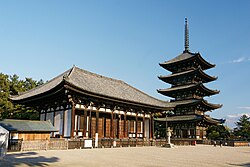
Photo by Saigen JiroWikimedia CommonsCC0

6 min of listening · Section 1 of 5: Welcome to Gangō-ji

Prefer reading? The full guide is below

Here in person? Walk on with Mappu

This audio guide tells one place’s story. Walk Mode keeps going as you walk:

  • It knows where you are and talks about what’s in front of you, not only these chapters.
  • It takes you on to the next sight and follows what interests you.
  • Ask about anything you see, and it answers on the spot.
  • Your phone stays in your pocket.

A 2-hour live walk with Mappu, €4.99.

50 credits from the Starter pack. One-time purchase, no subscription.

Self-guided audio walk. No guide accompanies you. Not affiliated with the sites.

Keep exploring

Discover more places in Mappu.

Gangō-ji • Section 1 of 5

Gangō-ji: is there a free audio guide?

Quick answer. Yes. Mappu’s Gangō-ji audio guide (Nara, Japan) is free in your browser: 5 sections and about 6 minutes of listening, in 8 languages. It covers “From Asuka to the New Capital”, “Decline, Fire and a Town Within the Temple” and “The Gokuraku-dō and the Pure Land Mandala”. In the Mappu app, Walk Mode narrates the places around you as you move and answers your follow-up questions.

Gangō-ji map

Mappu's own map of the place, with the paths and entrances OpenStreetMap shows around it.

Gangō-ji mapThe place on the map, with the guide's point marked.

Gangō-ji: what does the audio guide cover?

  1. 01

    Welcome to Gangō-ji

    Welcome to Gangō-ji, written 元興寺 in Japanese, in the old town of Naramachi in Nara. This is one of the first Buddhist temples in Japan, and it was ranked among the powerful Seven Great Temples of Nara. Here is the twist that makes it so interesting. The great temple of the past was once vast, but most of it is gone. Today the old town of Naramachi occupies most of what used to be its grounds. So as you walk, you are moving through a neighborhood that grew on top of a temple's story. What survives is a precious remnant. It includes the old monks' quarters and part of a lecture hall, along with a hall that holds a mandala of paradise. Alongside it are the marked spots where other parts of the complex once stood. Over the next few minutes I will take you from the temple's beginnings in the Asuka region, through its great fire, to the hall where worshippers still come today.

  2. 02

    From Asuka to the New Capital

    Gangō-ji's story begins before Nara was even a capital. In the sixth century, Soga no Umako founded a temple called Asukadera, also known as Hōkō-ji, in the Asuka region. It is described as the oldest full-scale Buddhist temple in Japan. Buddhism itself arrived with a debate. Tradition tells of Emperor Kinmei looking at a Buddha image sent from a land to the west and asking his ministers whether it should be worshipped. He found its face more beautiful than anything he had seen. Soga no Iname urged him to worship it, while others at court opposed the idea. The Soga family became champions of the new faith, and Umako's temple grew out of that tradition. Then the capital moved. When Heijō-kyō, the capital at Nara, was built, the temple was relocated and rebuilt within the new city. That is how Gangō-ji came to stand in Nara, and it joined the group known as the Seven Great Temples of the southern capital. So when you stand here, you are standing in a temple that carries the memory of Japan's earliest Buddhist foundation.

  3. 03

    Decline, Fire and a Town Within the Temple

    How does a vast temple disappear? Slowly, and then suddenly. The decline began in the late 700s, when the imperial capital moved from Nara to Kyoto. The court gradually stopped funding the temples of Nara, Gangō-ji included, and its grounds and buildings were lost over many centuries. The next major blow came in the autumn of 1451. Angry peasant farmers stormed into Nara to demand debt relief, and they set fire to houses during the rioting. The flames spread to the temple, and a devastating fire leveled nearly the entire complex. By the early seventeenth century the neighborhood of Naramachi was fully taking shape across the old grounds. But the temple left its fingerprints on the map. Imamikado-chō, Shimomikado-chō and Wakido-chō carry the names of temple gates that once stood here. Tsuijinouchi-chō means the town inside the wall, and it lies near the old outer wall of the complex. The history might have been forgotten if not for Murai Kodō, who lived from 1681 to 1749. He was a barber-surgeon and local historian who took an interest in the area around Gangō-ji.

  4. 04

    The Gokuraku-dō and the Pure Land Mandala

    The living heart of Gangō-ji today is the Gokuraku-in, also called Gokurakubō. It is the Shingon-Ritsu successor to the ancient temple. The old monks' quarters and part of the lecture hall survive here. In the Middle Ages this precinct was known as Gangō-ji Gokurakubō, and in early modern times as Nanto Gokurakuin. At its center stands the Gokuraku-dō, also called the Mandala-dō. Its principal object of devotion is the Chiko Mandala. This is a picture of the Pure Land with Amida Nyorai in the middle, drawn by Chiko, a scholar-monk of the Nara period. From the late Heian period it drew worshippers, at a time when people believed the end of the world was approaching and faith in Amida's Pure Land was rising. This hall and the neighboring Zen room are designated National Treasures. They are also part of the World Heritage Site Historic Monuments of Ancient Nara. The Gokuraku-in was renamed Gangō-ji Gokurakubō in 1955, and simply Gangō-ji in 1977. Its precinct became a National Historic Site in 1965, one of three parts of the ancient complex to be protected.

  5. 05

    Before You Head Off

    Before you move on, remember that the temple you are visiting is only one piece of a much larger puzzle. Two other parts of the ancient complex are also protected as national historic sites. One is the ruins of the East Pagoda, the base of the five-story pagoda of the Tōdaitō-in precinct, in the Shiba Araya-chō area of Naramachi. The other is the site of the Kotōin, part of the Western Small Pagoda precinct. So let your walk through Naramachi become a kind of treasure hunt. Notice the street names that echo temple gates and walls. Think of the lost pagoda foundation as the memory of a skyline that no longer exists. Then look again at the quiet hall that survived the centuries. What else in these lanes might be an echo of the great temple that once filled them?

About this guide

AI-generated from 6 sources; reviewed for accuracy and last updated on October 31, 2026. Verify tickets and opening hours on the official site. Independent guide by Mappu. Not affiliated with or endorsed by the site or its managers.

Run a travel site or blog? Embed this audio guide for free.

Walk on from here

This place is stop 1 of 6 of a self-guided walk: Gangō-ji to Kasuga-taisha, Nara. About 4.9 km and 65 minutes on foot, plus about 37 minutes of listening.

Route map: walking on from Gangō-ji6 numbered stops in walking order. Stop 1: Gangō-ji; Stop 2: Kōfuku-ji; Stop 3: Nara National Museum; Stop 4: Tōdai-ji; Stop 5: Nara Park; Stop 6: Kasuga-taisha.Stop 1: Gangō-ji1Stop 2: Kōfuku-ji2Stop 3: Nara National Museum3Stop 4: Tōdai-ji4Stop 5: Nara Park5Stop 6: Kasuga-taisha6
Distances are estimates along the walking route, from OpenStreetMap.

Indicative route. While you walk, watch where you're going, mind the traffic and follow local signs and rules. The map is an aid, not a safety guide. Terms

  1. Gangō-jiThis guide

    about 0.9 km · about 11 min on foot

  2. Kōfuku-ji

    about 0.8 km · about 11 min on foot

  3. Nara National Museum

    about 1.3 km · about 17 min on foot

  4. Tōdai-ji

    about 0.9 km · about 12 min on foot

  5. Nara Park

    about 1.1 km · about 14 min on foot

  6. Kasuga-taisha
Photo attribution

Walk Mode, in the free Mappu app: 2 hours for 50 credits (€4.99 Starter pack)

See the whole walk

Planning a trip to Nara?

Get your plan

Mappu sketches your days free in the chat, no account needed. Then take the full plan with you:

  • Weekend trip, €9.99: Your day-by-day plan plus 2 live walks
  • Save your trip’s free guides on your phone in the Mappu app: they play with no signal
See the trip packs

Already going? The 2-hour live walk in Nara is €4.99

Plan your trip

Photo attribution

Plan your trip on a map and get an audio guide for almost any place nearby: just tap it on the Mappu map.

Common questions

Gangō-ji: how long is the free audio guide?

About 6 minutes of listening in 5 sections: “Welcome to Gangō-ji”, “From Asuka to the New Capital”, “Decline, Fire and a Town Within the Temple”, “The Gokuraku-dō and the Pure Land Mandala”, and “Before You Head Off”.

Gangō-ji: what can I ask Mappu after the guide?

You can ask follow-up questions such as “How did the temple end up in Nara after being founded in Asuka?” and keep asking in Mappu, with the guide connected to your map and trip plan.