


Kōfuku-ji: how long is the free audio guide?
About 6 minutes of listening in 5 sections: “Welcome to Kōfuku-ji”, “A Temple on the Move”, “The Temple of the Fujiwara”, “Teachings and Scattered Treasures”, and “Before You Head Off”.
Audio guide for Kōfuku-ji

Quick answer. Yes. Mappu’s Kōfuku-ji audio guide (Nara, Japan) is free in your browser: 5 sections and about 6 minutes of listening, in 8 languages. It covers “A Temple on the Move”, “The Temple of the Fujiwara” and “Teachings and Scattered Treasures”. In the Mappu app, Walk Mode narrates the places around you as you move and answers your follow-up questions.
Mappu's own map of the place, with the paths and entrances OpenStreetMap shows around it.
Welcome to Kōfuku-ji, written 興福寺 in Japanese, one of the great Buddhist temples of Nara. You are in the heart of the old capital, in the Noboriōji district, right beside Nara Park, where the temple sits as a close neighbor of Tōdai-ji. This is a place with more than 13 centuries behind it. In its heyday Kōfuku-ji was counted among the Nanto Shichi Daiji, the Seven Great Temples of Nara, and today it serves as the national headquarters of the Hossō school, the Japanese branch of the East Asian Yogācāra tradition. The principal image of the temple is Shaka Nyorai, the historical Buddha, enshrined in the Central Golden Hall. Over the next few stops we will follow the temple on its journeys across the early Japanese landscape, meet the powerful family that stood behind it, and look at the sculptures and teachings that made its name. Take a slow breath, and let's begin.
Kōfuku-ji did not begin where you are standing. Its story starts in the year 669, when a predecessor temple was founded. That early foundation was tied to the illness of Fujiwara no Kamatari, a man who fell gravely ill and whose household turned to Buddhist devotion in the hope of recovery. Then the temple began to travel. In 672 it was moved to Fujiwara-kyō, the first planned Japanese capital, which copied the orthogonal grid pattern of the Chinese capital Chang'an. Imagine a city laid out like a chessboard, a bold new idea for its time, with the temple taking its place in that design. The capital moved again, and so did the temple. In 710 it was dismantled for the second time and rebuilt on its present site, on the east side of the newly constructed capital Heijō-kyō, which we know today as Nara. When the Nara tourism association describes Kōfuku-ji as the temple most closely woven into the life of the city, this long journey is part of the reason: it came to Nara together with the capital itself.
To understand Kōfuku-ji, you need to know the Fujiwara. The temple is the family temple of the Fujiwara clan, and its roots lead back to the clan's founder, Fujiwara no Kamatari, and to his son Fujiwara no Fuhito. It was Fuhito who, in 710, oversaw the transfer of the earlier temple to the new capital at Heijō-kyō. That close bond with one of the most influential families in the country shaped the temple's fortunes. Kōfuku-ji grew into one of the Seven Great Temples of Nara, a major force in the old capital. It also lived a dramatic life. Fire destroyed the temple's buildings again and again, and again and again the Fujiwara family and the community around it brought them back. That cycle of loss and revival is one of the defining features of the place. When you look at the grounds today, you are looking at the latest chapter in a story of rebuilding that has run for centuries.
Kōfuku-ji is not only a monument, it is a living center of a Buddhist school. It is the head temple of the Hossō school, the Japanese line of Yogācāra, a tradition of East Asian Buddhism. At the center of worship, the Central Golden Hall holds Shaka Nyorai as the temple's principal image. The temple also had a remarkable artistic life, and its treasures have traveled far from home. One of the five surviving sets of Four Heavenly Kings statues is divided among the temple itself, the Nara National Museum and the Miho Museum. A Nara-period pair of statues of Brahmā and Indra now belongs to the Asian Art Museum in San Francisco. A seated Rāgarāja, a sculpture made in 1256 by the temple, is now part of the Nara National Museum collection. There is even a painting from the fourteenth century, made between 1320 and 1340, showing the final death of the Buddha Sakyamuni. Taken together, these works tell you how widely the art of this one temple has spread, and why Nara's museums are a natural companion to a visit here.
As you wander on, keep in mind that this ground has held a temple since the early eighth century, when the capital arrived and the Fujiwara temple settled on the east side of the new city. Everything around you belongs to that long thread of moving, burning, rebuilding and worshipping. Look at how close you are to Nara Park and to Tōdai-ji, and notice how naturally the temple belongs to the town. Then ask yourself which of the temple's treasures you would most like to see in person, whether here or in a museum, since some of them now live far from where they began. There is plenty more to discover in this corner of Nara, and every step from here carries you through another layer of the old capital's story.
AI-generated from 6 sources; checked automatically and last updated on October 31, 2026. Verify tickets and opening hours on the official site. Independent guide by Mappu. Not affiliated with or endorsed by the site or its managers.
This place is stop 2 of 6 of a self-guided walk: Gangō-ji to Kasuga-taisha, Nara. About 4.9 km and 65 minutes on foot, plus about 37 minutes of listening.
Indicative route. While you walk, watch where you're going, mind the traffic and follow local signs and rules. The map is an aid, not a safety guide. Terms
 Gangō-ji
about 0.9 km · about 11 min on foot
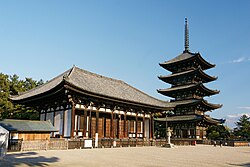
Kōfuku-jiThis guide
about 0.8 km · about 11 min on foot
 Nara National Museum
about 1.3 km · about 17 min on foot
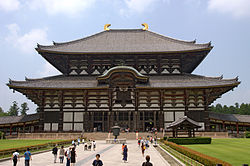 Tōdai-ji
about 0.9 km · about 12 min on foot
 Nara Park
about 1.1 km · about 14 min on foot
 Kasuga-taisha
Walk Mode, in the free Mappu app: 2 hours for 50 credits (€4.99 Starter pack)
Planning a trip to Nara?
Mappu sketches your days free in the chat, no account needed. Then take the full plan with you:
Plan your trip on a map and get an audio guide for almost any place nearby: just tap it on the Mappu map.
About 6 minutes of listening in 5 sections: “Welcome to Kōfuku-ji”, “A Temple on the Move”, “The Temple of the Fujiwara”, “Teachings and Scattered Treasures”, and “Before You Head Off”.
You can ask follow-up questions such as “How did the move to Fujiwara-kyō and then to Heijō-kyō shape the early life of Kōfuku-ji?” and keep asking in Mappu, with the guide connected to your map and trip plan.