Hōryū-ji Audio Guide

Audio guide for Hōryū-ji

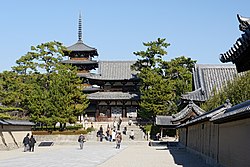
Hōryū-ji
Photo by 663highlandWikimedia CommonsCC BY 2.5

6 min of listening · Section 1 of 5: Welcome to Hōryū Temple

Prefer reading? The full guide is below

Here in person? Walk on with Mappu

This audio guide tells one place’s story. Walk Mode keeps going as you walk:

  • It knows where you are and talks about what’s in front of you, not only these chapters.
  • It takes you on to the next sight and follows what interests you.
  • Ask about anything you see, and it answers on the spot.
  • Your phone stays in your pocket.

A 2-hour live walk with Mappu, €4.99.

50 credits from the Starter pack. One-time purchase, no subscription.

Self-guided audio walk. No guide accompanies you. Not affiliated with the sites.

Keep exploring

Discover more places in Mappu.

Hōryū-ji • Section 1 of 5

Hōryū-ji: is there a free audio guide?

Quick answer. Yes. Mappu’s Hōryū-ji audio guide (Nara, Japan) is free in your browser: 5 sections and about 6 minutes of listening, in 8 languages. It covers “A Prince Moves to Ikaruga: The Story of Hōryū Temple”, “Two Precincts and the Hōryū Temple Layout” and “World Heritage and the Temples of Ikaruga Around Hōryū Temple”. In the Mappu app, Walk Mode narrates the places around you as you move and answers your follow-up questions.

Hōryū-ji map

Mappu's own map of the place, with the paths and entrances OpenStreetMap shows around it.

Hōryū-ji mapThe place on the map, with the guide's point marked.

Hōryū-ji: what does the audio guide cover?

  1. 01

    Welcome to Hōryū Temple

    Welcome to Hōryū Temple, known in Japanese as 法隆寺, in the town of Ikaruga in Nara Prefecture. This is the head temple of the Shotoku school of Buddhism, and its principal image is Shaka Nyorai, the historical Buddha. When it was first founded, it went by a different name: Ikaruga-dera, the temple of Ikaruga. Over time that became Hōryū Temple, and it has also been called Hōryū Gakumonji, the temple of learning. Before we start walking, look at the landscape for a moment. Ikaruga sits near the southern end of the Ikoma mountains, and in ancient times the Yamato River made it a crossroads, linking the old province of Yamato, today's Nara, with Kawachi, the southern part of today's Osaka. Burial mounds from the Kofun period, including the famous Fujinoki tomb, are scattered nearby. People were gathering in this corner of the Nara basin long before the temple appeared. In the next few minutes, I will take you through the story of how a prince's palace and a temple grew side by side, how the grounds are divided into two precincts, and why this place became Japan's first World Heritage site. Ready? Let's begin with the prince.

  2. 02

    A Prince Moves to Ikaruga: The Story of Hōryū Temple

    The story begins with Prince Shotoku, also called Prince Umayado. According to the Nihon Shoki, Japan's early chronicle, he decided in the year 601 to leave Asuka and settle here in Ikaruga. He began building a palace, the Ikaruga Palace, and in the year 605 he moved in. Right beside that palace rose the temple, Ikaruga-dera, which is what we now call Hōryū Temple. The town's own history places the founding of the temple in the year 607. The palace did not vanish without a trace. The Eastern Precinct of the temple stands on the site of the old Ikaruga Palace. In 1939, while workers were repairing buildings in that precinct, they found traces of posts set directly into the ground beneath it. Scholars presume these belonged to part of the palace itself, so the earth under your feet here has held a royal residence. There is also a darker chapter. In the year 643, Soga no Iruka attacked the prince's son, Yamashiro no Oe no O, at the Ikaruga Palace. Twenty-five members of the family took their own lives, and the Joguu royal house, the prince's bloodline, came to an end. The peaceful fields around Ikaruga once witnessed a very sharp turn in the politics of ancient Japan.

  3. 03

    Two Precincts and the Hōryū Temple Layout

    Now let's talk about how the grounds are arranged, because Hōryū Temple is really two temple areas in one. In the Western Precinct you find the Main Hall and the Five-Story Pagoda. In the Eastern Precinct stand the Yumedono Hall and the Shoryoin Hall. This arrangement is a signature feature of the temple, and it is known as the Hōryū Temple style of layout. The buildings carry the architecture and Buddhist culture of the Asuka period, which runs from the year 592 to 710, and the complex also preserves art from the Nara period, from 710 to 794. Here is a detail that adds a layer of time. Southeast of today's Western Precinct lie the ruins of Wakakusa Garan, which marks the first temple, the one that burned down. Excavations and the dating of roof tiles unearthed there have led scholars to agree that this earlier temple dates to the reign of Empress Suiko. So the buildings you see in the Western Precinct stand beside the footprint of their predecessor. One more tradition is tied to the place itself. A shrine on the temple grounds is linked to Tatsuta Taisha, and its deity is said to have told the founders that the village of Ikaruga was the right spot to build the temple.

  4. 04

    World Heritage and the Temples of Ikaruga Around Hōryū Temple

    In 1993, Hōryū Temple was registered together with Himeji Castle as one of the first two World Cultural Heritage sites in Japan, under the name Buddhist Monuments in the Horyu-ji Area. The temple preserves countless National Treasures and Important Cultural Properties, including historic buildings and Buddhist statues, and it is also part of the World Heritage listing Historic Monuments of Ancient Nara. But Hōryū Temple is not alone. Ikaruga's town government points visitors to a cluster of temples with ties to Prince Shotoku. Chuguji was built on the east side of the Eastern Precinct. Hokiji and Horinji were raised by the prince's eldest son, Yamashiro no Oe no O. Horinji has a founding story with two versions: one says the prince's sons built it to pray for his recovery from illness around the year 622, and the other says it was built after the fire of Ikaruga-dera in the year 670, with help from a Baekje monk. Horinji also shows how fragile these wooden monuments can be. Its original three-story pagoda was lost to lightning in 1944, and the present pagoda was rebuilt in 1975 through the efforts of the writer Koda Aya and others. Together these temples give you what the town calls a walk through 1,400 years of history.

  5. 05

    Before You Head Off from Hōryū Temple

    As you leave, take in the setting around you. The town of Ikaruga has designated a historic landscape zone with the temples and shrines of Hōryū Temple at its center. To the east and south, rice paddies and traditional farming hamlets open up, and the Tatsuta River flows on the west side of town while the Tomio River runs along the east. It is a quiet countryside, quite different from the busy crossroads it once was. As you walk, try to hold two ideas together. One is a palace and a temple standing side by side, with the Eastern Precinct resting on the old palace grounds. The other is the earlier temple, Wakakusa Garan, whose ruins lie close to the Western Precinct. See if you can sense how those lost buildings shaped the layout in front of you. And if you have energy to spare, let the road lead you to the neighboring temples of Ikaruga. Each one tells another chapter of the Prince Shotoku story, and each rewards a slow look.

About this guide

AI-generated from 6 sources; checked automatically and last updated on October 31, 2026. Verify tickets and opening hours on the official site. Independent guide by Mappu. Not affiliated with or endorsed by the site or its managers.

Run a travel site or blog? Embed this audio guide for free.

Walk on from here

The nearest places with a Mappu audio guide, in walking order: about 1.9 km and 25 minutes on foot in all.

Route map: walking on from Hōryū-ji3 numbered stops in walking order. Stop 1: Hōryū-ji; Stop 2: Chūgū Temple; Stop 3: Fujinoki Tomb.Stop 1: Hōryū-ji1Stop 2: Chūgū Temple2Stop 3: Fujinoki Tomb3
Distances are estimates: the straight line between places plus 30%.

Indicative route. While you walk, watch where you're going, mind the traffic and follow local signs and rules. The map is an aid, not a safety guide. Terms

  1. Hōryū-jiThis guide

    about 0.6 km · about 9 min on foot

  2. Chūgū Temple

    about 1.3 km · about 17 min on foot

  3. Fujinoki Tomb
Photo attribution

Walk Mode, in the free Mappu app: 2 hours for 50 credits (€4.99 Starter pack)

Planning a trip to Nara?

Get your plan

Mappu sketches your days free in the chat, no account needed. Then take the full plan with you:

  • Weekend trip, €9.99: Your day-by-day plan plus 2 live walks
  • Save your trip’s free guides on your phone in the Mappu app: they play with no signal
See the trip packs

Already going? The 2-hour live walk in Nara is €4.99

Plan your trip

Photo attribution

Plan your trip on a map and get an audio guide for almost any place nearby: just tap it on the Mappu map.

Common questions

Hōryū-ji: how long is the free audio guide?

About 6 minutes of listening in 5 sections: “Welcome to Hōryū Temple”, “A Prince Moves to Ikaruga: The Story of Hōryū Temple”, “Two Precincts and the Hōryū Temple Layout”, “World Heritage and the Temples of Ikaruga Around Hōryū Temple”, and “Before You Head Off from Hōryū Temple”.

Hōryū-ji: what can I ask Mappu after the guide?

You can ask follow-up questions such as “What do we know about the Ikaruga Palace that once stood where the Eastern Precinct is today?” and keep asking in Mappu, with the guide connected to your map and trip plan.