Kiyomizu-dera Audio Guide

The Pure Water Temple of Kyoto

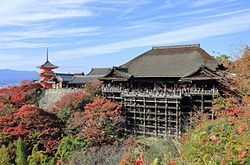
Kiyomizu-dera
Photo by Martin FalbisonerWikimedia CommonsCC BY-SA 4.0

7 min of listening · Section 1 of 5: Welcome to the Temple of Pure Water

Prefer reading? The full guide is below

Walk on from here

Kiyomizu-dera to Gion, Kyoto, live with Mappu: the stories of what’s in front of you, stop by stop. 50 credits (€4.99).

Kiyomizu-dera • Section 1 of 5

Kiyomizu-dera: is there a free audio guide?

Quick answer. Yes. Mappu’s Kiyomizu-dera audio guide (Kyoto, Japan) is free in your browser: 5 sections and about 7 minutes of listening, in 8 languages. It covers “A Vision in Seven Hundred and Seventy-Eight”, “The Miracle of the Nailless Stage” and “Waterfalls and Love Stones”. In the Mappu app, Walk Mode narrates the places around you as you move and answers your follow-up questions.

Before you visit

Last verified October 11, 2026. Sources: kiyomizudera.or.jp

Kiyomizu-dera map

Mappu's own map of the place, with the paths and entrances OpenStreetMap shows around it.

Kiyomizu-dera mapThe place on the map, with the guide's point marked.

Kiyomizu-dera: what does the audio guide cover?

  1. 01

    Welcome to the Temple of Pure Water

    Welcome to Kiyomizu-dera, one of the most iconic and beloved landmarks in Japan. As you stand here on the wooded slopes of Mount Otowa in eastern Kyoto, you are visiting a site that has been a center of spiritual devotion for over 1,200 years. The name Kiyomizu-dera literally translates to Pure Water Temple, a name inspired by the crystal-clear waters of the Otowa Waterfall that flows deep within the complex. This temple is a crowning jewel of the Historic Monuments of Ancient Kyoto and is recognized as a United Nations Educational, Scientific and Cultural Organization World Heritage site. As you begin your journey today, take a moment to listen to the sounds of nature surrounding you and the distant chime of temple bells. You are following in the footsteps of millions of pilgrims who, since ancient times, have climbed these same hills to seek mercy, health, and a glimpse of the divine. Allow the history of this sacred ground to unfold as we explore the architectural marvels and spiritual legends that define this incredible sanctuary.

  2. 02

    A Vision in Seven Hundred and Seventy-Eight

    The story of Kiyomizu-dera begins long before Kyoto even became the capital of Japan. It was founded in the year 778 AD by a monk from Nara named Enchin Shonin. Legend says Enchin received a divine vision that led him to find a spring of pure water hidden deep in these hills. There, he met an old sage who gave him a piece of sacred wood and instructed him to carve a statue of Kannon, the Bodhisatva of Mercy. A few years later, the site caught the attention of Sakanoue no Tamuramaro, a powerful military general and the first ever Shogun. Moved by the sanctity of the spring and the monk’s devotion, the Shogun donated his own residence to be moved here and converted into the temple's first great hall. This blending of humble monks and powerful warriors laid the foundation for an institution that has survived more than 10 devastating fires. The buildings you see today actually date back to 1633, when they were rebuilt by the Tokugawa Shogunate, yet they perfectly preserve the ancient spirit of that original vision found by the waterfall over a millennium ago.

  3. 03

    The Miracle of the Nailless Stage

    Look up at the magnificent Main Hall, known as the Hondo, and you will see perhaps the most famous wooden structure in all of Japan. This massive hall and its famous butai, or overhanging stage, jut out 13 meters over the steep hillside. What makes this feat of engineering truly miraculous is that the entire structure was built without the use of a single metal nail. Instead, it relies on a traditional Japanese technique called Kake-zukuri, or hanging construction, which uses intricate interlocking wooden joints to create a flexible, earthquake-resistant frame. The stage is supported by 168 massive pillars carved from ancient zelkova trees. In the past, there was a daring legend that if a person jumped off this thirteen-meter-high stage and survived, their wish would be granted. Records show that during the Edo period, over 200 people actually took the leap—and remarkably, nearly 85 percent of them survived! For your own visit, however, it is much wiser to simply enjoy the breathtaking panoramic view of Kyoto's skyline and the thousands of cherry and maple trees that blanket the valley below.

  4. 04

    Waterfalls and Love Stones

    As you descend from the main hall, you will find the Otowa Waterfall, where three separate streams of water fall into a stone pond. Visitors use long-handled cups to catch the water, as each stream is said to grant a specific blessing: longevity, success in studies, or a fortunate love life. Here is a practical pointer for your visit: it is considered greedy—and perhaps bad luck—to drink from all three streams at once, so choose the one wish that truly matters to you. Just behind the main hall, you will also discover the Jishu Shrine, a place dedicated to Okuninushi, the deity of love and matchmaking. The shrine is famous for its pair of love stones placed 18 meters apart. Local legend says that if you can walk from one stone to the other with your eyes closed, you will find true love. If you need a friend to shout out directions to help you find the way, it means you will need an intermediary or a matchmaker to find your partner in real life. Whether you are seeking health, wisdom, or romance, these ancient spots remind us that the temple has always been a place where people of all backgrounds come to hope for a better future.

  5. 05

    The Path Beyond the Gates

    As you move through the grounds, notice how the light changes against the vermilion walls of the three-story pagoda and the weathered wood of the ancient shrines. If you visit during the spring or autumn, you might witness the spectacular nighttime illuminations when the entire forest seems to glow with a celestial light. As you prepare to leave the inner sanctuary, consider the journey back down the hill. The stone-paved streets of Sannenzaka and Ninenzaka are just outside the gate, filled with traditional shops selling delicate pottery and Kyoto sweets that have been made for generations. For an even more tranquil experience, you might think about returning another day at 6 a.m., when the gates first open and the morning mist still clings to the mountainside. There is always another layer of history to peel back, another hidden corner to find, and another drop of pure water to seek at the heart of Mount Otowa. Keep your curiosity alive as you wander through the winding alleys of eastern Kyoto, and listen for the stories the wind whispers through the maple trees.

About this guide

AI-generated from 11 sources; checked automatically and last updated on June 3, 2026. Verify tickets and opening hours on the official site. Independent guide by Mappu. Not affiliated with or endorsed by the site or its managers.

Run a travel site or blog? Embed this audio guide for free.

Kiyomizu-dera: the story behind it

The video loads from YouTube when you press play. Google privacy policy

Kiyomizu-dera history: why the stage hangs over a cliff with no nails

Kiyomizu-dera's great wooden stage hangs over a cliff in Kyoto. And there isn't a single nail in it. So why build a temple on a cliff? In 778, the story goes, a monk followed a vision to a spring on this hillside. Kiyomizu means pure water. The temple grew up beside the spring. But the hill is steep, so the main hall had to stand on legs. Eighteen zelkova pillars, the tallest about twelve metres, with beams slotted right through them. Like a giant wooden scaffold. And on top, a stage for music and dance, offered to Kannon, the temple's Buddhist figure of compassion. Fire burned the temple down more than ten times. The hall you see was rebuilt in 1633, and it still stands on those legs. So don't just stand on the stage. Walk on to Okunoin hall and look back: there's the whole stage, on its legs. Then take the steps down towards the waterfall, and look up into the forest of pillars.

If you go: Walk on past the stage to Okunoin hall and look back to see the whole stage standing on its wooden pillars; then take the steps down towards the Otowa waterfall and look up into the timber grid beneath it.

Sources: Kiyomizu-dera (official site)
Walk on from here

This place is stop 1 of 3 of a self-guided walk: Kiyomizu-dera to Gion, Kyoto. About 1.9 km and 25 minutes on foot, plus about 20 minutes of listening.

Route map: walking on from Kiyomizu-dera3 numbered stops in walking order. Stop 1: Kiyomizu-dera; Stop 2: Higashiyama; Stop 3: Gion.Stop 1: Kiyomizu-dera1Stop 2: Higashiyama2Stop 3: Gion3
Distances are estimates along the walking route, from OpenStreetMap.

Indicative route. While you walk, watch where you're going, mind the traffic and follow local signs and rules. The map is an aid, not a safety guide. Terms

  1. Kiyomizu-deraThis guide

    about 1.0 km · about 14 min on foot

  2. Higashiyama

    about 0.8 km · about 11 min on foot

  3. Gion
Photo attribution

Walk Mode, in the free Mappu app: 2 hours for 50 credits (€4.99 Starter pack)

See the whole walk

Planning a trip to Kyoto?

Get your plan

Mappu sketches your days free in the chat, no account needed. Then take the full plan with you:

  • Weekend trip, €9.99: Your day-by-day plan plus 2 live walks
  • Save your trip’s free guides on your phone in the Mappu app: they play with no signal
See the trip packs

Already going? The 2-hour live walk in Kyoto is €4.99

Plan your trip on a map and get an audio guide for almost any place nearby: just tap it on the Mappu map.

Common questions

Kiyomizu-dera: how long is the free audio guide?

About 7 minutes of listening in 5 sections: “Welcome to the Temple of Pure Water”, “A Vision in Seven Hundred and Seventy-Eight”, “The Miracle of the Nailless Stage”, “Waterfalls and Love Stones”, and “The Path Beyond the Gates”.

Kiyomizu-dera: what can I ask Mappu after the guide?

You can ask follow-up questions such as “What are the historical survival rates and motivations behind the 'Kiyomizu stage jump' legend?” and keep asking in Mappu, with the guide connected to your map and trip plan.