Ueno Tōshō-gū Audio Guide

A gilded early Edo shrine to Tokugawa Ieyasu in Ueno Park

Ueno Tōshō-gū Shrine
Photo by Unkei6hokusai4Wikimedia CommonsCC BY-SA 3.0

7 min of listening · Section 1 of 5: Welcome to Ueno Tōshō-gū Shrine

Prefer reading? The full guide is below

Here in person? Walk on with Mappu

This audio guide tells one place’s story. Walk Mode keeps going as you walk:

  • It knows where you are and talks about what’s in front of you, not only these chapters.
  • It takes you on to the next sight and follows what interests you.
  • Ask about anything you see, and it answers on the spot.
  • Your phone stays in your pocket.

A 2-hour live walk with Mappu, €4.99.

50 credits from the Starter pack. One-time purchase, no subscription.

Self-guided audio walk. No guide accompanies you. Not affiliated with the sites.

Keep exploring

Discover more places in Mappu.

Ueno Tōshō-gū Shrine • Section 1 of 5

Ueno Tōshō-gū Shrine: is there a free audio guide?

Quick answer. Yes. Mappu’s Ueno Tōshō-gū audio guide (Tokyo, Japan) is free in your browser: 5 sections and about 7 minutes of listening, in 8 languages. It covers “A Deathbed Promise Behind Ueno Tōshō-gū Shrine”, “Gold, Gongen Style and a Giant Lantern at Ueno Tōshō-gū Shrine” and “How Ueno Tōshō-gū Shrine Survived”. In the Mappu app, Walk Mode narrates the places around you as you move and answers your follow-up questions.

Ueno Tōshō-gū map

Mappu's own map of the place, with the paths and entrances OpenStreetMap shows around it.

Ueno Tōshō-gū mapThe place on the map, with the guide's point marked.

Ueno Tōshō-gū Shrine: what does the audio guide cover?

  1. 01

    Welcome to Ueno Tōshō-gū Shrine

    Welcome to Ueno Tōshō-gū Shrine, known in Japanese as 上野東照宮. It sits inside Ueno Park in Tokyo's Taito Ward, a short stroll from the museums, the cherry trees and the zoo. Most people hurry through this park on the way to somewhere else. This shrine rewards you for slowing down. It was founded in 1627 and honors Tokugawa Ieyasu, the warlord who founded the shogunate that ruled Japan for more than two and a half centuries. He is worshipped here as Tōshō Daigongen. What makes the place special is how much of its early Edo period splendor is still standing. The shrine buildings came through wars and earthquakes and still carry that glittering, gold-toned look. They are now designated a national Important Cultural Property. Over the next few minutes we will walk through the deathbed promise that started it all, the architecture behind those golden halls, the extraordinary run of luck that kept the shrine standing, and a few present-day details to look for on your visit.

  2. 02

    A Deathbed Promise Behind Ueno Tōshō-gū Shrine

    The story begins in 1616, with Ieyasu gravely ill. He summoned two men to his bedside: the monk Tenkai, who served three Tokugawa shoguns, and the daimyo Tōdō Takatora. His request was that a place be made where the three of them could rest together in spirit for a very long time. The phrase for that is "three people, one place." It is also the origin of this shrine's alternate name, Sansho Gongen. Tenkai took that wish seriously. The second shogun, Hidetada, granted him the land that is now Ueno Park, where several lords, including Tōdō Takatora, had their secondary residences. Tenkai founded the great temple Kan'ei-ji there. Because Ueno hill lies in the northeast, the unlucky direction for Edo Castle, he conceived of it as an eastern counterpart to Mount Hiei, which guards the northeast of Kyoto. Within Kan'ei-ji's grounds, many halls and sub-temples were built. In 1627 one of them was the forerunner of today's shrine, first called Tōshō-sha. It was formally granted the title of a shrine, a gū, by the imperial court in 1646. And despite its shogunal pedigree, it did not stay exclusive. The people of Edo who admired Ieyasu came in numbers to worship here, so it became a shrine open to ordinary townspeople.

  3. 03

    Gold, Gongen Style and a Giant Lantern at Ueno Tōshō-gū Shrine

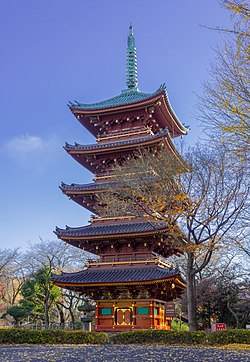
    Start at the entrance, beside the torii gate, where a huge stone lantern stands. It was donated by Sakuma Katsuyuki, a lord of Hitachi Hōjō and Shinano Naganuma, and it measures 6.06 meters in total height. Its scale earned it the nickname "ghost lantern," and it is counted among the three great lanterns of Japan. Now look at the shrine itself. It is built in the gongen style, the same architectural form used at Nikkō Tōshō-gū and Kunōzan Tōshō-gū. In many shrines of that era the sanctuary housing the deity and the worship hall were separate buildings. Here they are joined. A slightly lower connecting hall links the worship hall and the main sanctuary, so the whole thing reads as one building with three rooms. The present buildings date from 1651, when Ieyasu's grandson, the third shogun Iemitsu, rebuilt them. There is one more landmark to look for: the five-story pagoda. It once belonged to the shrine, but after the Meiji government separated Shinto and Buddhism it passed to Kan'ei-ji, and later to Tokyo. It now stands within the grounds of Ueno Zoo. Even so, its front faces the shrine's approach, a reminder of its original home.

  4. 04

    How Ueno Tōshō-gū Shrine Survived

    Tokyo has endured fires, civil war, earthquakes and bombing, yet this shrine is still here with its early Edo look intact. The record is remarkable. A fire in 1866 destroyed the shrine's corridor. Two years later came the Battle of Ueno, fought on the fifteenth day of the fifth month of the fourth year of Keiō, which corresponds to the fourth of July 1868. Shogunate loyalists known as the Shōgitai had their headquarters close to the shrine, and the main hall of Kan'ei-ji went up in flames. Yet the shrine, the five-story pagoda, Gokoku-in and Kiyomizu Kannon Hall were never touched by the fire. Not a single Tōshō-gū elsewhere was set alight either, even though the new government forces bore a grudge against the shogunate. The 1923 Great Kantō Earthquake, we are told, did not even topple the torii. And in the Tokyo air raids of the Second World War, an incendiary bomb landed beside the shrine building but failed to go off, so the hall stood. Whether you call it luck or divine protection, the result is the same: a rare, original Edo-period shrine right in the middle of modern Tokyo.

  5. 05

    Before You Head Off from Ueno Tōshō-gū Shrine

    Before you move on, notice how lively this shrine remains. Inside the grounds is a peony garden, opened in 1980, with peonies grown throughout the year. The spring peony festival runs from early April to early May. A winter peony display begins on New Year's Day and continues into late February, using flowers coaxed into blooming in the cold. In autumn, from late September to late October, dahlias take over the garden. The amulets are worth a look, too. A dragon-rising charm called Shōryū-mori is given out only on the seventeenth of each month. There is also a panda charm, a nod to the neighboring zoo, as well as charms that borrow Ieyasu's strength, and a tanuki-themed goshuin stamp. Goshuin are the stamps pilgrims collect at shrines. So as you leave, glance back at the golden halls and think of an old shogun's dying wish. How many other places in Tokyo have been quietly keeping a promise like that for four centuries?

About this guide

AI-generated from 6 sources; reviewed for accuracy and last updated on October 31, 2026. Verify tickets and opening hours on the official site. Independent guide by Mappu. Not affiliated with or endorsed by the site or its managers.

Run a travel site or blog? Embed this audio guide for free.

Walk on from here

This place is stop 4 of 5 of a self-guided walk: Yanaka to Ueno, Tokyo. About 3.3 km and 45 minutes on foot, plus about 28 minutes of listening.

Route map: walking on from Ueno Tōshō-gū Shrine5 numbered stops in walking order. Stop 1: Yanaka Cemetery; Stop 2: Kan'eiji Temple; Stop 3: Tokyo National Museum; Stop 4: Ueno Tōshō-gū Shrine; Stop 5: Ameya-Yokochō.Stop 1: Yanaka Cemetery1Stop 2: Kan'eiji Temple2Stop 3: Tokyo National Museum3Stop 4: Ueno Tōshō-gū Shrine4Stop 5: Ameya-Yokochō5
Distances are estimates along the walking route, from OpenStreetMap.

Indicative route. While you walk, watch where you're going, mind the traffic and follow local signs and rules. The map is an aid, not a safety guide. Terms

  1. Yanaka Cemetery

    about 0.6 km · about 9 min on foot

  2. Kan'eiji Temple

    about 0.9 km · about 12 min on foot

  3. Tokyo National Museum

    about 0.9 km · about 11 min on foot

  4. Ueno Tōshō-gū ShrineThis guide

    about 0.8 km · about 11 min on foot

  5. Ameya-Yokochō
Photo attribution

Walk Mode, in the free Mappu app: 2 hours for 50 credits (€4.99 Starter pack)

See the whole walk

Planning a trip to Tokyo?

Get your plan

Mappu sketches your days free in the chat, no account needed. Then take the full plan with you:

  • Weekend trip, €9.99: Your day-by-day plan plus 2 live walks
  • Save your trip’s free guides on your phone in the Mappu app: they play with no signal
See the trip packs

Already going? The 2-hour live walk in Tokyo is €4.99

Plan your trip

Photo attribution
  • Tokyo 3-Day Itinerary: Alex
  • Japan First Trip 10-Day Itinerary: Stefan K

Plan your trip on a map and get an audio guide for almost any place nearby: just tap it on the Mappu map.

Common questions

Ueno Tōshō-gū: how long is the free audio guide?

About 7 minutes of listening in 5 sections: “Welcome to Ueno Tōshō-gū Shrine”, “A Deathbed Promise Behind Ueno Tōshō-gū Shrine”, “Gold, Gongen Style and a Giant Lantern at Ueno Tōshō-gū Shrine”, “How Ueno Tōshō-gū Shrine Survived”, and “Before You Head Off from Ueno Tōshō-gū Shrine”.

Ueno Tōshō-gū: what can I ask Mappu after the guide?

You can ask follow-up questions such as “What was the connection between Tenkai, Tōdō Takatora and Tokugawa Ieyasu that led to the founding of this shrine?” and keep asking in Mappu, with the guide connected to your map and trip plan.