Yokohama Ma Zu Miao Audio Guide

A Chinatown temple to Mazu, the Chinese goddess of the sea

Ma Zhu Temple
Photo by VolfgangWikimedia CommonsCC BY-SA 3.0

5 min of listening · Section 1 of 5: Welcome to Ma Zhu Temple

Prefer reading? The full guide is below

Here in person? Walk on with Mappu

This audio guide tells one place’s story. Walk Mode keeps going as you walk:

  • It knows where you are and talks about what’s in front of you, not only these chapters.
  • It takes you on to the next sight and follows what interests you.
  • Ask about anything you see, and it answers on the spot.
  • Your phone stays in your pocket.

A 2-hour live walk with Mappu, €4.99.

50 credits from the Starter pack. One-time purchase, no subscription.

Self-guided audio walk. No guide accompanies you. Not affiliated with the sites.

Keep exploring

Discover more places in Mappu.

Ma Zhu Temple • Section 1 of 5

Ma Zhu Temple: is there a free audio guide?

Quick answer. Yes. Mappu’s Yokohama Ma Zu Miao audio guide (Yokohama, Japan) is free in your browser: 5 sections and about 5 minutes of listening, in 8 languages. It covers “Ma Zhu Temple and the Birth of a Port”, “Mazu: The Heavenly Empress of Ma Zhu Temple” and “A Young Temple with an Old Spirit at Ma Zhu Temple”. In the Mappu app, Walk Mode narrates the places around you as you move and answers your follow-up questions.

Yokohama Ma Zu Miao map

Mappu's own map of the place, with the paths and entrances OpenStreetMap shows around it.

Yokohama Ma Zu Miao mapThe place on the map, with the guide's point marked.

Ma Zhu Temple: what does the audio guide cover?

  1. 01

    Welcome to Ma Zhu Temple

    Welcome to Ma Zhu Temple, known locally as 媽祖廟, in the heart of Yokohama Chinatown. This is a temple devoted to Mazu, also spelled Matsu, the Chinese Goddess of the Sea, and it sits in a port city that has always lived by its harbor. This guide stays close to what is known about the temple: when it opened, who Mazu is, why she belongs in Yokohama, and what the temple does in the neighborhood today. Detailed accounts of its individual halls and carvings are thinner, so we will stay with the stories that are solid and not decorate them. Take a moment to look around, because this temple has a lot to say for such a young building. Let's start with how a port town came to have a sea goddess of its own.

  2. 02

    Ma Zhu Temple and the Birth of a Port

    To understand why a sea goddess feels at home here, go back to the middle of the nineteenth century. After the Treaty of Amity and Commerce between Japan and the United States in 1858, the coastal town of Yokohama was developed as an open port. It opened on June 2, 1859. Foreign companies began setting up businesses in Japan, and with them came many Chinese middlemen. Their job was to smooth the way for trade, negotiating with interpreters and local merchants. That is the root of Yokohama Chinatown, the neighborhood around you. So this temple belongs to a story of trade, travel, and people arriving by sea in a new place. A temple solely dedicated to the Goddess of the Sea suits a city with that past.

  3. 03

    Mazu: The Heavenly Empress of Ma Zhu Temple

    Mazu is one of the most beloved figures in Chinese devotion. She is commonly called Tianhou, the Heavenly Empress, and this temple is often referred to as Tianhou Temple, the Palace of the Heavenly Empress. Tradition describes her as a historical figure, a shamaness who was elevated after her death to the highest ranks among the gods of Chinese mythology. Japanese accounts say she was born as a daughter of the Lin family in Fujian province. She remains one of the most popular deities among Chinese people today. She is best known as the protector of those who travel by sea. Worshippers also pray to her for health and safety, and she is honored as a guardian against natural disasters, plague, war, and bandits. The temple's tradition also includes a god of culture and literature, who represents justness, compassion, and peace, and to whom people pray for success in their studies.

  4. 04

    A Young Temple with an Old Spirit at Ma Zhu Temple

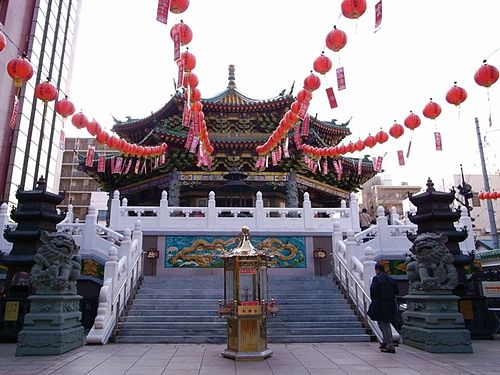
    Here is the surprise: Ma Zhu Temple is very young. It was inaugurated on March 17, 2006. Yet it is described as a Taoist temple whose atmosphere feels older than its years, and its traditional architecture draws visitors to Chinatown. Mazu temples are rare in Japan. It is estimated that there are only about 20 that enshrine her. The temple's role goes beyond worship: it serves to educate and preserve Chinese culture, and to invigorate the future of Yokohama Chinatown. So when you watch people stop here, you are seeing something living. Some come to pray for safe travels, health, and safety. Others come to take in the architecture and learn about a culture that has been part of this port since its first years.

  5. 05

    Before You Head Off

    Before you move on, think about the thread that runs through this place: a harbor opened in 1859, merchants who came across the water, and a goddess who watches over travelers. All of it meets in one temple opened in 2006. Look at how visitors behave here, who pauses, who prays, who simply gazes up at the details. Then let the streets of Chinatown carry you onward, and notice how the neighborhood around the temple still reflects that port-town story. There is plenty more to discover just outside the gate.

About this guide

AI-generated from 6 sources; reviewed for accuracy and last updated on October 31, 2026. Verify tickets and opening hours on the official site. Independent guide by Mappu. Not affiliated with or endorsed by the site or its managers.

Run a travel site or blog? Embed this audio guide for free.

Walk on from here

This place is stop 3 of 4 of a self-guided walk: Yamashita Park to Chinatown, Yokohama. About 1.2 km and 15 minutes on foot, plus about 23 minutes of listening.

Route map: walking on from Ma Zhu Temple4 numbered stops in walking order. Stop 1: Yamashita Park; Stop 2: Yokohama Marine Tower; Stop 3: Ma Zhu Temple; Stop 4: Yokohama Chinatown.Stop 1: Yamashita Park1Stop 2: Yokohama Marine Tower2Stop 3: Ma Zhu Temple3Stop 4: Yokohama Chinatown4
Distances are estimates along the walking route, from OpenStreetMap.

Indicative route. While you walk, watch where you're going, mind the traffic and follow local signs and rules. The map is an aid, not a safety guide. Terms

  1. Yamashita Park

    about 0.4 km · about 5 min on foot

  2. Yokohama Marine Tower

    about 0.6 km · about 8 min on foot

  3. Ma Zhu TempleThis guide

    about 0.2 km · about 3 min on foot

  4. Yokohama Chinatown
Photo attribution

Walk Mode, in the free Mappu app: 2 hours for 50 credits (€4.99 Starter pack)

See the whole walk

Planning a trip to Yokohama?

Get your plan

Mappu sketches your days free in the chat, no account needed. Then take the full plan with you:

  • Weekend trip, €9.99: Your day-by-day plan plus 2 live walks
  • Save your trip’s free guides on your phone in the Mappu app: they play with no signal
See the trip packs

Already going? The 2-hour live walk in Yokohama is €4.99

Plan your trip on a map and get an audio guide for almost any place nearby: just tap it on the Mappu map.

Common questions

Yokohama Ma Zu Miao: how long is the free audio guide?

About 5 minutes of listening in 5 sections: “Welcome to Ma Zhu Temple”, “Ma Zhu Temple and the Birth of a Port”, “Mazu: The Heavenly Empress of Ma Zhu Temple”, “A Young Temple with an Old Spirit at Ma Zhu Temple”, and “Before You Head Off”.

Yokohama Ma Zu Miao: what can I ask Mappu after the guide?

You can ask follow-up questions such as “How did the opening of Yokohama as a port in 1859 lead to the creation of Chinatown?” and keep asking in Mappu, with the guide connected to your map and trip plan.