Kan'ei-ji Audio Guide

A Tendai temple founded to guard Edo Castle, in Ueno

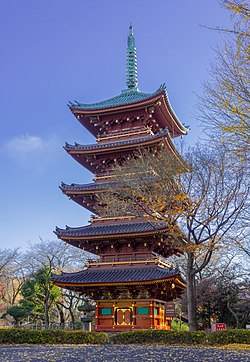
Kan'eiji Temple
Photo by KakidaiWikimedia CommonsCC BY-SA 4.0

6 min of listening · Section 1 of 5: Welcome to Kan'eiji Temple

Prefer reading? The full guide is below

Here in person? Walk on with Mappu

This audio guide tells one place’s story. Walk Mode keeps going as you walk:

  • It knows where you are and talks about what’s in front of you, not only these chapters.
  • It takes you on to the next sight and follows what interests you.
  • Ask about anything you see, and it answers on the spot.
  • Your phone stays in your pocket.

A 2-hour live walk with Mappu, €4.99.

50 credits from the Starter pack. One-time purchase, no subscription.

Self-guided audio walk. No guide accompanies you. Not affiliated with the sites.

Keep exploring

Discover more places in Mappu.

Kan'eiji Temple • Section 1 of 5

Kan'eiji Temple: is there a free audio guide?

Quick answer. Yes. Mappu’s Kan'ei-ji audio guide (Tokyo, Japan) is free in your browser: 5 sections and about 6 minutes of listening, in 8 languages. It covers “Kan'eiji Temple and the Guardian of the Demon Gate”, “Kan'eiji Temple, Shoguns and the Fire of 1868” and “Kan'eiji Temple, the Two Great Masters and the Mausoleums”. In the Mappu app, Walk Mode narrates the places around you as you move and answers your follow-up questions.

Kan'ei-ji map

Mappu's own map of the place, with the paths and entrances OpenStreetMap shows around it.

Kan'ei-ji mapThe place on the map, with the guide's point marked.

Kan'eiji Temple: what does the audio guide cover?

  1. 01

    Welcome to Kan'eiji Temple

    Welcome to Kan'eiji Temple, known in Japanese as 寛永寺. It sits in Ueno Sakuragi, in Taito Ward, on the edge of Ueno Park. The address given for this stop is only the ward, so this guide follows the temple's story as it is anchored in the Ueno Sakuragi district. Kan'eiji is the head temple in the Kanto region for the Tendai school of Buddhism. Its mountain name is Toeizan, which means the Eastern Hiei, a nod to the great Tendai monastery on Mount Hiei near Kyoto. In other words, the founders set out to plant a second Mount Hiei in the east. This was no ordinary neighborhood temple. It was built to guard Edo Castle and to serve as a resting place for shoguns. In the next few minutes we will look at why it was placed here, what happened when war reached these hills, and what you can still see and visit today.

  2. 02

    Kan'eiji Temple and the Guardian of the Demon Gate

    Start with the idea behind the place. In Edo-period belief, the northeast was the direction of the demon gate, the quarter from which misfortune was thought to arrive. Edo Castle's northeast corner needed protection, and the monk Tenkai, later honored as Jigen Daishi, advised the shogunate to build a temple there. The main residence of the temple was completed in 1625. The name carries its own date stamp. The temple received its imperial title from the era name of its founding years, Kan'ei, which is where the name Kan'eiji comes from. The founder, in the formal sense, was the third Tokugawa shogun, Tokugawa Iemitsu, while Tenkai served as the guiding monk behind it. And the plan was ambitious. Just as Mount Hiei guarded the old capital of Kyoto, Kan'eiji's hill was meant to protect the new capital of the shoguns. The hill and the temple together were a statement about where power now sat.

  3. 03

    Kan'eiji Temple, Shoguns and the Fire of 1868

    Kan'eiji became one of the two burial temples of the Tokugawa shogun family, sharing that role with Zojoji in Shiba. In its prime, the whole hill of Ueno was covered with halls and subtemples, with the main residence, called Entsuin, at the center. Then came 1868, the first year of the Keio era's final chapter and the end of the shogunate. The eastern expedition army clashed with the Shogitai in what is called the Battle of Ueno, and much of the temple complex burned down. A landscape that had taken generations to build was largely lost in a single conflict. The present Konpon Chudo, the central hall, is a story of rescue and reuse. In 1879, the eleventh year of Meiji's reign counted from 1868 as year one, the building was moved here from the Honjido of Kita-in temple in Kawagoe. So the great hall you see today was not built on this spot. It was carried here to give the temple a heart again.

  4. 04

    Kan'eiji Temple, the Two Great Masters and the Mausoleums

    One of the most affectionate stories here belongs to Tenkai himself. In 1644, a hall was built to enshrine his statue. In 1648, the imperial court granted him the posthumous title Jigen Daishi, so the hall became known as the Founder's Hall, or Jigen Hall. Later it also housed an image of Jie Daishi Ryogen, the Heian-period monk Tenkai admired most, and so people began calling it Ryodaishi, the Hall of the Two Great Masters. The shogunal mausoleums are another layer. They lie inside the temple's cemetery and are normally closed to the public. Groups of five or more can visit by reservation on roughly three days each month. Taito Ward also holds a special opening for one day every autumn. Even without entering, you can see the imperial tablet gate of the mausoleum of Gyoyuin from the road outside. It is worth pausing over that contrast. The temple that once ruled a hill of halls now keeps its most solemn spaces quiet, and invites you to appreciate them from the outside, or at a carefully chosen moment.

  5. 05

    Before You Head Off from Kan'eiji Temple

    Look around and you will notice that the temple's story spills far beyond its own gates. Ueno Park, the green space that surrounds this hill, today draws crowds for cherry blossom season, and since the Meiji era it has also become a cultural center with museums, galleries and a zoo. Much of that land once belonged to the world of Kan'eiji and its subtemples. As you wander, try holding two pictures in your mind at once: the hill as a vast Tokugawa temple landscape guarding the castle, and the hill as the open public park it is now. Where does one end and the other begin? If you want to dig deeper, there are subtemples to read about, a temple hall that traveled from Kawagoe, and a mausoleum gate you can spot from the road. Each is a small door into the story of Edo, and each is still waiting for you to push it open.

About this guide

AI-generated from 6 sources; reviewed for accuracy and last updated on October 31, 2026. Verify tickets and opening hours on the official site. Independent guide by Mappu. Not affiliated with or endorsed by the site or its managers.

Run a travel site or blog? Embed this audio guide for free.

Walk on from here

This place is stop 2 of 5 of a self-guided walk: Yanaka to Ueno, Tokyo. About 3.3 km and 45 minutes on foot, plus about 28 minutes of listening.

Route map: walking on from Kan'eiji Temple5 numbered stops in walking order. Stop 1: Yanaka Cemetery; Stop 2: Kan'eiji Temple; Stop 3: Tokyo National Museum; Stop 4: Ueno Tōshō-gū Shrine; Stop 5: Ameya-Yokochō.Stop 1: Yanaka Cemetery1Stop 2: Kan'eiji Temple2Stop 3: Tokyo National Museum3Stop 4: Ueno Tōshō-gū Shrine4Stop 5: Ameya-Yokochō5
Distances are estimates along the walking route, from OpenStreetMap.

Indicative route. While you walk, watch where you're going, mind the traffic and follow local signs and rules. The map is an aid, not a safety guide. Terms

  1. Yanaka Cemetery

    about 0.6 km · about 9 min on foot

  2. Kan'eiji TempleThis guide

    about 0.9 km · about 12 min on foot

  3. Tokyo National Museum

    about 0.9 km · about 11 min on foot

  4. Ueno Tōshō-gū Shrine

    about 0.8 km · about 11 min on foot

  5. Ameya-Yokochō
Photo attribution

Walk Mode, in the free Mappu app: 2 hours for 50 credits (€4.99 Starter pack)

See the whole walk

Planning a trip to Tokyo?

Get your plan

Mappu sketches your days free in the chat, no account needed. Then take the full plan with you:

  • Weekend trip, €9.99: Your day-by-day plan plus 2 live walks
  • Save your trip’s free guides on your phone in the Mappu app: they play with no signal
See the trip packs

Already going? The 2-hour live walk in Tokyo is €4.99

Plan your trip

Photo attribution
  • Tokyo 3-Day Itinerary: Alex
  • Japan First Trip 10-Day Itinerary: Stefan K

Plan your trip on a map and get an audio guide for almost any place nearby: just tap it on the Mappu map.

Common questions

Kan'ei-ji: how long is the free audio guide?

About 6 minutes of listening in 5 sections: “Welcome to Kan'eiji Temple”, “Kan'eiji Temple and the Guardian of the Demon Gate”, “Kan'eiji Temple, Shoguns and the Fire of 1868”, “Kan'eiji Temple, the Two Great Masters and the Mausoleums”, and “Before You Head Off from Kan'eiji Temple”.

Kan'ei-ji: what can I ask Mappu after the guide?

You can ask follow-up questions such as “Why did the founders of Kan'eiji Temple choose the northeast of Edo Castle, and how does the idea of an Eastern Hiei connect to that choice?” and keep asking in Mappu, with the guide connected to your map and trip plan.