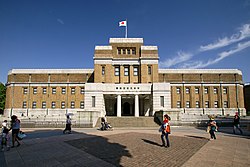
The museum's main building and its grounds have been recognized at the highest levels. In 2007 the main building was designated an Important Cultural Property of Japan. Then, on the seventeenth of July 2016, at the fortieth session of the World Heritage Committee in Istanbul, the main building and its grounds were inscribed on the World Heritage List. They are part of a group called The Architectural Work of Le Corbusier, an Outstanding Contribution to the Modern Movement. That group has 17 components spread across seven countries: France, Switzerland, Belgium, Germany, Argentina, India and Japan. It was the first time a serial listing spanning three continents had been inscribed in a single decision. The building has grown over time. A new building was completed in 1979, for the museum's twentieth anniversary, designed to work together with Le Corbusier's main building. Its outer walls are open-joint precast panels with dark green stoneware tile set into them. It is arranged to wrap around zelkova and ginkgo trees, which creates a deeply green courtyard. An exhibition building followed in 1997. The front garden was renewed in April 2022, so you can once again experience it much as it looked when the museum was first created. From the hall, you can see the Tokyo Bunka Kaikan to the south.