Ninna-ji Audio Guide

Audio guide for Ninna-ji

Ninna-ji
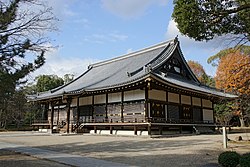
Photo by 663highlandWikimedia CommonsCC BY 2.5

6 min of listening · Section 1 of 5: Welcome to Ninna temple

Prefer reading? The full guide is below

Here in person? Walk on with Mappu

This audio guide tells one place’s story. Walk Mode keeps going as you walk:

  • It knows where you are and talks about what’s in front of you, not only these chapters.
  • It takes you on to the next sight and follows what interests you.
  • Ask about anything you see, and it answers on the spot.
  • Your phone stays in your pocket.

A 2-hour live walk with Mappu, €4.99.

50 credits from the Starter pack. One-time purchase, no subscription.

Self-guided audio walk. No guide accompanies you. Not affiliated with the sites.

Keep exploring

Discover more places in Mappu.

Ninna-ji • Section 1 of 5

Ninna-ji: is there a free audio guide?

Quick answer. Yes. Mappu’s Ninna-ji audio guide (Kyoto, Japan) is free in your browser: 5 sections and about 6 minutes of listening, in 8 languages. It covers “Ninna temple and the Retired Emperor”, “A Palace Hall Reborn at Ninna temple” and “Gate, Pagoda and Gardens of Ninna temple”. In the Mappu app, Walk Mode narrates the places around you as you move and answers your follow-up questions.

Ninna-ji map

Mappu's own map of the place, with the paths and entrances OpenStreetMap shows around it.

Ninna-ji mapThe place on the map, with the guide's point marked.

Ninna-ji: what does the audio guide cover?

  1. 01

    Welcome to Ninna temple

    Welcome to Ninna temple, known in Japanese as 仁和寺, in the Omuro Ouchi district of Kyoto's Ukyo Ward, at the foot of Mount Kinugasa along the road called Kinugake no Michi. This is the head temple of the Omuro branch of Shingon Buddhism. Its mountain name is Dainai-zan, and its principal image is Amida Nyorai, the Buddha of the Pure Land. The temple was founded by Emperor Uda, and that royal connection is the thread running through your whole visit. For centuries, the abbots here came from the imperial family, and the temple was nicknamed the Omuro Palace. Today it is part of the World Heritage listing called Historic Monuments of Ancient Kyoto, which was inscribed in 1994. Over the next few stops, I will walk you through how the temple began, how an imperial palace hall ended up as a Buddhist hall, and what to look for in the gate, the pagoda and the famous cherry trees. Settle in, and let's begin at the beginning.

  2. 02

    Ninna temple and the Retired Emperor

    Our story starts in the year 886, when Emperor Koko issued an imperial order to build a temple here. It was completed in 888, and it took its name from the era in which it was built, the years called Ninna. In Japanese, the temple's name is literally a calendar stamp. Then came Emperor Uda, who took the tonsure, shaving his head to enter religious life, and entered this temple. Within its grounds he set up a private residence called the Omuro, which means something like a honorable chamber. That is why the temple has long been called the Omuro Palace. From then until the Meiji Restoration, imperial princes and grandsons served in turn as its head, as monzeki, the title for a temple led by a member of the nobility. Ninna temple ranked first among such temples. It is also counted as one of the three Kobo Daishi temples of Kyoto, together with Toji and Shinkoin. So as you walk through, you are moving through a place where religion, court life and Kyoto's imperial history are woven together.

  3. 03

    A Palace Hall Reborn at Ninna temple

    Here is one of the most surprising facts about Ninna temple. Most of its buildings burned during the Onin War, which raged from 1467 to 1477. Rebuilding came in the Kan'ei and Shoho eras, between 1624 and 1648. In 1634, the twenty-first head of the temple, Prince Kakushin, asked the shogun Tokugawa Iemitsu, who was visiting Kyoto, to help restore the temple. Iemitsu agreed, and the shogunate's backing made the rebuilding possible. The result was a kind of recycling on an imperial scale. When the imperial palace in Kyoto was rebuilt in the Kan'ei years, some of its old buildings were granted to the temple and moved here. The Golden Hall, a National Treasure, is the former Shishinden, the main ceremonial hall of the palace, built in 1613. It is the oldest surviving Shishinden anywhere. When it became a Buddhist hall, the roof was changed from cypress bark to tile, but you can still see palace touches, such as lattice shutters that lift upward and gold decorative metal fittings. Inside, the principal image is Amida Nyorai. The Founder's Hall, an Important Cultural Property, was built between 1641 and 1645 using timber from the palace's former Seiryoden hall. It enshrines images of Kobo Daishi, the founder of the Shingon school, along with Emperor Uda and the second head of the temple, Prince Shoshin.

  4. 04

    Gate, Pagoda and Gardens of Ninna temple

    As you enter, the Niomon gate greets you. It was completed around 1644 and is built in a purely Japanese style, which gives it an old-fashioned, dignified feel suited to a temple founded in the Heian period. It is counted among the three great gates of Kyoto. Then look for the five-story pagoda, completed in 1644 and standing about 36 meters tall. Like the pagoda at Toji, its stories shrink only slightly as they rise, which gives it a calm, stately outline and makes it a signature of the Kan'ei period. Together with the Omuro cherry trees, it is the symbol of the temple. Beside the main path lies the residence quarter, the Goten, which occupies about a quarter of the grounds near where Emperor Uda's residence once stood. Its Shinden hall burned in 1887 and was rebuilt in 1914 to a design by the garden craftsman Kameoka Suekichi. It sits between a south garden of white gravel and a north garden with a pond for strolling. Together they keep an air of the old palace.

  5. 05

    Before You Head Off from Ninna temple

    Before you move on, notice the Omuro cherry trees. There are around 200 of them, and they are known as the latest-blooming cherries in Kyoto, usually flowering in mid-April. They are low trees, only 2 to 3 meters tall, so the blossoms form a pink layer around the pagoda instead of a high canopy. In autumn, the grounds are also known for their colored leaves. There is still plenty to discover. The Reihokan treasure hall holds temple art, and the Kannon Hall, the bell tower and the sutra repository are among the other Important Cultural Properties. Look too at the imperial-style gate by the main path, which was rebuilt in 1913 and is not used for entry. When you wander back, ask yourself which building felt most like a palace and which felt most like a temple. At Ninna temple, you may find that the answer changes from one hall to the next.

About this guide

AI-generated from 6 sources; checked automatically and last updated on October 31, 2026. Verify tickets and opening hours on the official site. Independent guide by Mappu. Not affiliated with or endorsed by the site or its managers.

Run a travel site or blog? Embed this audio guide for free.

Walk on from here

The nearest places with a Mappu audio guide, in walking order: about 2.5 km and 35 minutes on foot in all.

Route map: walking on from Ninna-ji4 numbered stops in walking order. Stop 1: Ninna-ji; Stop 2: Ryōan-ji; Stop 3: Tōji-in Temple; Stop 4: Hirano Shrine.Stop 1: Ninna-ji1Stop 2: Ryōan-ji2Stop 3: Tōji-in Temple3Stop 4: Hirano Shrine4
Distances are estimates: the straight line between places plus 30%.

Indicative route. While you walk, watch where you're going, mind the traffic and follow local signs and rules. The map is an aid, not a safety guide. Terms

  1. Ninna-jiThis guide

    about 0.7 km · about 10 min on foot

  2. Ryōan-ji

    about 0.7 km · about 10 min on foot

  3. Tōji-in Temple

    about 1.0 km · about 14 min on foot

  4. Hirano Shrine
Photo attribution

Walk Mode, in the free Mappu app: 2 hours for 50 credits (€4.99 Starter pack)

Planning a trip to Kyoto?

Get your plan

Mappu sketches your days free in the chat, no account needed. Then take the full plan with you:

  • Weekend trip, €9.99: Your day-by-day plan plus 2 live walks
  • Save your trip’s free guides on your phone in the Mappu app: they play with no signal
See the trip packs

Already going? The 2-hour live walk in Kyoto is €4.99

Plan your trip on a map and get an audio guide for almost any place nearby: just tap it on the Mappu map.

Common questions

Ninna-ji: how long is the free audio guide?

About 6 minutes of listening in 5 sections: “Welcome to Ninna temple”, “Ninna temple and the Retired Emperor”, “A Palace Hall Reborn at Ninna temple”, “Gate, Pagoda and Gardens of Ninna temple”, and “Before You Head Off from Ninna temple”.

Ninna-ji: what can I ask Mappu after the guide?

You can ask follow-up questions such as “How did the tradition of imperial princes serving as abbots shape the temple's reputation?” and keep asking in Mappu, with the guide connected to your map and trip plan.