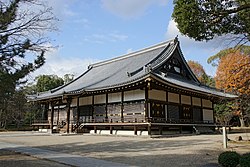
Tōji-in Audio Guide

The Zen family temple of the Ashikaga shoguns, founded in 1341

Tōji-in Temple
Photo by 663highlandWikimedia CommonsCC BY-SA 4.0

5 min of listening · Section 1 of 5: Welcome to Tōji-in

Prefer reading? The full guide is below

Here in person? Walk on with Mappu

This audio guide tells one place’s story. Walk Mode keeps going as you walk:

  • It knows where you are and talks about what’s in front of you, not only these chapters.
  • It takes you on to the next sight and follows what interests you.
  • Ask about anything you see, and it answers on the spot.
  • Your phone stays in your pocket.

A 2-hour live walk with Mappu, €4.99.

50 credits from the Starter pack. One-time purchase, no subscription.

Self-guided audio walk. No guide accompanies you. Not affiliated with the sites.

Keep exploring

Discover more places in Mappu.

Tōji-in Temple • Section 1 of 5

Tōji-in Temple: is there a free audio guide?

Quick answer. Yes. Mappu’s Tōji-in audio guide (Kyoto, Japan) is free in your browser: 5 sections and about 5 minutes of listening, in 8 languages. It covers “Tōji-in and the Ashikaga Shoguns”, “A Zen Foundation Beneath Kinugasa Mountain” and “Fire, Rebuilding and the Great Daruma”. In the Mappu app, Walk Mode narrates the places around you as you move and answers your follow-up questions.

Tōji-in map

Mappu's own map of the place, with the paths and entrances OpenStreetMap shows around it.

Tōji-in mapThe place on the map, with the guide's point marked.

Tōji-in Temple: what does the audio guide cover?

  1. 01

    Welcome to Tōji-in

    Welcome to Tōji-in, written 等持院 in Japanese, a Zen temple in the northern part of Kyoto, in the Kita ward, in a neighborhood that carries the temple's own name. The detailed written record about this particular temple is modest, so this guide stays with the firm foundations: who founded it, which school it belongs to, and the few features that visitors consistently remember. Tōji-in belongs to the Tenryū-ji branch of the Rinzai school of Zen Buddhism. Its mountain name, the formal title Zen temples carry alongside their ordinary name, is Mannenzan, which means Ten Thousand Year Mountain. Its principal image is Shakyamuni, the historical Buddha. The temple's real claim to fame is its link with one of Japan's great warrior families. It is the family temple of the Ashikaga clan, and it holds the grave of Ashikaga Takauji. Let's begin there.

  2. 02

    Tōji-in and the Ashikaga Shoguns

    Tōji-in was founded in 1341, the fourth year of the Ryakuō era, by Ashikaga Takauji, the first shogun of the Muromachi shogunate. He was the warlord who founded a dynasty of military rulers that governed Japan from Kyoto for more than two centuries. A temple built by a man like that was never only a place of prayer. It was also a statement about lineage and legitimacy. That is why Tōji-in became the Ashikaga family temple, the place where the clan looked after the memory of its ancestors. Takauji's grave is here, and it is the reason this quiet temple is so closely tied to Kyoto's medieval history. As you walk the grounds, remember that you are in a place that was tied to the family at the center of Kyoto's political life in the fourteenth century.

  3. 03

    A Zen Foundation Beneath Kinugasa Mountain

    Takauji did not choose the monk who would shape his new temple at random. He turned to the Zen master Musō Kokushi of Tenryū-ji, one of the leading Zen figures of the age, and the temple was established at the southern foot of Mount Kinugasa. That explains why Tōji-in belongs today to the Tenryū-ji branch of Rinzai Zen. It also explains the temple's setting. Kyoto's northwestern hills rise behind it, and the temple sits in the gentle land below them, away from the busy heart of the city. That setting suits Zen well, which has always favored quiet, simple spaces for contemplation. Visitors often come away remembering the green of the garden. A walk here is a good moment to slow down and let the greenery and the stillness do their work.

  4. 04

    Fire, Rebuilding and the Great Daruma

    Tōji-in's long life has not been peaceful. Some of its halls were lost to fire during the Ōnin War, the devastating conflict of the fifteenth century that ravaged much of Kyoto. The temple's story continued afterward, and repairs were later carried out by Toyotomi Hideyori, the son of the great unifier Toyotomi Hideyoshi. Then there is a much more recent attraction. As you enter the grounds, you meet a very large painting of Daruma, the founder of Zen Buddhism in China, known in Japanese as Daruma Daishi. It was painted by Seki Bokuō, a Rinzai Zen monk of the modern era. It makes a striking contrast. On one side is a temple of shoguns and medieval memory. On the other is a bold, direct ink portrait that sums up the spirit of Zen in a single powerful figure.

  5. 05

    Before You Head Off

    Tōji-in is a small temple, and its charm lies in the layers it holds: a shogun's family temple, a Zen foundation laid with the help of a famous master, a history marked by fire and rebuilding, and a modern Daruma greeting you at the entrance. Before you leave, look at how the garden's greenery meets the buildings, and think about how many generations have walked this same ground. Then ask yourself what a family so powerful hoped to preserve by building a place so calm. There is plenty more to discover here, in the details that only a slow visit reveals.

About this guide

AI-generated from 6 sources; reviewed for accuracy and last updated on October 31, 2026. Verify tickets and opening hours on the official site. Independent guide by Mappu. Not affiliated with or endorsed by the site or its managers.

Run a travel site or blog? Embed this audio guide for free.

Walk on from here

The nearest places with a Mappu audio guide, in walking order: about 1.5 km and 20 minutes on foot in all.

Route map: walking on from Tōji-in Temple3 numbered stops in walking order. Stop 1: Tōji-in Temple; Stop 2: Ryōan-ji; Stop 3: Ninna-ji.Stop 1: Tōji-in Temple1Stop 2: Ryōan-ji2Stop 3: Ninna-ji3
Distances are estimates: the straight line between places plus 30%.

Indicative route. While you walk, watch where you're going, mind the traffic and follow local signs and rules. The map is an aid, not a safety guide. Terms

  1. Tōji-in TempleThis guide

    about 0.7 km · about 10 min on foot

  2. Ryōan-ji

    about 0.7 km · about 10 min on foot

  3. Ninna-ji
Photo attribution

Walk Mode, in the free Mappu app: 2 hours for 50 credits (€4.99 Starter pack)

Planning a trip to Kyoto?

Get your plan

Mappu sketches your days free in the chat, no account needed. Then take the full plan with you:

  • Weekend trip, €9.99: Your day-by-day plan plus 2 live walks
  • Save your trip’s free guides on your phone in the Mappu app: they play with no signal
See the trip packs

Already going? The 2-hour live walk in Kyoto is €4.99

Plan your trip on a map and get an audio guide for almost any place nearby: just tap it on the Mappu map.

Common questions

Tōji-in: how long is the free audio guide?

About 5 minutes of listening in 5 sections: “Welcome to Tōji-in”, “Tōji-in and the Ashikaga Shoguns”, “A Zen Foundation Beneath Kinugasa Mountain”, “Fire, Rebuilding and the Great Daruma”, and “Before You Head Off”.

Tōji-in: what can I ask Mappu after the guide?

You can ask follow-up questions such as “Why did Ashikaga Takauji choose to found a Zen temple, and what did it mean to be the Ashikaga family temple?” and keep asking in Mappu, with the guide connected to your map and trip plan.