Tokyo Skytree Audio Guide

Audio guide for Tokyo Skytree

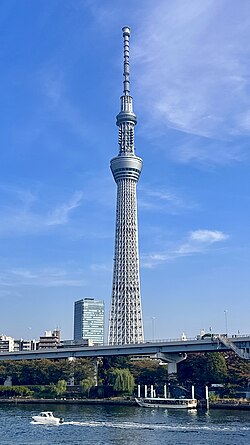
Tokyo Skytree
Photo by AkonnchirollWikimedia CommonsCC0

6 min of listening · Section 1 of 5: Welcome to Tokyo Skytree

Prefer reading? The full guide is below

Here in person? Walk on with Mappu

This audio guide tells one place’s story. Walk Mode keeps going as you walk:

  • It knows where you are and talks about what’s in front of you, not only these chapters.
  • It takes you on to the next sight and follows what interests you.
  • Ask about anything you see, and it answers on the spot.
  • Your phone stays in your pocket.

A 2-hour live walk with Mappu, €4.99.

50 credits from the Starter pack. One-time purchase, no subscription.

Self-guided audio walk. No guide accompanies you. Not affiliated with the sites.

Keep exploring

Discover more places in Mappu.

Tokyo Skytree • Section 1 of 5

Tokyo Skytree: is there a free audio guide?

Quick answer. Yes. Mappu’s Tokyo Skytree audio guide (Tokyo, Japan) is free in your browser: 5 sections and about 6 minutes of listening, in 8 languages. It covers “Tokyo Skytree: From Freight Yard to Sky”, “How Tokyo Skytree Stands Tall” and “Tokyo Skytree and the Spirit of Sumida”. In the Mappu app, Walk Mode narrates the places around you as you move and answers your follow-up questions.

Tokyo Skytree map

Mappu's own map of the place, with the paths and entrances OpenStreetMap shows around it.

Tokyo Skytree mapThe place on the map, with the guide's point marked.

Tokyo Skytree: what does the audio guide cover?

  1. 01

    Welcome to Tokyo Skytree

    Tilt your head back, because you are standing at the foot of Tokyo Skytree, known in Japanese as 東京スカイツリー. It rises in the Oshiage district of Sumida Ward, on the east side of the city, and it reaches 634 meters into the sky. That makes it the tallest tower in Japan, and when it was finished it was celebrated as the tallest tower in the world. This is a broadcasting tower and a visitor attraction in one. It was completed on 29 February 2012 and opened to the public on 22 May 2012. It sits between two stations: Tokyo Skytree station on the Tobu Skytree Line, and Oshiage station, where several railway and subway lines meet. So you can arrive by rail almost at its feet. Over the next few stops we will look at the ground it stands on, which has a story of its own. We will also see how engineers got something this tall to stand on such a small footprint, how a whole neighborhood hoped to be reborn around it, and how it got its name. Let us start with the ground beneath you.

  2. 02

    Tokyo Skytree: From Freight Yard to Sky

    Before this tower existed, the land beneath it was far more humble. The site was a former freight yard belonging to Tobu Railway. Its old platforms later served the station called Narihirabashi, and they were closed in 2003. Next to it stood a plant that made ready-mixed concrete, which kept running until 2007. Tobu Railway owned the land, and that is why a railway company ended up developing a giant tower and a large complex around it. The idea began with television. As Japan moved to digital terrestrial broadcasting, the public broadcaster NHK and the main commercial networks wanted a new tower of around 600 meters. In December 2003 they launched a joint project to make it happen. Sumida Ward and local people, hoping to attract it, asked Tobu Railway for help. In March 2006 the area around the old freight yard, between Oshiage and Narihirabashi stations, was chosen. There was one more hurdle, and it was invisible: the sky itself. Under aviation law, this area fell under the height limits tied to Haneda Airport, so buildings could rise only to 295 meters above sea level. On 28 April 2005 the restricted zone was reviewed, and a tower of this height became possible.

  3. 03

    How Tokyo Skytree Stands Tall

    Here is the engineering puzzle: how do you build a self-supporting tower this high on a plot that is surprisingly small? The answer lies in how much construction technology had advanced since Tokyo Tower was built in 1957 and 1958. Steel quality, welding techniques, structural simulation and special foundation methods had all improved enormously. Tokyo Skytree covers a much smaller building area than Tokyo Tower, yet it stands far taller. Look at the main frame and you are looking at steel pipes rather than the H-shaped beams used in many structures. The major joints are welded, and the pipes are joined directly to each other with branching connections. That choice made the tower lighter and improved its resistance to earthquakes, a serious matter in Tokyo. The design was by the architectural firm Nikken Sekkei, and a central reinforced concrete shaft working with oil dampers is described as a counterbalance during quakes. Many people also link the tower's thinking to the five-story pagodas of the Edo period, which were known for riding out earthquakes. Even the color has a Japanese root: the tower is painted Skytree White, a faintly bluish white based on the traditional shade called aijiro.

  4. 04

    Tokyo Skytree and the Spirit of Sumida

    This tower was never meant to stand alone. After the war, Sumida Ward was rebuilt as a town of small and medium factories. They powered the years of rapid growth and nurtured the shitamachi culture of old downtown Tokyo. In the early 1970s there were nearly 10,000 factories here. By around 2008, when construction began, only about a third remained. The ward saw the tower as a chance to bring back liveliness through tourism and to give its craft and manufacturing a fresh lift. For the tower's owners there was a second concern: towers often draw crowds when they open, and then the numbers fade. Making the neighborhood itself attractive was the answer. The two visions met, and the project became a joint effort between public and private partners to turn the whole ward into a destination. The ward also hoped visitors would flow between here and nearby Asakusa and Kameido. The results are big. By the end of 2021, Tokyo Skytree had welcomed 40 million visitors, and the whole Tokyo Skytree Town, including its shopping complex Tokyo Solamachi and an office building, had passed 300 million in total. At the Tembo Deck, 350 meters up, a tenth anniversary installation called the W1SH RIBBON invited visitors to tie a golden ribbon on a tree with a wish.

  5. 05

    Before You Head Off from Tokyo Skytree

    There is one more story worth carrying with you: the name. On 19 March 2008, a committee chose six final candidates, among them Tokyo Edo Tower, Rising Tower, Mirai Tower, which means Tower of the Future, and Yumemi Yagura, which means Dream Lookout. The name you see on the tower today was the one that won out. As you look up, you might imagine the other tower this could have been. The opening spring of 2012 was full of firsts. On 23 April, the radio stations NHK Tokyo FM and J-WAVE moved their transmitters here from Tokyo Tower and began regular broadcasting from Tokyo Skytree. Three days later, on 26 April, the Emperor and Empress of the time visited and inspected the Tembo Corridor. Then, in early May, residents of Sumida Ward were the first ordinary visitors invited to look around. Before you leave, try seeing the tower from a distance. In the neighborhood of Kameido, people look at it from the arched drum bridge of Kameido Tenjin Shrine. Notice how the tower's slender silhouette changes as you walk away, and wonder what other corners of this old downtown district it quietly connects to.

About this guide

AI-generated from 6 sources; checked automatically and last updated on October 31, 2026. Verify tickets and opening hours on the official site. Independent guide by Mappu. Not affiliated with or endorsed by the site or its managers.

Run a travel site or blog? Embed this audio guide for free.

Walk on from here

This place is stop 3 of 3 of a self-guided walk: Senso-ji to Tokyo Skytree, Tokyo. About 1.9 km and 25 minutes on foot, plus about 18 minutes of listening.

Route map: walking on from Tokyo Skytree3 numbered stops in walking order. Stop 1: Senso-ji; Stop 2: Asakusa Shrine; Stop 3: Tokyo Skytree.Stop 1: Senso-ji1Stop 2: Asakusa Shrine2Stop 3: Tokyo Skytree3
Distances are estimates along the walking route, from OpenStreetMap.

Indicative route. While you walk, watch where you're going, mind the traffic and follow local signs and rules. The map is an aid, not a safety guide. Terms

  1. Senso-ji

    about 0.2 km · about 2 min on foot

  2. Asakusa Shrine

    about 1.7 km · about 23 min on foot

  3. Tokyo SkytreeThis guide

Photo attribution

Walk Mode, in the free Mappu app: 2 hours for 50 credits (€4.99 Starter pack)

See the whole walk

Planning a trip to Tokyo?

Get your plan

Mappu sketches your days free in the chat, no account needed. Then take the full plan with you:

  • Weekend trip, €9.99: Your day-by-day plan plus 2 live walks
  • Save your trip’s free guides on your phone in the Mappu app: they play with no signal
See the trip packs

Already going? The 2-hour live walk in Tokyo is €4.99

Plan your trip

Photo attribution
  • Tokyo 3-Day Itinerary: Alex
  • Japan First Trip 10-Day Itinerary: Stefan K

Useful for your visit

Tickets, tours and practical extras for this trip, from Mappu's partners.

Partner links (Airalo, Amazon, Booking.com, GetYourGuide, Klook, Tiqets, Trip.com, Viator, Welcome Pickups): if you book or buy through them, Mappu may earn a commission, at no extra cost to you.

Plan your trip on a map and get an audio guide for almost any place nearby: just tap it on the Mappu map.

Common questions

Tokyo Skytree: how long is the free audio guide?

About 6 minutes of listening in 5 sections: “Welcome to Tokyo Skytree”, “Tokyo Skytree: From Freight Yard to Sky”, “How Tokyo Skytree Stands Tall”, “Tokyo Skytree and the Spirit of Sumida”, and “Before You Head Off from Tokyo Skytree”.

Tokyo Skytree: what can I ask Mappu after the guide?

You can ask follow-up questions such as “How did a freight yard and a concrete plant end up as the site of the tallest tower in Japan?” and keep asking in Mappu, with the guide connected to your map and trip plan.