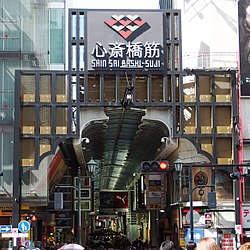
To understand why a street like Sōemon feels the way it does, it helps to zoom out to the city itself. By the Tokugawa period, which ran from 1603 to 1867, Osaka had grown into the country's main commercial hub. Unlike many Japanese cities of the time, it was not dominated by samurai. Its canals carried trade, and that helped it expand as a commercial and manufacturing center. In the Edo period, Osaka became known as the nation's kitchen. A network of canals ran through the city, with wooden merchant houses and warehouses along them, and the architecture of that era was practical, built for trade and for working life. Osaka has long been a center of culture too, with traditional and modern drama, music and Bunraku puppet theater performed across the area. A lively, democratic, food-loving atmosphere is part of the city's character, and you can feel an echo of it in the evening bustle of Sōemon.