



Arashiyama: how long is the free audio guide?
About 6 minutes of listening in 5 sections: “Welcome to Arashiyama”, “A Getaway for Nobles and Poets”, “Tenryuji and the Borrowed Mountains”, “Bamboo, River and Bridge”, and “Before You Head Off”.
Poets, Zen gardens and a river at the western edge of Kyoto
Quick answer. Yes. Mappu’s Arashiyama audio guide (Kyoto, Japan) is free in your browser: 5 sections and about 6 minutes of listening, in 8 languages. It covers “A Getaway for Nobles and Poets”, “Tenryuji and the Borrowed Mountains” and “Bamboo, River and Bridge”. In the Mappu app, Walk Mode narrates the places around you as you move and answers your follow-up questions.
Mappu's own map of the place, with the paths and entrances OpenStreetMap shows around it.
Welcome to Arashiyama, on the northwestern side of Kyoto. A quick note on what this guide covers: it tells the story of the whole district, the temples, the river, the bamboo and the old retreats of nobles, rather than one single building or monument. Arashiyama is known worldwide for its bamboo grove and for scenery that changes with every season. The area is dotted with temples, old imperial villas and famous historical sites. Many of them are National Treasures or have been recognized as World Heritage sites. It sits between the Katsura River and forested hills, and the feeling is of a retreat from the busy streets of downtown Kyoto, even though public transportation makes it easy to reach. Over the next few stops we will look at why aristocrats and poets were drawn here, how a great Zen temple turned the mountains into part of its garden, and what to notice along the river. Settle in and let the landscape do some of the talking.
Arashiyama's reputation is more than a thousand years old. During the Heian period, which ran from the year 794 to 1185, nobles and aristocrats came here to escape the city. They enjoyed the seasonal beauty and composed poetry under cherry blossoms in spring or maple leaves in autumn. Mountains and a broad river made it an ideal stage for that kind of refined pastime. The fascination never faded. Since ancient times, renowned poets such as Basho have made the pilgrimage to Arashiyama. In the Kamakura period, the district also flourished as a center of Buddhist culture, so that scenery and spirituality grew up side by side. The result is a place that has developed through very different eras: aristocratic leisure, temple building, and eventually its modern life as a beloved destination. The mountain that rises here is called Arashiyama. Its name can be read as Storm Mountain. It stands about 382 meters high, and together with the Oi River it forms the classic view that visitors still come for today.
The great anchor of Arashiyama is Tenryuji. It is a Zen temple ranked among Kyoto's five great Zen temples, and it is the largest and most impressive temple in the district. It is also registered as a UNESCO World Heritage site. Its story begins with consolation: Ashikaga Takauji had it built to console the spirit of Emperor Go-Daigo. Then there is the garden, counted among the best in Kyoto. Its designers used a concept called shakkei, or borrowed scenery. Instead of ending at the garden wall, the design pulls the surrounding mountains into the composition, so the hills beyond the pond feel like part of the garden itself. Take a moment to look past the foreground and notice where the planted garden ends and the borrowed landscape begins. For planning, the temple is open from 8:30 in the morning until 5:00 in the afternoon, with entry until 4:50. Admission to the gardens is listed as 500 yen, with an additional 300 yen to enter the buildings. The exit at the back of the grounds leads directly to the famous bamboo grove, which makes a natural next step.
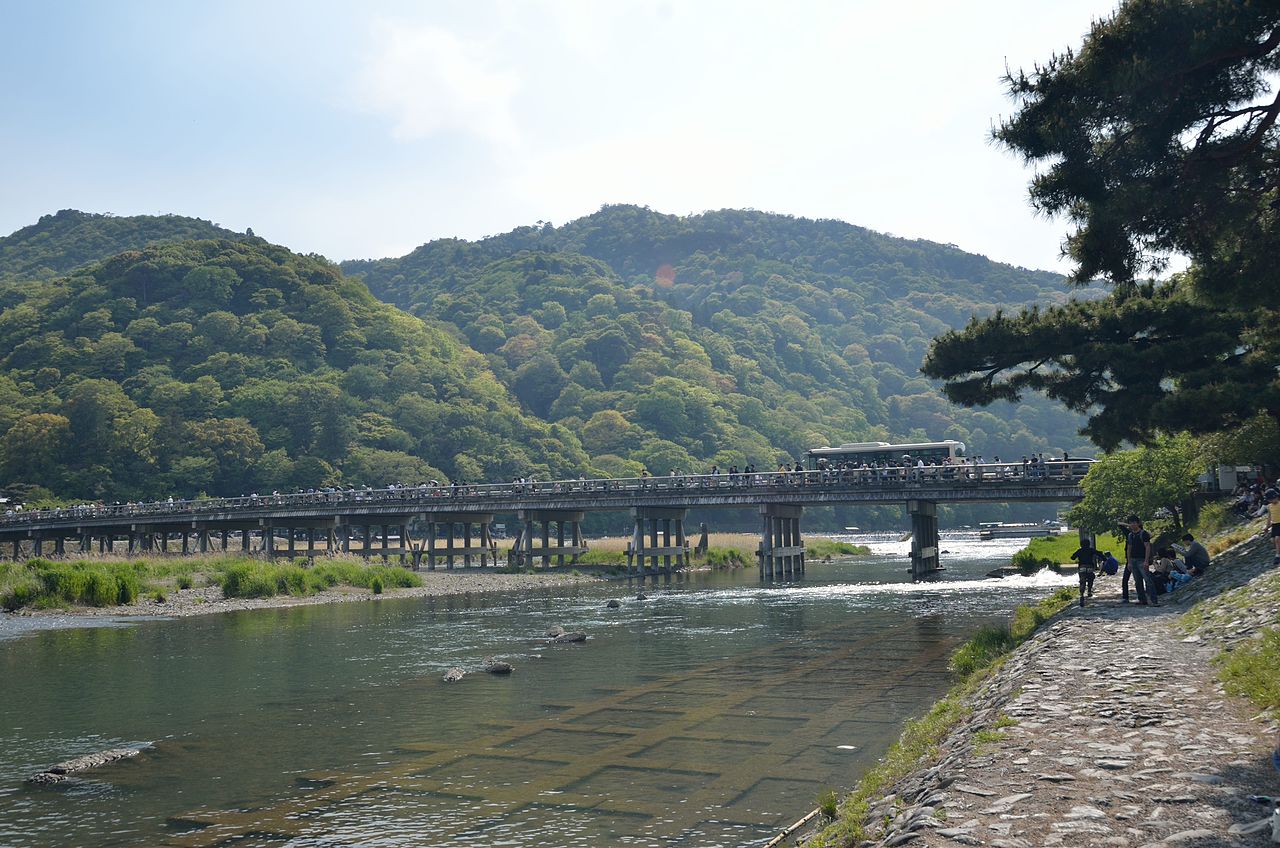
Step through the back of Tenryuji and you arrive at the bamboo grove. Bamboo paths lined with thousands of stalks are among the sights that bring the world to Arashiyama. It is worth listening here as much as looking. The tall, dense stalks filter the light and change the mood of the walk. Then head toward the water. A narrow-gauge train also runs along the river, and visiting both the grove and the train gives you a closer look at the changing face of Arashiyama's natural landscape, which poets have celebrated since ancient times. Nearby stands Togetsukyo Bridge, one of the district's best-known landmarks. A tradition tied to it holds that if you do not look back until you have completely crossed, it represents spiritual growth and determination. Try it, and see how hard it is to resist glancing at the view behind you. If you want a quieter experience, the district also offers a facility called Hogan, run by the garden restoration and maintenance organization Sone Zoen. There, visitors can try Zen sand raking in a traditional Japanese house and garden.
Arashiyama rewards slow looking. It has been a place of poetry, Buddhist culture and seasonal beauty for well over a thousand years, and each season gives it a different face. Cherry blossoms, green summer hills and autumn colors all offer a new view of the same mountain and river. As you wander, try a few small experiments. Look for the place in a garden where borrowed mountains meet planted trees. Listen to the bamboo and notice how the light changes along the path. Glance at the river and imagine the nobles and poets who once came here to find the right words for what they saw. There is plenty more to discover in the temples, villas and riverside lanes. Follow whichever path pulls at your curiosity, and let Arashiyama show you something you did not expect.
AI-generated from 6 sources; checked automatically and last updated on October 31, 2026. Verify tickets and opening hours on the official site. Independent guide by Mappu. Not affiliated with or endorsed by the site or its managers.
The nearest places with a Mappu audio guide, in walking order: about 2.6 km and 35 minutes on foot in all.
Indicative route. While you walk, watch where you're going, mind the traffic and follow local signs and rules. The map is an aid, not a safety guide. Terms

ArashiyamaThis guide
about 1.0 km · about 13 min on foot
 Monkey Park Iwatayama
about 1.0 km · about 14 min on foot
 Tenryū-ji
about 0.3 km · about 4 min on foot
 Arashiyama Bamboo Grove
about 0.2 km · about 3 min on foot
 Ōkōchi Sansō
Walk Mode, in the free Mappu app: 2 hours for 50 credits (€4.99 Starter pack)
Planning a trip to Kyoto?
Mappu sketches your days free in the chat, no account needed. Then take the full plan with you:
 Kyoto 3-Day Itinerary This guide is on day 3
 Japan First Trip 10-Day Itinerary This guide is on day 5
Tickets, tours and practical extras for this trip, from Mappu's partners.
Partner links (Airalo, Amazon, Booking.com, GetYourGuide, Klook, Tiqets, Trip.com, Viator, Welcome Pickups): if you book or buy through them, Mappu may earn a commission, at no extra cost to you.
 Monkey Park Iwatayama Kyoto
 Ōkōchi Sansō Kyoto
 Arashiyama Bamboo Grove Kyoto
 Tenryū-ji Kyoto
 Togetsu Bridge Kyoto
 Nonomiya Shrine Kyoto
Plan your trip on a map and get an audio guide for almost any place nearby: just tap it on the Mappu map.
About 6 minutes of listening in 5 sections: “Welcome to Arashiyama”, “A Getaway for Nobles and Poets”, “Tenryuji and the Borrowed Mountains”, “Bamboo, River and Bridge”, and “Before You Head Off”.
You can ask follow-up questions such as “What kind of poetry and pastimes did Heian-period nobles enjoy when they retreated to Arashiyama?” and keep asking in Mappu, with the guide connected to your map and trip plan.