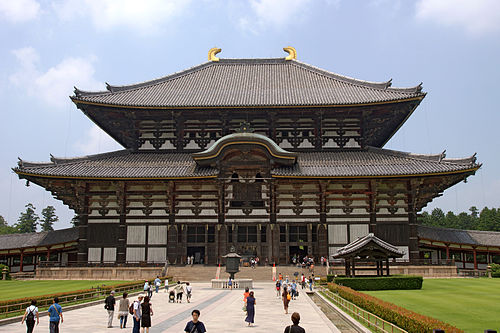
Picture Kyoto in the late sixteenth century. Toyotomi Hideyoshi has brought the country under his control, and he decides the capital needs a Great Buddha to rival the famous one at Tōdai-ji in Nara. Tradition says he boasted at the outset that he would finish in half the time it took Emperor Shōmu to complete the Great Buddha of Nara. Work began in 1588, on ground in the area where the Kyoto National Museum stands today. The project was dogged by bad luck. A great earthquake brought the work down, and fire destroyed it as well. On January 15, 1602, a fire caused by careless workmen consumed both the great Buddha image and the hall that housed it. The project was finally completed in 1612 under Hideyoshi's son, Hideyori. The story of the buildings did not end there. When Tōdai-ji's Great Buddha Hall was rebuilt, with work finishing in 1709, its design took the second Hōkō-ji hall as a model. So the Great Buddha Hall you may know in Nara carries echoes of the Kyoto one. For nearly 90 years, from 1709 until lightning burned the Kyoto Buddha and its hall in 1798, two Great Buddhas stood side by side, one in Nara and one in Kyoto. A smaller Buddha was rebuilt in 1843 and lasted until March 28, 1973, when an accidental fire destroyed it. After that, the Great Buddha vanished from Hōkō-ji.