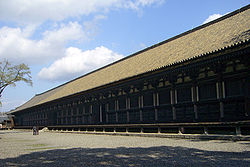
Picture Kyoto in the twelfth century. For a little over a hundred years from around 1086, a succession of emperors broke with tradition and tried to run Japan's politics and economy directly. Their trick was abdication. Once retired, they could gather enormous wealth and pursue wide-ranging political schemes. They also moved physically outside the capital's formal boundaries, building sprawling complexes that combined temples and palaces. Retired Emperor Goshirakawa, who lived from 1127 to 1192, built one of them right here. It was called Hōjūjidono, and it covered over 14 hectares, about 10 soccer fields, along Shichijō Avenue between the Kamo River and the eastern hills. When he wanted a temple within it, the warrior leader Taira no Kiyomori, who lived from 1118 to 1181, offered to help pay. The hall was completed in the Chōkan era, in 1164. The dedication fell on the seventeenth day of the twelfth month, which on our modern calendar is late January 1165. The name itself carries a message. Rengeo, Lotus King, is another name for the Thousand-Armed Kannon. Historians also read it as echoing the Lotus Sutra and the Indian ideal of a universal monarch, and see it as a signal that Goshirakawa saw himself as a transcendent Dharma Sovereign. The pattern had a precedent: Goshirakawa's father, Retired Emperor Toba, had a thousand-statue hall built in the eastern part of Kyoto with a donation from Kiyomori's father, Tadamori. Two retired emperors, two temples, both funded by the head of the Taira clan, a reminder of how the Taira rose.