Granary Burying Ground Audio Guide

Where Boston's patriots, merchants and children rest on Tremont Street

Granary Burying Ground
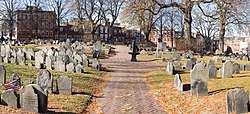
Photo by Marco Almbauer / Wikimedia Commons / CC0 1.0 · Wikimedia Commons · CC0 1.0

7 min of listening · Section 1 of 5: Welcome to Granary Burying Ground

Prefer reading? The full guide is below

Here in person? Walk on with Mappu

This audio guide tells one place’s story. Walk Mode keeps going as you walk:

  • It knows where you are and talks about what’s in front of you, not only these chapters.
  • It takes you on to the next sight and follows what interests you.
  • Ask about anything you see, and it answers on the spot.
  • Your phone stays in your pocket.

A 2-hour live walk with Mappu, €4.99.

50 credits from the Starter pack. One-time purchase, no subscription.

Self-guided audio walk. No guide accompanies you. Not affiliated with the sites.

Keep exploring

Discover more places in Mappu.

Granary Burying Ground • Section 1 of 5

Granary Burying Ground: is there a free audio guide?

Quick answer. Yes. Mappu’s Granary Burying Ground audio guide (Boston, United States) is free in your browser: 5 sections and about 7 minutes of listening, in 6 languages. It covers “A Name Borrowed from a Grain Store”, “Patriots, Judges and a Famous Family Tomb” and “Ordinary Bostonians and a Nineteenth-Century Makeover”. In the Mappu app, Walk Mode narrates the places around you as you move and answers your follow-up questions.

Granary Burying Ground map

Mappu's own map of the place, with the paths and entrances OpenStreetMap shows around it.

Granary Burying Ground mapThe place on the map, with the guide's point marked.

Granary Burying Ground: what does the audio guide cover?

  1. 01

    Welcome to Granary Burying Ground

    This section of the Mappu audio guide to the Granary Burying Ground highlights Welcome to Granary Burying Ground and points out what to notice during your visit.

    Welcome to the Granary Burying Ground, a small, tree-shaded patch of old slate and granite on Tremont Street in the heart of Boston. Step up to the fence and you are looking at the city's third-oldest cemetery, founded in 1660. It is a stop on the Freedom Trail, and it draws over one million visitors every year, which makes it the most visited historic burying ground in the Northeast. The story begins with a practical problem. King's Chapel Burying Ground, a block to the east, was Boston's first cemetery, and it was running out of room as the town grew. So town officials set aside part of what was then Boston Common as new burial space. It was first called the South Burying Ground, and later the Middle Burying Ground, once another cemetery opened. Over the next few minutes we will look at how the place got its curious name, who lies here, and how the grounds you see today were shaped by the nineteenth century. Look around as you listen. The tilted slate markers, the iron fence and the old trees all have a story to tell.

  2. 02

    A Name Borrowed from a Grain Store

    This section of the Mappu audio guide to the Granary Burying Ground highlights A Name Borrowed from a Grain Store and points out what to notice during your visit.

    Why is a cemetery named after grain? For its first decades, this ground was simply the South Burying Ground, and it was part of Boston Common. Just two years after it was established, the southwest portion of the block was taken for public buildings, including a granary and a house of correction. Then, in 1737, the burying ground took the granary's name. The building was a grain storage house that held 12,000 bushels, and it stood on the site of today's Park Street Church, right next door. The boundaries kept shifting. In 1717 the cemetery was enlarged by taking part of the highway on its eastern side, which is Tremont Street today. So the street you walked along to get here once ran through ground that later became part of the graveyard. The Common's livestock also played a part. Because the burying ground was once part of the Common, the animals that grazed there handled the landscaping of the cemetery as well. It is a very different picture from the carefully kept grounds you see now.

  3. 03

    Patriots, Judges and a Famous Family Tomb

    This section of the Mappu audio guide to the Granary Burying Ground highlights Patriots, Judges and a Famous Family Tomb and points out what to notice during your visit.

    The names buried here read like a roll call of early American history. Paul Revere rests near the back, where a large marker placed in the nineteenth century stands beside a smaller, older slate stone. In the two front corners, matching stones commemorate James Otis and Samuel Adams. Right beside the stone for Adams is the marker for the victims of the Boston Massacre. John Hancock is also buried here, and so is Christopher Seider, who is remembered as the first American casualty of the Revolution. Boston's first mayor, John Phillips, lies here too. Not every story is about revolution. Samuel Sewall, a justice on the Court of Oyer and Terminer, a figure tied to the Salem witch trials, is buried here. Benjamin Woodbridge, who died in 1728, was the victim of the first duel fought in Boston. And then there is the Franklin family tomb, where Benjamin Franklin's parents are buried. Franklin himself is not here. He moved to Philadelphia at seventeen and is buried in Christ Church Burial Ground there. Visitors often leave coins or flags by the markers of the famous, a small sign of how personal these graves still feel.

  4. 04

    Ordinary Bostonians and a Nineteenth-Century Makeover

    This section of the Mappu audio guide to the Granary Burying Ground highlights Ordinary Bostonians and a Nineteenth-Century Makeover and points out what to notice during your visit.

    For all its famous names, the Granary was never reserved for any one group. Thousands of Bostonians of all economic classes and skin colors lie within these walls. The grounds hold approximately 2,345 gravestones and tombs, yet it is estimated that over 5,000 people are buried here. That gap is one of the cemetery's quiet mysteries. Look closely and you will notice many stones for children who died of diseases we can now treat or prevent. One tomb was designated especially for children, and it held over 400 young people. The grave markers are predominantly slate, a stone that lets carvers add fine detail. The look of the place owes a lot to the mid-nineteenth century. That is when the front wall, the fence and the Egyptian gate went in, along with pedestrian walkways, shade trees and shrubbery. The granite wall, entrance gate and cast-iron fence date to 1840. The stones themselves were also rearranged into straighter rows over the years, to suit nineteenth-century taste and the modern lawnmower. So the neat rows you see may not match the original layout. A major preservation project in 2016 earned an award from the Massachusetts Historical Commission.

  5. 05

    Before You Head Off

    This section of the Mappu audio guide to the Granary Burying Ground highlights Before You Head Off and points out what to notice during your visit.

    The Granary Burying Ground has never been just a monument. It is a working piece of Boston's story, and it fills with visitors on Independence Day, when people come looking for a tangible link to the nation's founding. Some people also trade ghost stories about the place, with tales of strange lights and whispers, and that lore is part of how it is talked about today. Before you move on, try a few things. Find the Franklin Monument and read its text. Compare Paul Revere's older slate marker with the larger one beside it. Then let your eyes drift past the famous graves to the smaller stones, the ones with names you do not recognize. Those belong to the thousands of other Bostonians who made this ground their final resting place. The Freedom Trail continues from here, and King's Chapel Burying Ground, the older cemetery that made this one necessary, is only a block to the east. Walking between the two is a good way to see how a growing town kept making room for its dead.

About this guide

AI-generated from 6 sources; reviewed for accuracy and last updated on October 26, 2026. Verify tickets and opening hours on the official site.

Run a travel site or blog? Embed this audio guide for free.

Walk on from here

This place is stop 4 of 16 of a self-guided walk: Freedom Trail, Boston. About 5.8 km and 75 minutes on foot, plus about 100 minutes of listening.

Route map: walking on from Granary Burying Ground16 numbered stops in walking order. Stop 1: Boston Common; Stop 2: Massachusetts State House; Stop 3: Park Street Church; Stop 4: Granary Burying Ground; Stop 5: King's Chapel; Stop 6: Boston Latin School Site; Stop 7: Old Corner Bookstore; Stop 8: Old South Meeting House; Stop 9: Old State House; Stop 10: Boston Massacre Site; Stop 11: Freedom Trail Boston; Stop 12: Paul Revere House; Stop 13: Old North Church; Stop 14: Copp's Hill Burying Ground; Stop 15: USS Constitution; Stop 16: Bunker Hill Monument.Stop 1: Boston Common1Stop 2: Massachusetts State House2Stop 3: Park Street Church3Stop 4: Granary Burying Ground4Stop 5: King's Chapel5Stop 6: Boston Latin School Site6Stop 7: Old Corner Bookstore7Stop 8: Old South Meeting House8Stop 9: Old State House9Stop 10: Boston Massacre Site10Stop 11: Freedom Trail Boston11Stop 12: Paul Revere House12Stop 13: Old North Church13Stop 14: Copp's Hill Burying Ground14Stop 15: USS Constitution15Stop 16: Bunker Hill Monument16
Distances are estimates along the walking route, from OpenStreetMap.

Indicative route. While you walk, watch where you're going, mind the traffic and follow local signs and rules. The map is an aid, not a safety guide. Terms

  1. Boston Common

    about 0.4 km · about 5 min on foot

  2. Massachusetts State House

    about 0.3 km · about 3 min on foot

  3. Park Street Church

    about 0.1 km · about 1 min on foot

  4. Granary Burying GroundThis guide

    about 0.2 km · about 2 min on foot

  5. King's Chapel

    about 0.1 km · about 1 min on foot

  6. Boston Latin School Site

    about 0.1 km · about 1 min on foot

  7. Old Corner Bookstore

    about 0.1 km · about 1 min on foot

  8. Old South Meeting House

    about 0.2 km · about 3 min on foot

  9. Old State House

    about 0.1 km · about 1 min on foot

  10. Boston Massacre Site

    about 0.2 km · about 2 min on foot

  11. Freedom Trail Boston

    about 0.8 km · about 11 min on foot

  12. Paul Revere House

    about 0.4 km · about 6 min on foot

  13. Old North Church

    about 0.2 km · about 2 min on foot

  14. Copp's Hill Burying Ground

    about 1.4 km · about 18 min on foot

  15. USS Constitution

    about 1.4 km · about 19 min on foot

  16. Bunker Hill Monument
Photo attribution

Walk Mode, in the free Mappu app: 2 hours for 50 credits (€4.99 Starter pack)

See the whole walk

Planning a trip to Boston?

Get your plan

Mappu sketches your days free in the chat, no account needed. Then take the full plan with you:

  • Weekend trip, €9.99: Your day-by-day plan plus 2 live walks
  • Save your trip’s free guides on your phone in the Mappu app: they play with no signal
See the trip packs

Already going? The 2-hour live walk in Boston is €4.99

Plan your trip on a map and get an audio guide for almost any place nearby: just tap it on the Mappu map.

Common questions

Granary Burying Ground: how long is the free audio guide?

About 7 minutes of listening in 5 sections: “Welcome to Granary Burying Ground”, “A Name Borrowed from a Grain Store”, “Patriots, Judges and a Famous Family Tomb”, “Ordinary Bostonians and a Nineteenth-Century Makeover”, and “Before You Head Off”.

Granary Burying Ground: what can I ask Mappu after the guide?

You can ask follow-up questions such as “Why did Boston need a new burying ground in 1660, and how did King's Chapel Burying Ground fit into that story?” and keep asking in Mappu, with the guide connected to your map and trip plan.