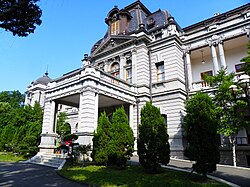
The grounds are as much a part of the national historic site as the mansion itself. Two gardens sit on opposite sides, and each follows its own tradition. At the front, the South Garden follows a formal French layout. A central fountain is encircled by symmetrical, geometrically arranged flower beds, which echo the mansion's grandeur. Behind the building lies the large North Garden, designed in the Japanese style. Its pond is shaped like the Chinese character for heart, and it is framed by trees. You will also find an odeum, a pavilion, a stone bridge with balustrades, stone tables, masonry bridges, artificial hills, waterfalls and fountains. It is a calm contrast to the busy streets outside. These quiet grounds have also seen history made. The Treaty of Taipei was signed here in 1952. Decades later, on May 14, 2009, President Ma Ying-jeou signed both the International Covenant on Civil and Political Rights and the International Covenant on Economic, Social and Cultural Rights at this same venue. A house built in 1901 has been a witness to many of Taiwan's political and cultural changes.