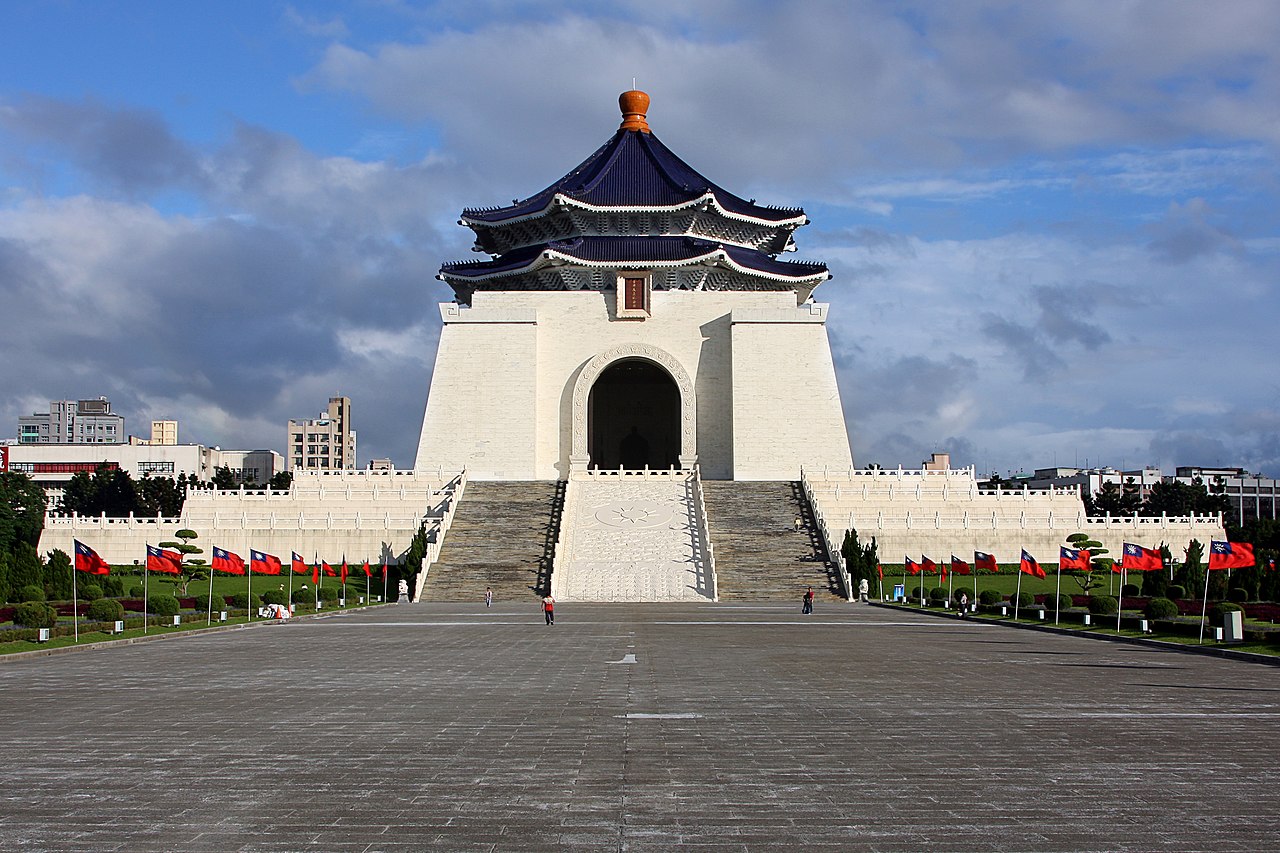
Before there was any memorial, this land belonged to soldiers. In the Qing period, a battalion stationed outside the east gate of Taipei's walled city camped around what is now the park. In the Japanese colonial era the area was called Asahi-cho. A mountain artillery base opened here in 1905, and in November 1944 an infantry regiment base followed. After 1945 those were abolished, and when the Republic of China government relocated to Taiwan in 1950, the buildings were taken down. The site then housed the army headquarters, the Combined Service Forces headquarters and the military police headquarters. At that time it was the largest military zone inside Taipei. Then came April 5, 1975, when Chiang Kai-shek died of a heart attack. The government set up a funeral committee, and on June 26 it approved a preparatory group to plan a memorial, with 16 members drawn from government and business. On July 2 the site was chosen, bounded by Hangzhou South Road, Zhongshan South Road, Aiguo East Road and Xinyi Road. Linsen South Road used to run straight through here, and it was rerouted into an underground passage to make room. The design was chosen by competition, and the winner was Yang Cho-cheng, the architect behind the Grand Hotel in Taipei. The completion ceremony took place on April 4, 1980, with more than 4,000 people attending and about 400 foreign guests. The hall opened to the public the next day, on the fifth anniversary of Chiang's death.