Presidential Office Building, Taipei Audio Guide

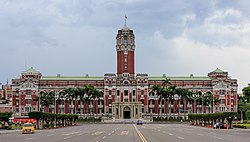
A red-and-white landmark from the Japanese colonial era, now the seat of Taiwan's presidency

Presidential Office Building
Photo by CEphoto, Uwe AranasWikimedia CommonsCC BY-SA 3.0

6 min of listening · Section 1 of 5: Welcome to the Presidential Office Building, Taipei

Prefer reading? The full guide is below

Here in person? Walk on with Mappu

This audio guide tells one place’s story. Walk Mode keeps going as you walk:

  • It knows where you are and talks about what’s in front of you, not only these chapters.
  • It takes you on to the next sight and follows what interests you.
  • Ask about anything you see, and it answers on the spot.
  • Your phone stays in your pocket.

A 2-hour live walk with Mappu, €4.99.

50 credits from the Starter pack. One-time purchase, no subscription.

Self-guided audio walk. No guide accompanies you. Not affiliated with the sites.

Keep exploring

Discover more places in Mappu.

Presidential Office Building • Section 1 of 5

Presidential Office Building: is there a free audio guide?

Quick answer. Yes. Mappu’s Presidential Office Building, Taipei audio guide (Taipei, Taiwan) is free in your browser: 5 sections and about 6 minutes of listening, in 8 languages. It covers “From Colonial Headquarters to Design Contest”, “Red Brick, Balconies and a Baroque Silhouette” and “War Damage, a New Name and a New Role”. In the Mappu app, Walk Mode narrates the places around you as you move and answers your follow-up questions.

Presidential Office Building, Taipei map

Mappu's own map of the place, with the paths and entrances OpenStreetMap shows around it.

Presidential Office Building, Taipei mapThe place on the map, with the guide's point marked.

Presidential Office Building: what does the audio guide cover?

  1. 01

    Welcome to the Presidential Office Building, Taipei

    Welcome to downtown Taipei, where one of the city's most recognizable buildings rises in front of you. Its façade is banded in red and white, and it is crowned by a tall central tower. This is the Presidential Office Building, on Chongqing South Road, Section 1. Today it is a symbol of Taiwan's central government and a famous historical landmark. But the building did not begin life as a presidential home. It was built as the headquarters of the governor-general of Taiwan, during the decades of Japanese rule. It was once the tallest building on the island. Over time it has gone from a place many older residents remember as solemn and forbidding to one that feels much more approachable. Over the next few stops, you will hear how the building came to be, why it looks the way it does, how it survived a wartime air raid, and what it has become. If you are visiting on foot, you will find it a short walk southwest of National Taiwan University Hospital Station on the Taipei Metro.

  2. 02

    From Colonial Headquarters to Design Contest

    Our story starts in 1895, when Japanese rule of Taiwan and the Pescadores began. On June 14 of that year, Governor-General Kabayama moved the seat of government to Taipei. He set up temporary headquarters in the former Qing dynasty Taiwan Provincial Administration Compound, the largest group of official buildings in the city at that time. Temporary was never meant to last. The new rulers began making long-term plans for the island, and those plans soon included a purpose-built headquarters for the governor-general. The idea of holding an architectural design contest came from Shinpei Goto, who was in charge of civil affairs at the Taiwan Governor's Office under the fourth governor. The contest ran in two stages, in 1906 and 1910. Construction began in 1912 and was completed in 1919. In those years, major public buildings were often designed with Western architectural influences, as a way of showing modernization. So when you look up at this façade, you are looking at a statement about how its builders wanted to be seen.

  3. 03

    Red Brick, Balconies and a Baroque Silhouette

    Take a moment with the façade. The building is described as Baroque in style, and its red brickwork is banded with white. Behind that brick is a steel-reinforced concrete structure. This choice was distinctive. Colonial administrative headquarters in Southeast Asia at that time often had stone exteriors, but the Governor-General's Office was clothed in red brick. In Western architectural thinking, stone stands for eternity, while brick speaks more of commerce and the Industrial Revolution. Now look at how the building responds to Taipei's climate. The east, south and west sides have balconies, to suit the subtropical heat. The north side has none, because it receives much less sunlight. It is a neat piece of design logic you can read straight off the walls. The building's height mattered too. It was once the tallest on the island of Taiwan, and even today the tower gives it a commanding presence among the streets around it.

  4. 04

    War Damage, a New Name and a New Role

    The building's story took a dramatic turn in May 1945, during the Taipei air raid. Allied forces heavily damaged it, and the front left side suffered serious harm. Yet the soundness of its construction allowed the main structure to survive. In 1946, the building was extensively renovated and renamed Chieh Shou Hall, in celebration of President Chiang Kai-shek's sixtieth birthday. After the Republic of China government relocated to Taiwan in 1949, the building officially became the Office of the President. Restoration work was eventually completed in 1961. In 1998, it was declared a national historic site and an important cultural asset. A story also circulates in Taiwan about a hidden tunnel. Former President Chen Shui-bian said that the grounds of the Shilin Official Residence hold the entrance to a tunnel connecting to this building. It is a tale told by a former president, so you can enjoy it as a piece of local lore.

  5. 05

    Before You Head Off

    In 2019, the building celebrated its hundredth birthday. These days it has acquired a sense of intimacy that older residents might not have expected. Visitors can explore areas such as the Taiwan Heritage Room, the President's Hall, the Rainbow Room and the Auditorium, which showcase Taiwan's history, culture and presidential heritage. In 2019, an unusual program even invited international guests to spend a night inside. Before you move on, notice how much sits within walking distance. The Judicial Yuan Building, 228 Memorial Park and the National Taiwan Museum are all close by. A few blocks to the west lies the lively Ximending shopping district. As you wander, see if you can spot the bands of red and white from different angles, and think about what a building like this chooses to say with its brick, its balconies and its tower.

About this guide

AI-generated from 6 sources; checked automatically and last updated on October 31, 2026. Verify tickets and opening hours on the official site. Independent guide by Mappu. Not affiliated with or endorsed by the site or its managers.

Run a travel site or blog? Embed this audio guide for free.

Walk on from here

This place is stop 4 of 5 of a self-guided walk: 228 Peace Park to Chiang Kai-shek Memorial Hall, Taipei. About 3.3 km and 45 minutes on foot, plus about 31 minutes of listening.

Route map: walking on from Presidential Office Building5 numbered stops in walking order. Stop 1: 228 Peace Memorial Park; Stop 2: National Taiwan Museum; Stop 3: Taipei Guest House; Stop 4: Presidential Office Building; Stop 5: Chiang Kai-shek Memorial Hall.Stop 1: 228 Peace Memorial Park1Stop 2: National Taiwan Museum2Stop 3: Taipei Guest House3Stop 4: Presidential Office Building4Stop 5: Chiang Kai-shek Memorial Hall5
Distances are estimates along the walking route, from OpenStreetMap.

Indicative route. While you walk, watch where you're going, mind the traffic and follow local signs and rules. The map is an aid, not a safety guide. Terms

  1. 228 Peace Memorial Park

    about 0.2 km · about 3 min on foot

  2. National Taiwan Museum

    about 0.7 km · about 9 min on foot

  3. Taipei Guest House

    about 0.8 km · about 11 min on foot

  4. Presidential Office BuildingThis guide

    about 1.6 km · about 21 min on foot

  5. Chiang Kai-shek Memorial Hall
Photo attribution

Walk Mode, in the free Mappu app: 2 hours for 50 credits (€4.99 Starter pack)

See the whole walk

Planning a trip to Taipei?

Get your plan

Mappu sketches your days free in the chat, no account needed. Then take the full plan with you:

  • Weekend trip, €9.99: Your day-by-day plan plus 2 live walks
  • Save your trip’s free guides on your phone in the Mappu app: they play with no signal
See the trip packs

Already going? The 2-hour live walk in Taipei is €4.99

Plan your trip on a map and get an audio guide for almost any place nearby: just tap it on the Mappu map.

Common questions

Presidential Office Building, Taipei: how long is the free audio guide?

About 6 minutes of listening in 5 sections: “Welcome to the Presidential Office Building, Taipei”, “From Colonial Headquarters to Design Contest”, “Red Brick, Balconies and a Baroque Silhouette”, “War Damage, a New Name and a New Role”, and “Before You Head Off”.

Presidential Office Building, Taipei: what can I ask Mappu after the guide?

You can ask follow-up questions such as “How did Taipei become the seat of government in 1895, and what happened to the Qing-era compound used as temporary headquarters?” and keep asking in Mappu, with the guide connected to your map and trip plan.