Lukang Tianhou Temple Audio Guide

Audio guide for Lukang Tianhou Temple

Lukang Matsu Temple
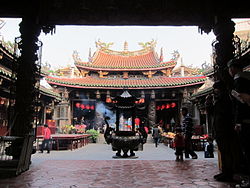
Photo by Regina800809Wikimedia CommonsCC BY-SA 3.0

6 min of listening · Section 1 of 5: Welcome to Matsu temple

Prefer reading? The full guide is below

Here in person? Walk on with Mappu

This audio guide tells one place’s story. Walk Mode keeps going as you walk:

  • It knows where you are and talks about what’s in front of you, not only these chapters.
  • It takes you on to the next sight and follows what interests you.
  • Ask about anything you see, and it answers on the spot.
  • Your phone stays in your pocket.

A 2-hour live walk with Mappu, €4.99.

50 credits from the Starter pack. One-time purchase, no subscription.

Self-guided audio walk. No guide accompanies you. Not affiliated with the sites.

Keep exploring

Discover more places in Mappu.

Lukang Matsu Temple • Section 1 of 5

Lukang Matsu Temple: is there a free audio guide?

Quick answer. Yes. Mappu’s Lukang Tianhou Temple audio guide (Lukang, Taiwan) is free in your browser: 5 sections and about 6 minutes of listening, in 8 languages. It covers “Matsu temple and the Image from Meizhou”, “Matsu temple: Canal, Land and Gratitude” and “Matsu temple: A Hall of Art”. In the Mappu app, Walk Mode narrates the places around you as you move and answers your follow-up questions.

Lukang Tianhou Temple map

Mappu's own map of the place, with the paths and entrances OpenStreetMap shows around it.

Lukang Tianhou Temple mapThe place on the map, with the guide's point marked.

Lukang Matsu Temple: what does the audio guide cover?

  1. 01

    Welcome to Matsu temple

    Welcome to Matsu temple, known locally as 鹿港天后宮, at number 430 on Zhongshan Road in the old port town of Lukang, in Changhua County, Taiwan. This is the spiritual heart of Lukang. It is dedicated to Matsu, the Heavenly Mother, protector of seafarers, and today it is a nationally designated monument. The location is part of the story. The temple stands near the northern end of the old street once known as the Street Without Sky, which is now Zhongshan Road, and it sits close to where the harbor once did its work. Matsu watches over ships, so her temple was placed where ships came and went. Its entrance faces the Taiwan Strait, and from there it looks toward the ancestral Matsu temple on Meizhou Island across the water. Over the next few stops, you will hear how a small shrine became a grand temple, how one sacred image arrived with a war fleet and stayed, and why a wall here was left deliberately unfinished. Take a slow breath, look up at the roofs, and let us begin.

  2. 02

    Matsu temple and the Image from Meizhou

    The story of Matsu temple begins before the grand halls you see today. The earliest temple stood a little to the north of this site, near an old place name, Chuanzaitou, in what is now the area of Santiao Lane. Matsu was already one of the guardian deities of the early settlers from Fujian. Then came 1683. When General Shi Lang campaigned to bring Taiwan under Qing control, an image of the founding Matsu of Meizhou crossed the strait with his troops. When the army prepared to return, his relatives Shi Qibing and Shi Shibang asked to keep the image in Lukang so that local people could worship it. It stayed. Over the years incense smoke darkened its face, which is why it is affectionately called the Black-faced Matsu. That image made this temple a major center in Taiwan for the worship of the founding Matsu of Meizhou. Pilgrims traveled long distances to pray here, and incense burned ever more heavily. Many other Matsu temples across Taiwan trace their lineage to this one, including temples in Puli, Xihu, Qishan and Banqiao.

  3. 03

    Matsu temple: Canal, Land and Gratitude

    Why is the temple standing here and not further north? The answer involves irrigation. In 1709 the gentleman Shi Shibang began building a canal called the Shi family canal, later known as the Bazhen Canal. It took 10 years to complete. Once water reached the Changhua Plain, large numbers of migrants arrived to farm, and Lukang grew into an important port town for them. In 1725 Shi Shibang donated land, and the Matsu temple was moved to its present site. The people of Lukang did not forget him. Inside the temple, in the right-hand corridor, a longevity tablet honors him, and it records his titles and his role as the great patron of the temple. The temple was repaired again and again. By 1814 the old temple was falling into ruin, and merchant guilds from Quanzhou, Xiamen and elsewhere, together with local gentry, donated funds. The work was completed in March of 1815. A stone tablet from that restoration still stands in the temple and is a precious record of those efforts. Further rebuilding followed in 1874 and in the 1930s.

  4. 04

    Matsu temple: A Hall of Art

    Matsu temple is often called a palace of art. It is a typical medium-sized Taiwanese temple, yet it pushes building skill and the competitive spirit of master craftsmen to the limit. Its present form was largely shaped when 96 local figures formed a rebuilding committee and raised funds, with the master carpenter Haitong leading construction. In the early 1930s the front Sanchuan Hall was restored under Wang Yishun, who gathered leading painters, woodcarvers and stone carvers. The work took 10 years and was finished in 1936. Look for the three-hall, two-courtyard layout: the Sanchuan Hall, the main hall and the rear hall, which was rebuilt in 1971. The roofs are double-eaved, and the projecting eaves rest on interlocking wooden brackets that spread the weight and let the roof reach far outward. In the main hall, two fierce guardians flank Matsu: Thousand-Li Eye and Wind-Accompanying Ear. They were sculpted by the Quanzhou master Lian Yongchuan. Their blue faces and fangs are meant to drive away evil. Then look at the brick wall of the main hall. Construction holes were left open there, since the completion ritual was never held, as a sign that the temple is not yet finished.

  5. 05

    Before You Head Off

    Before you go, remember the layers you have just walked through: a harbor shrine, a sacred image from Meizhou, a canal that changed the plain, and craftsmen who competed to make each beam and carving remarkable. The temple was named a third-class monument in 1985 and was raised to national monument in 2019. A few practical things are worth knowing. The temple has no dedicated guides, but brochures are available at the incense counter in the Sanchuan Hall and in the reception room. Behind the right-hand side chamber, you can also find a display of cultural and creative products connected with the temple. As you leave, try a small game. Face the entrance and remember that the temple looks out toward the strait and Meizhou beyond. Then look back at the roofs, the guardians' faces and the unfinished wall. See how many of today's stories you can match to what is in front of you. The rest of Zhongshan Road has more to show you.

About this guide

AI-generated from 6 sources; checked automatically and last updated on October 31, 2026. Verify tickets and opening hours on the official site. Independent guide by Mappu. Not affiliated with or endorsed by the site or its managers.

Run a travel site or blog? Embed this audio guide for free.

Walk on from here

The nearest places with a Mappu audio guide, in walking order: about 1.9 km and 25 minutes on foot in all.

Route map: walking on from Lukang Matsu Temple5 numbered stops in walking order. Stop 1: Lukang Matsu Temple; Stop 2: Lukang Folk Arts Museum; Stop 3: Lukang Xingan Temple; Stop 4: Lukang Longshan Temple; Stop 5: Lukang Dicangwang Temple.Stop 1: Lukang Matsu Temple1Stop 2: Lukang Folk Arts Museum2Stop 3: Lukang Xingan Temple3Stop 4: Lukang Longshan Temple4Stop 5: Lukang Dicangwang Temple5
Distances are estimates: the straight line between places plus 30%.

Indicative route. While you walk, watch where you're going, mind the traffic and follow local signs and rules. The map is an aid, not a safety guide. Terms

  1. Lukang Matsu TempleThis guide

    about 1.0 km · about 13 min on foot

  2. Lukang Folk Arts Museum

    about 0.2 km · about 3 min on foot

  3. Lukang Xingan Temple

    about 0.3 km · about 4 min on foot

  4. Lukang Longshan Temple

    about 0.4 km · about 5 min on foot

  5. Lukang Dicangwang Temple
Photo attribution

Walk Mode, in the free Mappu app: 2 hours for 50 credits (€4.99 Starter pack)

Planning a trip to Lukang?

Get your plan

Mappu sketches your days free in the chat, no account needed. Then take the full plan with you:

  • Weekend trip, €9.99: Your day-by-day plan plus 2 live walks
  • Save your trip’s free guides on your phone in the Mappu app: they play with no signal
See the trip packs

Already going? The 2-hour live walk in Lukang is €4.99

Plan your trip on a map and get an audio guide for almost any place nearby: just tap it on the Mappu map.

Common questions

Lukang Tianhou Temple: how long is the free audio guide?

About 6 minutes of listening in 5 sections: “Welcome to Matsu temple”, “Matsu temple and the Image from Meizhou”, “Matsu temple: Canal, Land and Gratitude”, “Matsu temple: A Hall of Art”, and “Before You Head Off”.

Lukang Tianhou Temple: what can I ask Mappu after the guide?

You can ask follow-up questions such as “How did the image of Matsu from Meizhou come to stay in Lukang after 1683?” and keep asking in Mappu, with the guide connected to your map and trip plan.