


Zōjō-ji: how long is the free audio guide?
About 6 minutes of listening in 5 sections: “Welcome to Zōjōji”, “Zōjōji and the Tokugawa Shoguns”, “A Temple City at Its Height: Zōjōji”, “Survivors and Losses at Zōjōji”, and “Before You Head Off”.
Audio guide for Zōjō-ji

Quick answer. Yes. Mappu’s Zōjō-ji audio guide (Tokyo, Japan) is free in your browser: 5 sections and about 6 minutes of listening, in 8 languages. It covers “Zōjōji and the Tokugawa Shoguns”, “A Temple City at Its Height: Zōjōji” and “Survivors and Losses at Zōjōji”. In the Mappu app, Walk Mode narrates the places around you as you move and answers your follow-up questions.
Mappu's own map of the place, with the paths and entrances OpenStreetMap shows around it.
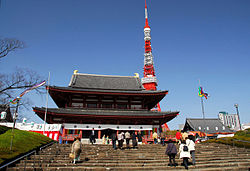
Welcome to Zōjōji, written 増上寺 in Japanese, a Buddhist temple in the Shiba neighborhood of Minato, Tokyo. It belongs to the Jōdo-shū, the Pure Land school of Buddhism, and it is the main temple of the Chinzei branch of that school in the Kantō region. Its mountain name, the poetic title temples traditionally carry, is San'en-zan. The setting is part of the surprise. Shiba Park has been built around the temple, and Tokyo Tower rises right beside it. So you can stand among temple roofs and look up at a red-and-white broadcasting tower, with centuries of Tokyo history framed in one view. The temple has a special bond with the Tokugawa family, the clan whose shoguns ruled Japan from 1603 to 1867. In the next few minutes we will follow that bond: how the temple grew into a giant, what survives from its great age, and why many people today know it as a temple of victory.
Zōjōji was founded in 1393, back when Edo, the future Tokyo, was still a small village. The temple stood just southwest of Edo Castle, on the site of today's Imperial Palace. Then history turned. In 1590 the warlord Tokugawa Ieyasu made Edo his base. He went on to found the shogunate that governed Japan from 1603 to 1867, and his castle became its military heart. In 1598 the temple moved to its present location, and under Ieyasu's patronage it grew ever more influential and prosperous. When Ieyasu died in 1616, his funeral was held at Zōjōji. His body was buried elsewhere, but the Tokugawa family kept supporting the temple long afterward. That loyalty shaped the grounds. Elaborate mausoleums here held six of the Tokugawa shoguns, along with other members of the family. Zōjōji was not just a place of prayer. It was woven into the way the ruling family honored its dead.
Picture Zōjōji in its prime. It is the head temple of the Jōdo-shū school in eastern Japan, and within the school it ranks in importance just after Chion-in in Kyoto. At its peak, nothing in eastern Japan matched it for scale. The grounds covered more than 82 hectares and held 48 sub-temples. Around 3,000 monks trained and worked here. The gates, halls and mausoleums were some of the finest showcases of Edo craftsmanship. It was less a single temple than a whole religious town. Time was not kind to that world. After the Tokugawa shogunate ended in 1867, the anti-Buddhist movement of the 1870s brought hard times. Many buildings were burned, and part of the grounds was turned into a park. That is the origin of the green space you see around the temple today.
The greatest disaster in the temple's history came in 1945, when the Tokyo air raids burned most of its important buildings. Among the losses were the Taitoku-in Mausoleum of Hidetada, with the monument to his wife Sūgen'in, and the mausoleums of Ienobu and Ietsugu. All of them had been designated National Treasures of Japan. Today, parts of two of the graves are Important Cultural Properties. One structure came through the war. It is the main gate, the Sangedatsumon, a two-storied gate 21 meters, or 69 feet, tall. It was built in 1622, which makes it the oldest wooden building in Tokyo, and it is the temple's only original structure to survive the Second World War. It is an Important Cultural Property. When you pass beneath it, you are walking through the early years of the Tokugawa age. The lost mausoleums are not forgotten. In April 2015, a Treasures Gallery opened on the first basement floor of the main hall, marking 400 years since Tokugawa Ieyasu's death. Its centerpiece is a one-tenth scale architectural model of the Daitokuin Mausoleum, which once stood on the right side of the grounds, near the Tokyo Prince Hotel.
There is one more side of Zōjōji, and it is a living one. The temple was founded in 1393 and has about 600 years of history. Today it is well loved as a temple of victory, because it enshrines the Black Honzon, a hidden Buddha image connected with Tokugawa Ieyasu. As you wander, try holding two timelines in your mind. One is the shogun's world of grand mausoleums and thousands of monks. The other is modern Tokyo, with Tokyo Tower rising beside the temple and the park spreading around it. Look at the old main gate, then lift your eyes to the tower, and ask yourself what each one has watched over. If you have time, think about the empty places too. A model of a vanished mausoleum, a park that was once temple ground, a gate that outlived a war. Each one has a story waiting for you to notice it.
AI-generated from 6 sources; checked automatically and last updated on October 31, 2026. Verify tickets and opening hours on the official site. Independent guide by Mappu. Not affiliated with or endorsed by the site or its managers.
This place is stop 2 of 4 of a self-guided walk: Tokyo Tower to Shiodome, Tokyo. About 2.9 km and 40 minutes on foot, plus about 23 minutes of listening.
Indicative route. While you walk, watch where you're going, mind the traffic and follow local signs and rules. The map is an aid, not a safety guide. Terms
 Tokyo Tower
about 0.5 km · about 7 min on foot
Zōjō-jiThis guide
about 1.2 km · about 16 min on foot
 Kyu Shiba Rikyu Garden
about 1.2 km · about 16 min on foot
 Ni-Tele Really Big Clock
Walk Mode, in the free Mappu app: 2 hours for 50 credits (€4.99 Starter pack)
Planning a trip to Tokyo?
Mappu sketches your days free in the chat, no account needed. Then take the full plan with you:
 Tokyo Tower Tokyo
 Atago Shrine Tokyo
 Kyu Shiba Rikyu Garden Tokyo
 Ni-Tele Really Big Clock Tokyo
 Zenpuku-ji Tokyo
 Hikawa-jinja Tokyo
Plan your trip on a map and get an audio guide for almost any place nearby: just tap it on the Mappu map.
About 6 minutes of listening in 5 sections: “Welcome to Zōjōji”, “Zōjōji and the Tokugawa Shoguns”, “A Temple City at Its Height: Zōjōji”, “Survivors and Losses at Zōjōji”, and “Before You Head Off”.
You can ask follow-up questions such as “How did Tokugawa Ieyasu's move to Edo change the fortunes of Zōjōji?” and keep asking in Mappu, with the guide connected to your map and trip plan.