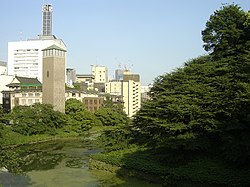
Before you go, remember that this is a museum as well as a building. It holds three major exhibitions a year, and each has a theme in modern art from the late nineteenth century to the early twentieth century. Alongside them run three smaller shows, drawn mainly from the museum's own collection and shaped by what interests its curators. If you step into the history room, you will find a recreated Meiji-era office with plaster walls and a wooden coffered ceiling. The furniture follows the tradition of Shiba furniture, made in the area near today's Shimbashi Station, where Conder supported local craftsmen. There is also a model of the original building at one-fortieth scale, and in it, on the wall of the bank's main hall, hangs an Okame mask linked to Iwasaki Yataro. A timeline also shows how Marunouchi developed, from the early Edo period to the present. In December 2024, the Chiyoda city government designated the building an Important Landscape and Townscape Property. Take a last look at the brick, the roofs and the towers rising behind them, and see how the old and the new have learned to share one corner of Tokyo.