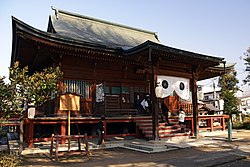
The treasures here include a tall standing Sho Kannon, about 2 meters high, carved in the twelfth century, in the Heian period, from cypress wood, and it is a national Important Cultural Property. Tradition attributes it to a Kasuga sculptor and says it was the main image of the old Hida provincial nunnery. That nunnery declined toward the end of the Heian period, and its site is now the Tsujigamori Sansha shrines in Okamoto-machi. Tradition holds that the priest Genkai brought the statue here in the Tensho era, between 1573 and 1592. Its original paint is thought to have been colorful, though it has now flaked away. There is also a wooden Benzaiten by the monk-sculptor Enku, about 1 meter tall, from the Edo period. Enku lived from 1632 to 1695 and is said to have carved 120,000 statues in his lifetime, using a bold, hatchet-hewn style called natabori. He stayed in Hida around 1685. A six-armed Nyoirin Kannon in a pensive pose, said to have come from a former temple whose site is now Hida Toshogu, rounds out the group. Outside, look for the great ginkgo, estimated at 1250 years old, with a trunk 10 meters around and a height of 28 meters. Since ancient times it has been called the milk ginkgo. And one tradition says that when Takayama Castle was dismantled in 1695, part of it was moved here and used for the bell tower gate.