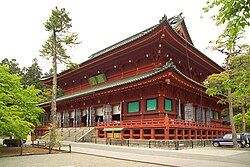
At the spiritual heart of Rinnō Temple Complex is the Three Buddha Hall, known in Japanese as Sanbutsudō. Inside are gold-leafed wooden statues of three figures: Amida, Senju Kannon, the Kannon with a thousand arms, and Batō Kannon, the Kannon with a horse's head. They are the three Buddhas that form the foundation of worship at Nikko. Here is the clever part. These Buddhist figures are considered manifestations of Nikko's three mountain kami, the native deities enshrined at Futarasan Shrine. In other words, the mountains behind you are honored twice, as Shinto deities at one place and as Buddhas at another. Rinnō Temple Complex enshrines the three Buddhas of the mountains behind it, so you are looking at a mountain faith expressed in gold. The temple's reach goes beyond this one hall. Many of Nikko's grand and important treasures belong to Rinnō Temple Complex, and in all, 37 other structures in the complex are designated as Important Cultural Properties. Among its holdings is Daiyūin, the lavish final resting place of the third shogun, Tokugawa Iemitsu, who lived from 1604 to 1651. Like neighboring Toshogu Shrine, the temple is distinguished by elaborate, gilded carvings.