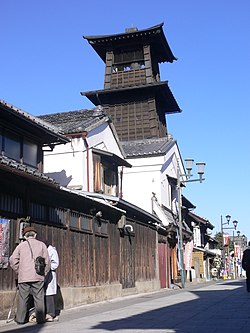
The story turns in 1590, when Toyotomi Hideyoshi, the warrior who unified Japan, conquered the Kanto region. He took Kawagoe Castle as part of that campaign. He then ordered Tokugawa Ieyasu, his retainer, to rule the Kanto. Ieyasu went on to found the Tokugawa shogunate in 1603, and the Edo period that followed lasted until 1867. Edo, which is modern Tokyo, grew into the center of power, and Kawagoe lay to its north as a castle town and a vital link in the chain of trade. Goods bound for Edo travelled along the Kawagoe-kaido highway, so a fortress that had once defended against northern attackers now watched over a busy trade route. That wealth shaped the town you see today. Merchants built more than two hundred two-storied kurazukuri warehouses, with thick earthen walls designed to resist fire, to store the goods passing through. Some of these ornate storehouses still stand, and they are the reason Kawagoe earned the nickname Little Edo. The castle and the warehouse district are two halves of one story: the lord's power and the merchants' prosperity.