Tamaudun Audio Guide

The stone royal mausoleum of the Ryukyu Kingdom in Shuri

Tamaudun
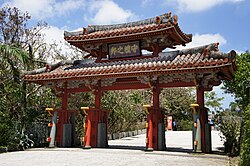
Photo by 663highlandWikimedia CommonsCC BY 2.5

6 min of listening · Section 1 of 5: Welcome to Tamaudun

Prefer reading? The full guide is below

Here in person? Walk on with Mappu

This audio guide tells one place’s story. Walk Mode keeps going as you walk:

  • It knows where you are and talks about what’s in front of you, not only these chapters.
  • It takes you on to the next sight and follows what interests you.
  • Ask about anything you see, and it answers on the spot.
  • Your phone stays in your pocket.

A 2-hour live walk with Mappu, €4.99.

50 credits from the Starter pack. One-time purchase, no subscription.

Self-guided audio walk. No guide accompanies you. Not affiliated with the sites.

Keep exploring

Discover more places in Mappu.

Tamaudun • Section 1 of 5

Tamaudun: is there a free audio guide?

Quick answer. Yes. Mappu’s Tamaudun audio guide (Naha, Japan) is free in your browser: 5 sections and about 6 minutes of listening, in 8 languages. It covers “A Palace Carved in Stone at Tamaudun”, “Who Rests in Tamaudun, and Who Does Not” and “From Wartime Damage to World Heritage”. In the Mappu app, Walk Mode narrates the places around you as you move and answers your follow-up questions.

Tamaudun map

Mappu's own map of the place, with the paths and entrances OpenStreetMap shows around it.

Tamaudun mapThe place on the map, with the guide's point marked.

Tamaudun: what does the audio guide cover?

  1. 01

    Welcome to Tamaudun

    Welcome to Tamaudun, known in Japanese as 玉陵, the royal mausoleum of the Ryukyu Kingdom. It sits in the Shuri district of Naha, just a short walk from the hill where Shuri Castle once ruled the island. Slow down as you arrive. This is a place of quiet, built for remembering rather than for show. Here is the big picture. In 1501, King Shō Shin built Tamaudun to rebury the remains of his father, King Shō En. From then on it became the tomb of the Second Shō dynasty, the royal line that governed the Ryukyu Kingdom. Today the whole site is a national historic site and part of a World Heritage listing, and its main structures are designated national treasures. Over the next few minutes we will look at how the tomb was designed, who was laid to rest here and who was left out, and how a place so heavily damaged in the Battle of Okinawa came back to life. Keep your eyes on the stone. It was shaped to imitate something far more fragile.

  2. 02

    A Palace Carved in Stone at Tamaudun

    Look at the overall shape of Tamaudun. The whole structure is a stone building that represents the palace of its day, which had a roof of wooden planks. In other words, the builders took a royal residence and translated it into stone, so that the king could keep a palace even after death. It is the largest tomb of its gabled style in Okinawa Prefecture. The burial chambers are laid out in three connected rooms, and each room has its own purpose. The middle room is where a body was placed before the bones were washed, a traditional funerary custom in the Ryukyu Islands. After the washing, kings and queens were laid to rest in the east room. The west room was for a limited circle of family members, named on the stele standing in the courtyard in front of the tomb. Watch for the stone lion carvings. They are protected as prefectural cultural property, along with the stele. Guardian lions are a familiar sight across Okinawa, and here they serve the royal dead. The stone walls that enclose the tomb are protected too: the three chambers and the two stone walls together make up the five structures that carry national treasure status.

  3. 03

    Who Rests in Tamaudun, and Who Does Not

    Tamaudun is the resting place of the kings and queens of the Second Shō dynasty, with only a few exceptions. It began with King Shō En, whose remains were brought here by his son King Shō Shin, the third king of the line, who reigned from 1477 to 1527. Shō Shin's own reign is remembered as one of the most powerful of the kingdom. The stele in the courtyard set out which family members were allowed to be buried here, and it makes the tomb as much a statement of royal order as a place of mourning. Yet the rules did not always hold. Shō Shin's son and successor, King Shō Sei, soon after taking the throne moved his disinherited elder brother, Shō Ikō, also known as Prince Chōman of Urasoe, into Tamaudun, going against what the inscription laid down. Two kings are not buried here at all. The second king, Shō Sen'i, is traditionally said to lie elsewhere in what is now Okinawa City. The seventh king, Shō Nei, rests at Urasoe Yodore in Urasoe. And the name is not unique: there are two other tombs called Tamaudun, one on Izena Island and one in Yamakawa, so this Shuri tomb is the royal one you have come to see.

  4. 04

    From Wartime Damage to World Heritage

    What you see today is a restored monument. Tamaudun suffered heavy damage in the Battle of Okinawa, and was then repaired through restoration work that returned it to its former appearance. That recovery is part of its story as much as the 1501 founding. The modern chapter has some notable milestones. In 1992 the site was donated to Naha City by Shō Hiroshi, a descendant of the royal family. In 2000 it was inscribed on the World Heritage List as part of the Gusuku Sites and Related Properties of the Kingdom of Ryukyu. The tomb as a whole is a national historic site, and its five main structures are national treasures. There is also an exhibition space on the grounds, the Hōenkan, where displays and models explain the history of the Ryukyu Kingdom and the architectural value of the tomb. It is a good place to deepen what you have seen outside.

  5. 05

    Before You Head Off

    As you linger at Tamaudun, try reading the site as a story told in three chambers: one for waiting, one for royalty, and one for a chosen family. Then look back at the stele and ask what it was meant to protect, and why it was not always obeyed. Tamaudun is also an easy neighbor to Shuri Castle, so it is worth thinking of the two together: the palace where the kings governed and the stone house where they came to rest. Notice how the tomb echoes the palace in its form. Take your time with the details, the lions, the walls and the stillness of the courtyard. There is more to discover here than a single visit can hold.

About this guide

AI-generated from 6 sources; reviewed for accuracy and last updated on October 31, 2026. Verify tickets and opening hours on the official site. Independent guide by Mappu. Not affiliated with or endorsed by the site or its managers.

Run a travel site or blog? Embed this audio guide for free.

Walk on from here

This place is stop 3 of 3 of a self-guided walk: Shuri Castle to Tamaudun, Naha. About 0.8 km and 10 minutes on foot, plus about 18 minutes of listening.

Route map: walking on from Tamaudun3 numbered stops in walking order. Stop 1: Shuri Castle; Stop 2: Shureimon; Stop 3: Tamaudun.Stop 1: Shuri Castle1Stop 2: Shureimon2Stop 3: Tamaudun3
Distances are estimates along the walking route, from OpenStreetMap.

Indicative route. While you walk, watch where you're going, mind the traffic and follow local signs and rules. The map is an aid, not a safety guide. Terms

  1. Shuri Castle

    about 0.3 km · about 4 min on foot

  2. Shureimon

    about 0.5 km · about 6 min on foot

  3. TamaudunThis guide

Photo attribution

Walk Mode, in the free Mappu app: 2 hours for 50 credits (€4.99 Starter pack)

See the whole walk

Planning a trip to Naha?

Get your plan

Mappu sketches your days free in the chat, no account needed. Then take the full plan with you:

  • Weekend trip, €9.99: Your day-by-day plan plus 2 live walks
  • Save your trip’s free guides on your phone in the Mappu app: they play with no signal
See the trip packs

Already going? The 2-hour live walk in Naha is €4.99

Plan your trip on a map and get an audio guide for almost any place nearby: just tap it on the Mappu map.

Common questions

Tamaudun: how long is the free audio guide?

About 6 minutes of listening in 5 sections: “Welcome to Tamaudun”, “A Palace Carved in Stone at Tamaudun”, “Who Rests in Tamaudun, and Who Does Not”, “From Wartime Damage to World Heritage”, and “Before You Head Off”.

Tamaudun: what can I ask Mappu after the guide?

You can ask follow-up questions such as “What was the purpose of each of the three chambers at Tamaudun, and how does the custom of bone washing fit in?” and keep asking in Mappu, with the guide connected to your map and trip plan.