Ayutthaya Historical Park Audio Guide

The Splendor of the Second Siamese Capital

Ayutthaya Historical Park
Photo by Rangan Datta WikiWikimedia CommonsCC BY-SA 4.0

7 min of listening · Section 1 of 5: Welcome to the Island City

Prefer reading? The full guide is below

Here in person? Walk on with Mappu

This audio guide tells one place’s story. Walk Mode keeps going as you walk:

  • It knows where you are and talks about what’s in front of you, not only these chapters.
  • It takes you on to the next sight and follows what interests you.
  • Ask about anything you see, and it answers on the spot.
  • Your phone stays in your pocket.

A 2-hour live walk with Mappu, €4.99.

50 credits from the Starter pack. One-time purchase, no subscription.

Self-guided audio walk. No guide accompanies you. Not affiliated with the sites.

Keep exploring

Discover more places in Mappu.

Ayutthaya Historical Park • Section 1 of 5

Ayutthaya Historical Park: is there a free audio guide?

Quick answer. Yes. Mappu’s Ayutthaya Historical Park audio guide (Ayutthaya, Thailand) is free in your browser: 5 sections and about 7 minutes of listening, in 8 languages. It covers “The Royal Heart: Wat Phra Si Sanphet”, “Nature’s Embrace: The Great Relic of Wat Mahathat” and “Riverside Grandeur: Wat Chaiwatthanaram”. In the Mappu app, Walk Mode narrates the places around you as you move and answers your follow-up questions.

Ayutthaya Historical Park map

Mappu's own map of the place, with the paths and entrances OpenStreetMap shows around it.

Ayutthaya Historical Park mapThe place on the map, with the guide's point marked.

Ayutthaya Historical Park: what does the audio guide cover?

  1. 01

    Welcome to the Island City

    Welcome to Ayutthaya Historical Park. You are standing within the remains of one of the world’s greatest cosmopolitan cities of the fourteenth to eighteenth centuries. Founded in 1351 by King Ramathibodi the First, this city served as the second capital of the Siamese Kingdom for 417 years. As you begin your journey, look around and imagine the landscape as it once was: a thriving island metropolis at the confluence of three major rivers—the Chao Phraya, the Pa Sak, and the Lop Buri. These waterways provided a natural defense and turned Ayutthaya into a global hub for diplomacy and commerce, connecting the kingdom to the rest of the world. In 1991, UNESCO recognized the immense historical value of these ruins, naming them a World Heritage Site. The brick foundations and soaring towers you see today are the survivors of a golden age that was abruptly halted by a Burmese invasion in 1767. Today, we invite you to step into the footprints of kings and traders as we explore the heart of this ancient empire.

  2. 02

    The Royal Heart: Wat Phra Si Sanphet

    Our first major stop is Wat Phra Si Sanphet, widely considered the holiest and most significant temple of the Ayutthaya period. This was the equivalent of Bangkok’s Temple of the Emerald Buddha, but with a unique twist: it was located within the royal palace grounds and had no resident monks. Instead, it was used exclusively for royal ceremonies and to house the remains of the monarchy. The three iconic bell-shaped towers, or chedis, that dominate the skyline here are the final resting places for three Ayutthayan kings: King Borommatrailokkanat, King Ramathibodi the Second, and King Borommaracha the Fourth. Once, a massive bronze Buddha statue covered in more than 300 kilograms of gold stood here, known as the Phra Si Sanphetdayan. Sadly, during the invasion of 1767, the golden skin was melted down by invaders, leaving only the stone and brick skeletons you see today. As you walk among these foundations, notice the symmetry and scale, which served as the primary model for the urban planning of modern-day Bangkok.

  3. 03

    Nature’s Embrace: The Great Relic of Wat Mahathat

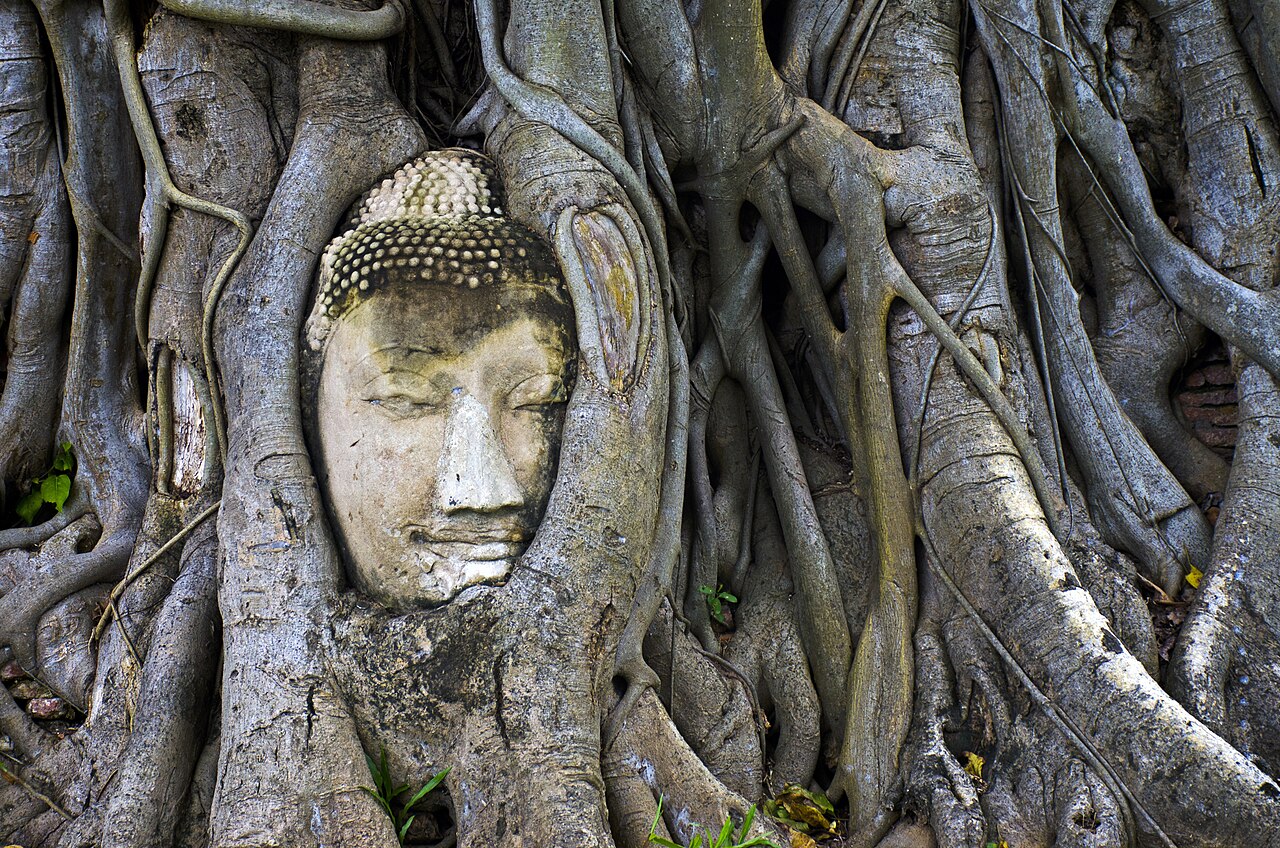
    Next, we move to Wat Mahathat, the ‘Temple of the Great Relic,’ which served as the spiritual center of the kingdom and the seat of the Supreme Patriarch. While the temple was once home to a forty-three-meter-high Khmer-style tower, it is now most famous for one of the most photographed sights in Thailand: a sandstone Buddha head entwined in the roots of a Bodhi tree. Local tradition and historical research suggest that after the city fell in 1767, many statues were defaced and abandoned. Over the decades and centuries of abandonment, a Bodhi tree grew around one of these fallen heads, slowly lifting it from the earth and cradling it in its roots. This image has become a powerful symbol of nature reclaiming the spiritual, and of resilience in the face of destruction. For a practical tip, when you take photos here, it is essential to show respect: visitors are asked to keep their own heads lower than the Buddha’s head, often by kneeling down. Take a moment to feel the serenity of this spot, where history and the natural world have become inextricably linked.

  4. 04

    Riverside Grandeur: Wat Chaiwatthanaram

    To see the pinnacle of late Ayutthaya architecture, we look to Wat Chaiwatthanaram, located on the west bank of the Chao Phraya River. Built in 1630 by King Prasat Thong, its design is heavily influenced by Khmer architecture, featuring a massive central prang, or corn-cob shaped tower, surrounded by smaller ones. The layout represents the Buddhist and Hindu cosmology, with the central tower symbolizing Mount Meru, the center of the universe. This temple is particularly famous for its breathtaking views at sunset, when the red brick glows under the golden light of the fading sun. Before you enter, please keep in mind a vital etiquette tip: like most sacred sites in Thailand, a modest dress code is strictly enforced. Your shoulders and knees must be covered, so consider carrying a light sarong or wearing long linen pants to stay cool in the tropical heat. The entrance fee is fifty Thai Baht for international visitors, a small price to pay to witness what many consider the most photogenic temple in the historical park.

  5. 05

    The Enduring Spirit of Ayutthaya

    As our tour through the central park concludes, the story of Ayutthaya is far from over. After the final fall of the city in 1767, the capital was moved south, eventually becoming the Bangkok we know today. But the spirit of Ayutthaya lives on in the traditions, the food, and the architecture of modern Thailand. Beyond these main temples, hundreds of smaller ruins are scattered across the surrounding plains and along the riverbanks, many of which are rarely visited by large crowds. You might consider renting a bicycle for about fifty Thai Baht or taking a long-tail boat trip around the island to see the city from the water, just as the kings did centuries ago. What else lies hidden beneath the lush greenery? What other stories are waiting to be told by the silent stone statues? We invite you to continue your exploration, perhaps following the canals to the Japanese or Dutch quarters, to fully understand why this city was once called the ‘Venice of the East’. Let your curiosity guide you further into the mysteries of the Siamese past.

About this guide

AI-generated from 12 sources; checked automatically and last updated on June 3, 2026. Verify tickets and opening hours on the official site. Independent guide by Mappu. Not affiliated with or endorsed by the site or its managers.

Run a travel site or blog? Embed this audio guide for free.

Planning a trip to Ayutthaya?

Get your plan

Mappu sketches your days free in the chat, no account needed. Then take the full plan with you:

  • Weekend trip, €9.99: Your day-by-day plan plus 2 live walks
  • Save your trip’s free guides on your phone in the Mappu app: they play with no signal
See the trip packs

Already going? The 2-hour live walk in Ayutthaya is €4.99

Useful for your visit

Tickets, tours and practical extras for this trip, from Mappu's partners.

Partner links (Airalo, Amazon, Booking.com, GetYourGuide, Klook, Tiqets, Trip.com, Viator, Welcome Pickups): if you book or buy through them, Mappu may earn a commission, at no extra cost to you.

Plan your trip on a map and get an audio guide for almost any place nearby: just tap it on the Mappu map.

Common questions

Ayutthaya Historical Park: how long is the free audio guide?

About 7 minutes of listening in 5 sections: “Welcome to the Island City”, “The Royal Heart: Wat Phra Si Sanphet”, “Nature’s Embrace: The Great Relic of Wat Mahathat”, “Riverside Grandeur: Wat Chaiwatthanaram”, and “The Enduring Spirit of Ayutthaya”.

Ayutthaya Historical Park: what can I ask Mappu after the guide?

You can ask follow-up questions such as “What was the strategic reason behind founding Ayutthaya on an island?” and keep asking in Mappu, with the guide connected to your map and trip plan.
