St Martin's Church Audio Guide

Colmar's Gothic collegiate church

St Martin's Church
Photo by Eric Gaba / Wikimedia Commons / CC BY-SA 3.0 · Wikimedia Commons · CC BY-SA 3.0

6 min of listening · Section 1 of 5: Welcome to St Martin's Church

Prefer reading? The full guide is below

Here in person? Walk on with Mappu

This audio guide tells one place’s story. Walk Mode keeps going as you walk:

  • It knows where you are and talks about what’s in front of you, not only these chapters.
  • It takes you on to the next sight and follows what interests you.
  • Ask about anything you see, and it answers on the spot.
  • Your phone stays in your pocket.

A 2-hour live walk with Mappu, €4.99.

50 credits from the Starter pack. One-time purchase, no subscription.

Self-guided audio walk. No guide accompanies you. Not affiliated with the sites.

Keep exploring

Discover more places in Mappu.

St Martin's Church • Section 1 of 5

St Martin's Church: is there a free audio guide?

Quick answer. Yes. Mappu’s St Martin's Church audio guide (Colmar, France) is free in your browser: 5 sections and about 6 minutes of listening, in 6 languages. It covers “From Carolingian Foundations to a Collegiate Church”, “Reading the Gothic Exterior” and “Fire, Revolution and Restoration”. In the Mappu app, Walk Mode narrates the places around you as you move and answers your follow-up questions.

St Martin's Church map

Mappu's own map of the place, with the paths and entrances OpenStreetMap shows around it.

St Martin's Church mapThe place on the map, with the guide's point marked.

St Martin's Church: what does the audio guide cover?

  1. 01

    Welcome to St Martin's Church

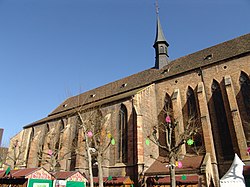
    Welcome to Colmar, and to the church that dominates its old town: Saint Martin's, the largest church in the city. It is a Roman Catholic church in the Haut-Rhin, built in the Gothic style. As you look up at it, you will notice a tower crowned with a distinctive helmet, and roofs covered in coloured tiles that give the whole building a very Alsatian look. You will hear it called by three names. Officially it is the Église Saint-Martin, Saint Martin's Church. Because it once belonged to a college of canons, it is also the Collégiale Saint-Martin. And because of its sheer size, many people call it the Cathédrale Saint-Martin, even though Colmar has never been the seat of a bishop. Locals long thought of it as their cathedral, and that habit has stuck. Over the next few minutes we will dig down to the earliest church on this spot, walk through the Gothic building that rose in the thirteenth and fourteenth centuries, and look closely at the details on its walls that tell harder stories. Take your time with the exterior first. It rewards slow looking.

  2. 02

    From Carolingian Foundations to a Collegiate Church

    Before the Gothic church you see today, there were other churches on this ground. Archaeologists have uncovered the remains of a first church in Carolingian style, built around the year 1000, and the foundations of a Romanesque church that followed it. The Gothic building you see rests on a much older sacred site. The present story begins in 1234, when Pope Gregory IX gave permission to build a collegiate church to replace an earlier oratory. Three years later, the Bishop of Basel, Henri de Thoune, established a chapter here, a community of canons. That meant the church suddenly needed to be bigger, and the plans were extended to match. The college was devoted to the cult of Martin of Tours, the saint whose name the church bears. And that explains the name Collégiale. A collegiate church is not a cathedral, because it has no bishop's seat. Yet people in Colmar treated it as theirs. One account holds that it was formally a cathedral for only about a decade, from the Civil Constitution of 1790 until the Concordat of 1801. After that, the word stayed in everyday speech.

  3. 03

    Reading the Gothic Exterior

    Now stand back and read the building like a book. The present church was built between 1234 and 1365, more than a century of work, in a Latin cross plan. Its walls are built of red and golden stone, which gives them a warm glow, especially when the sun is low. Look at the two ends of the church, because they are almost opposites. The east end, the choir, is tall and graceful, with high apse windows that make it feel airy. The west end is heavier. Massive pillars support the façade, which is an architectural rarity, and thick buttresses and asymmetrical towers give the front a sturdy, almost cumbersome look. Gothic lightness at one end, weight at the other. Then there are the roofs. The coloured tile roof is one of the most striking features of the exterior, and it recalls the roof of the collegiate church in Thann, another Alsatian town. Together with the stone, those tiles give Saint Martin's its local flavour, a Gothic church dressed in Alsatian colours.

  4. 04

    Fire, Revolution and Restoration

    The church has not had a quiet life. In 1572, a fire broke out in the south tower, and the framework and roofs were destroyed. In the years that followed, the tower was crowned with the helmet-shaped top you see today, a Renaissance addition that gives Saint Martin's its silhouette against the Colmar sky. Later came the French Revolution, when the church suffered extensive damage, and it was restored afterwards. In the nineteenth century a major restoration repaired the stained glass and redecorated the interior. Many of the nineteenth-century windows show scenes from the life of Saint Martin. A new campaign of care for them began in April 2024, led by the Vincent-Petit workshop in Troyes, and it is planned to continue until 2030. So you may find scaffolding or work in progress during your visit. On the exterior there is one more detail that deserves a thoughtful pause. Two sculptures known as Judensäue, one a gargoyle and the other a corner sculpture at a portal, survive here. They are reminders of the troubled history of Jews in Alsace, and they are worth looking at as part of the building's full story, not only its beauty.

  5. 05

    Before You Head Off

    Before you move on, take one more slow look at the building, and let your eyes travel from the tall, airy choir across to the heavy western front, then up to the helmet crowning the tower. Each part comes from a different moment in more than a century of building, and from the later repairs that followed fire and upheaval. If you are walking on, Little Venice and the Koïfhus are both close by in Colmar's old town. If you step inside, photography is welcome, but flash is not, so keep it respectful for those who come to pray. And here is something to hunt for as you circle the church: can you spot the roof tiles in their patterns, the pillars that hold up the façade, and the sculptures that carry difficult memories? Each one holds a story, and you may find that a second walk around the outside tells you more than the first.

About this guide

AI-generated from 6 sources; reviewed for accuracy and last updated on October 26, 2026. Verify tickets and opening hours on the official site.

Run a travel site or blog? Embed this audio guide for free.

Walk on from here

This place is stop 2 of 5 of a self-guided walk: Colmar Christmas markets. About 1.0 km and 15 minutes on foot, plus about 30 minutes of listening.

Route map: walking on from St Martin's Church5 numbered stops in walking order. Stop 1: Dominican Church; Stop 2: St Martin's Church; Stop 3: Maison Pfister; Stop 4: Koïfhus; Stop 5: Little Venice.Stop 1: Dominican Church1Stop 2: St Martin's Church2Stop 3: Maison Pfister3Stop 4: Koïfhus4Stop 5: Little Venice5
Distances are estimates along the walking route, from OpenStreetMap.

Indicative route. While you walk, watch where you're going, mind the traffic and follow local signs and rules. The map is an aid, not a safety guide. Terms

  1. Dominican Church

    about 0.4 km · about 5 min on foot

  2. St Martin's ChurchThis guide

    about 0.1 km · about 1 min on foot

  3. Maison Pfister

    about 0.2 km · about 2 min on foot

  4. Koïfhus

    about 0.4 km · about 6 min on foot

  5. Little Venice
Photo attribution

Walk Mode, in the free Mappu app: 2 hours for 50 credits (€4.99 Starter pack)

See the whole walk

Plan your trip on a map and get an audio guide for almost any place nearby: just tap it on the Mappu map.

Common questions

St Martin's Church: how long is the free audio guide?

About 6 minutes of listening in 5 sections: “Welcome to St Martin's Church”, “From Carolingian Foundations to a Collegiate Church”, “Reading the Gothic Exterior”, “Fire, Revolution and Restoration”, and “Before You Head Off”.

What is the story behind St Martin's Church?

Before the Gothic church you see today, there were other churches on this ground. Archaeologists have uncovered the remains of a first church in Carolingian style, built around the year 1000, and the foundations of a Romanesque church that followed it. The Gothic building you see rests on a much older sacred site. The present story begins in 1234, when Pope Gregory IX gave permission to build a collegiate church to replace an earlier oratory.

St Martin's Church: what can I ask Mappu after the guide?

You can ask follow-up questions such as “Why do people in Colmar call this church a cathedral when the city has never been the seat of a bishop?” and keep asking in Mappu, with the guide connected to your map and trip plan.