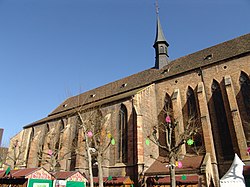
Petite France Audio Guide

Audio guide for Petite France

Petite France
Photo by Claude Truong-Ngoc / Wikimedia Commons / CC BY-SA 3.0 · Wikimedia Commons · CC BY-SA 3.0

7 min of listening · Section 1 of 5: Welcome to Petite France

Prefer reading? The full guide is below

Here in person? Walk on with Mappu

This audio guide tells one place’s story. Walk Mode keeps going as you walk:

  • It knows where you are and talks about what’s in front of you, not only these chapters.
  • It takes you on to the next sight and follows what interests you.
  • Ask about anything you see, and it answers on the spot.
  • Your phone stays in your pocket.

A 2-hour live walk with Mappu, €4.99.

50 credits from the Starter pack. One-time purchase, no subscription.

Self-guided audio walk. No guide accompanies you. Not affiliated with the sites.

Keep exploring

Discover more places in Mappu.

Petite France • Section 1 of 5

Petite France: is there a free audio guide?

Quick answer. Yes. Mappu’s Petite France audio guide (Strasbourg, France) is free in your browser: 5 sections and about 7 minutes of listening, in 6 languages. It covers “A Little France with a Painful Past”, “The Tanners and Their Houses” and “Canals, Covered Bridges and the Vauban Dam”. In the Mappu app, Walk Mode narrates the places around you as you move and answers your follow-up questions.

Petite France map

Mappu's own map of the place, with the paths and entrances OpenStreetMap shows around it.

Petite France mapThe place on the map, with the guide's point marked.

Petite France: what does the audio guide cover?

  1. 01

    Welcome to Petite France

    Welcome to Petite France, one of the most photographed corners of Strasbourg. You are in the south-western part of the Grande Île, the island that forms the city's historic centre. Here the river Ill splits into a web of small channels that cascade past flower-lined quays, locks and leaning half-timbered houses. The whole district covers only about 10 hectares, yet it is one of the most famous places in Alsace. It is also known as the Tanners' Quarter, and that second name tells you what this place was really about. In the Middle Ages it was the home of tanners, millers and fishermen, working people who needed running water. It was not a postcard then. It was a busy, smelly, modest neighbourhood. Over the next few stops we will look at the surprising story behind the name, the craftsmen who built these houses, and the bridges, towers and dam that give the quarter its shape. Take your time, because every canal corner here has a tale.

  2. 02

    A Little France with a Painful Past

    Let us start with the question everyone asks: why Little France? You might expect a patriotic reason, or something to do with the architecture. It is neither. The name goes back to a hospice for the incurable, called the Blatterhüs in Alsatian, which cared for people suffering from syphilis. In 1494 a great epidemic of the disease swept across Europe, and many Europeans nicknamed it the French disease. Strasbourg later took in the sick at a hospice in the Finkwiller district. That hospice was moved onto the Grande Île in the late 1680s, to a new building on the street of the mills, the rue des Moulins, which today runs along the Quai de la Petite France. Locals called the place after its patients, in the Alsatian dialect Französel, meaning little France, and the nickname gradually spread to the whole neighbourhood. So a charming name carries a rather sombre origin. Before the nineteenth century the area was not even known by it. Its parts were called am Pflanzbad, der Mühlenplan, which means the mill plan, and bei den Gedeckten Brücken, meaning by the covered bridges.

  3. 03

    The Tanners and Their Houses

    Look up at the roofs, because they are the clue to the trade that shaped this quarter. The tanners who lived here built tall houses with steep, pointed roofs, narrow dormer windows and open attics. Those attics were not for show. They were where animal hides were hung to dry. The work was hard on the neighbourhood. Tanners washed their hides in the Ill, and the water suffered for it. The white and red tanners' workshops also filled the air with smells, so for a long time this was not a fashionable address. In the sixteenth century it was a poor, working-class quarter of fishermen, millers and tanners. The half-timbered houses you admire today date mostly from the sixteenth and seventeenth centuries. One famous example is the Maison des Tanneurs, a former tannery built in 1572 on the rue du Bain-aux-Plantes. It is now a restaurant, which tells you how the quarter's fortunes have turned. A small clue to spot nearby: the rue des Dentelles is often thought of as part of the district, but it was once separated from it by a moat, the Fossé des Tanneurs. Notice that its houses are often built of masonry rather than timber frames.

  4. 04

    Canals, Covered Bridges and the Vauban Dam

    The waterways here were built and shaped from as early as the tenth century. They were tied to the defences of Strasbourg and used both to protect the city and to carry river trade and craft work. The Ill was the main navigable route, eventually reaching the Rhine to the north of the city. The defensive past is still visible. You will see the Pont du Faisan, the locks, the covered bridges, and the square towers that belonged to the old fortifications. The covered bridges give the district its old nickname, and a boat trip on the Ill takes you right beneath them and through the locks, which is a very different way to read the quarter. Nearby stands the Vauban Dam, a masterpiece of seventeenth-century French engineering, which was designated a historical monument in 1971. In 1966 the city added a panoramic terrace on top of it, the Terrasse Vauban. From up there you can look back over the roofs and channels and see the whole pattern of the district at once.

  5. 05

    Before You Head Off

    Petite France is part of the historic centre of Strasbourg, which was inscribed on the UNESCO World Heritage list in 1988. Today it is a place of Alsatian restaurants, shops and quays, welcoming millions of visitors, and during the Christmas season it joins the wider Christmas market. That market has been held every year since 1570 across the Grande Île and this quarter. Before you wander on, try a little detective work. Look for the tall roofs with open attics and imagine them hung with drying hides. Find the square towers and picture the fortifications they once belonged to. Then listen to the water, because it is the reason this entire quarter exists. The lanes are narrow, and every bend in the canal gives a new view. Follow whichever one tempts you and see what else the old tanners left behind.

About this guide

AI-generated from 6 sources; reviewed for accuracy and last updated on October 26, 2026. Verify tickets and opening hours on the official site.

Run a travel site or blog? Embed this audio guide for free.

Walk on from here

This place is stop 3 of 5 of a self-guided walk: Strasbourg Christmas markets. About 2.4 km and 30 minutes on foot, plus about 31 minutes of listening.

Route map: walking on from Petite France5 numbered stops in walking order. Stop 1: Place Broglie; Stop 2: Place Kléber; Stop 3: Petite France; Stop 4: Strasbourg Cathedral; Stop 5: Palais Rohan.Stop 1: Place Broglie1Stop 2: Place Kléber2Stop 3: Petite France3Stop 4: Strasbourg Cathedral4Stop 5: Palais Rohan5
Distances are estimates along the walking route, from OpenStreetMap.

Indicative route. While you walk, watch where you're going, mind the traffic and follow local signs and rules. The map is an aid, not a safety guide. Terms

  1. Place Broglie

    about 0.4 km · about 6 min on foot

  2. Place Kléber

    about 0.6 km · about 8 min on foot

  3. Petite FranceThis guide

    about 1.0 km · about 14 min on foot

  4. Strasbourg Cathedral

    about 0.4 km · about 5 min on foot

  5. Palais Rohan
Photo attribution

Walk Mode, in the free Mappu app: 2 hours for 50 credits (€4.99 Starter pack)

See the whole walk

Plan your trip on a map and get an audio guide for almost any place nearby: just tap it on the Mappu map.

Common questions

Petite France: how long is the free audio guide?

About 7 minutes of listening in 5 sections: “Welcome to Petite France”, “A Little France with a Painful Past”, “The Tanners and Their Houses”, “Canals, Covered Bridges and the Vauban Dam”, and “Before You Head Off”.

What is the story behind Petite France?

Let us start with the question everyone asks: why Little France? You might expect a patriotic reason, or something to do with the architecture. It is neither. The name goes back to a hospice for the incurable, called the Blatterhüs in Alsatian, which cared for people suffering from syphilis. In 1494 a great epidemic of the disease swept across Europe, and many Europeans nicknamed it the French disease.

Petite France: what can I ask Mappu after the guide?

You can ask follow-up questions such as “How did a hospice for syphilis patients end up giving its name to the whole district?” and keep asking in Mappu, with the guide connected to your map and trip plan.