Palais Rohan Audio Guide

A Parisian-style mansion beside Strasbourg Cathedral

Palais Rohan
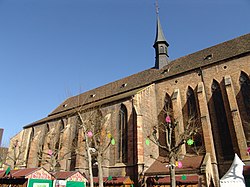
Photo by Coyau / Wikimedia Commons / CC BY-SA 3.0 · Wikimedia Commons · CC BY-SA 3.0

6 min of listening · Section 1 of 5: Welcome to Palais Rohan

Prefer reading? The full guide is below

Here in person? Walk on with Mappu

This audio guide tells one place’s story. Walk Mode keeps going as you walk:

  • It knows where you are and talks about what’s in front of you, not only these chapters.
  • It takes you on to the next sight and follows what interests you.
  • Ask about anything you see, and it answers on the spot.
  • Your phone stays in your pocket.

A 2-hour live walk with Mappu, €4.99.

50 credits from the Starter pack. One-time purchase, no subscription.

Self-guided audio walk. No guide accompanies you. Not affiliated with the sites.

Keep exploring

Discover more places in Mappu.

Palais Rohan • Section 1 of 5

Palais Rohan: is there a free audio guide?

Quick answer. Yes. Mappu’s Palais Rohan audio guide (Strasbourg, France) is free in your browser: 5 sections and about 6 minutes of listening, in 6 languages. It covers “A Bishop, an Architect and a Parisian Dream”, “Four Cardinals and a Famous Scandal” and “Prison, University, Museums and Presidents”. In the Mappu app, Walk Mode narrates the places around you as you move and answers your follow-up questions.

Palais Rohan map

Mappu's own map of the place, with the paths and entrances OpenStreetMap shows around it.

Palais Rohan mapThe place on the map, with the guide's point marked.

Palais Rohan: what does the audio guide cover?

  1. 01

    Welcome to Palais Rohan

    Welcome to the Palais Rohan, on the Place du Château in the historic heart of Strasbourg, right beside the Cathedral of Notre-Dame. Take a moment to look at the façade in front of you. It is calm, noble and classical, and it looks as if it belongs on a grand Paris street rather than in an Alsatian old town. That is exactly what its designers intended. This was the residence of the prince-bishops and cardinals of the House of Rohan, an ancient French noble family originally from Brittany. It was built between 1732 and 1742, and it is considered one of the finest architectural creations of eighteenth-century France. Today it holds three of the city's most important museums, so the palace is both a monument and a treasure chest. Over the next few stops we will look at why a bishop wanted a palace like this, how it was designed, and how it has been used since. It has been a prison, a medical school, a university and a stage for presidents. Let's start by getting our bearings.

  2. 02

    A Bishop, an Architect and a Parisian Dream

    The palace is the result of a meeting between two remarkable people. One was Cardinal Armand-Gaston-Maximilien de Rohan-Soubise, prince-bishop of Strasbourg. The other was Robert de Cotte, Principal Architect to the King. Between 1732 and 1742, de Cotte's plans turned the cardinal's ambitions into stone. The building did not rise on empty ground. It replaced the earlier episcopal palace, on a site where a bishop's residence is recorded since at least 1262. Even the square holds deep layers of history. An archaeological excavation on the Place du Château has explored a past stretching from Roman legionaries to the builders of the cathedral. The style tells its own story too. The classical manner became fashionable in Strasbourg after the French conquest of the city, and this palace was designed to resemble one of the great Parisian mansions. So you are looking at a piece of Paris placed beside one of the grandest Gothic cathedrals in Europe.

  3. 03

    Four Cardinals and a Famous Scandal

    Why is it called the Palais Rohan? Because in the eighteenth century, four prince-bishops of the Rohan family succeeded one another at the head of the diocese of Strasbourg. The palace was their home, and their name stayed with it. The most notorious of them was Cardinal Louis-René de Rohan, nephew of the one who commissioned the palace's predecessor in the family line. He became entangled in the Affair of the Queen's Necklace, one of the great scandals of the French monarchy before the Revolution. When you walk through these halls, remember that the palace belonged to people who moved at the highest levels of church and court. The entrance reflects that status. Visitors pass through a grand portal, a monumental arch topped with statues representing Clemency and Religion. It leads into the cour d'honneur, the courtyard of honor, flanked on the left and right by the administrative and utility buildings that kept a princely household running.

  4. 04

    Prison, University, Museums and Presidents

    After the bishops, the palace had many lives. During the French Revolution it served as a place of detention. Then, on 21 December 1794, the solemn opening of a military health officers' school in Strasbourg took place, with its classes held here in the palace. The next change came after the German annexation of Strasbourg. Between 1872 and 1884 the palace housed the faculties of law, philosophy and sciences of the newly established Kaiser-Wilhelms-Universität, until the Palais universitaire opened. Since the end of the nineteenth century, it has been home to museums: the Archaeological Museum in the basement, the Museum of Decorative Arts on the ground floor, and the Museum of Fine Arts on the first and second floors. The Galerie Robert Heitz, in a lateral wing, hosts temporary exhibitions. The palace has been a listed historic monument since 1920. It was restored after the bombings of 1944, and it still receives distinguished guests. On 3 April 2009, during the North Atlantic Treaty Organization summit, it hosted the first meeting between French President Nicolas Sarkozy and the newly elected American President Barack Obama.

  5. 05

    Before You Head Off

    The Palais Rohan rewards slow looking. Step back across the square and compare the calm, ordered façade with the soaring cathedral beside it. Two very different ideas of grandeur sit side by side. If you go inside, you can follow the palace's story from the bottom up. Archaeology lies in the basement, decorative arts on the ground floor and fine arts above. The terrace has even hosted contemporary work, including the glass and architecture competition winners shown there in 2015. Afterwards, the old town is right at your feet. Its cobbled streets, half-timbered houses and the riverbanks of the Ill lead toward Petite France. Keep wondering what the palace's walls have seen, from bishops to revolutionaries to presidents. There is always another room, and another story, to look for.

About this guide

AI-generated from 6 sources; reviewed for accuracy and last updated on October 26, 2026. Verify tickets and opening hours on the official site.

Run a travel site or blog? Embed this audio guide for free.

Walk on from here

This place is stop 5 of 5 of a self-guided walk: Strasbourg Christmas markets. About 2.4 km and 30 minutes on foot, plus about 31 minutes of listening.

Route map: walking on from Palais Rohan5 numbered stops in walking order. Stop 1: Place Broglie; Stop 2: Place Kléber; Stop 3: Petite France; Stop 4: Strasbourg Cathedral; Stop 5: Palais Rohan.Stop 1: Place Broglie1Stop 2: Place Kléber2Stop 3: Petite France3Stop 4: Strasbourg Cathedral4Stop 5: Palais Rohan5
Distances are estimates along the walking route, from OpenStreetMap.

Indicative route. While you walk, watch where you're going, mind the traffic and follow local signs and rules. The map is an aid, not a safety guide. Terms

  1. Place Broglie

    about 0.4 km · about 6 min on foot

  2. Place Kléber

    about 0.6 km · about 8 min on foot

  3. Petite France

    about 1.0 km · about 14 min on foot

  4. Strasbourg Cathedral

    about 0.4 km · about 5 min on foot

  5. Palais RohanThis guide

Photo attribution

Walk Mode, in the free Mappu app: 2 hours for 50 credits (€4.99 Starter pack)

See the whole walk

Plan your trip on a map and get an audio guide for almost any place nearby: just tap it on the Mappu map.

Common questions

Palais Rohan: how long is the free audio guide?

About 6 minutes of listening in 5 sections: “Welcome to Palais Rohan”, “A Bishop, an Architect and a Parisian Dream”, “Four Cardinals and a Famous Scandal”, “Prison, University, Museums and Presidents”, and “Before You Head Off”.

What is the story behind the Palais Rohan?

The palace is the result of a meeting between two remarkable people. One was Cardinal Armand-Gaston-Maximilien de Rohan-Soubise, prince-bishop of Strasbourg. The other was Robert de Cotte, Principal Architect to the King. Between 1732 and 1742, de Cotte's plans turned the cardinal's ambitions into stone. The building did not rise on empty ground. It replaced the earlier episcopal palace, on a site where a bishop's residence is recorded since at least 1262.

Palais Rohan: what can I ask Mappu after the guide?

You can ask follow-up questions such as “How did Robert de Cotte's design make a palace in Strasbourg resemble a great Parisian mansion?” and keep asking in Mappu, with the guide connected to your map and trip plan.