Basilica of the Holy Apostles Audio Guide

A Romanesque landmark beside Cologne's busy Neumarkt

Basilica of the Holy Apostles
Photo by Raimond Spekking / Wikimedia Commons / CC BY-SA 4.0 · Wikimedia Commons · CC BY-SA 4.0

6 min of listening · Section 1 of 5: Welcome to Basilica of the Holy Apostles

Prefer reading? The full guide is below

Here in person? Walk on with Mappu

This audio guide tells one place’s story. Walk Mode keeps going as you walk:

  • It knows where you are and talks about what’s in front of you, not only these chapters.
  • It takes you on to the next sight and follows what interests you.
  • Ask about anything you see, and it answers on the spot.
  • Your phone stays in your pocket.

A 2-hour live walk with Mappu, €4.99.

50 credits from the Starter pack. One-time purchase, no subscription.

Self-guided audio walk. No guide accompanies you. Not affiliated with the sites.

Keep exploring

Discover more places in Mappu.

Basilica of the Holy Apostles • Section 1 of 5

Basilica of the Holy Apostles: is there a free audio guide?

Quick answer. Yes. Mappu’s Basilica of the Holy Apostles audio guide (Cologne, Germany) is free in your browser: 5 sections and about 6 minutes of listening, in 6 languages. It covers “From Monastery to Collegiate Church”, “The Trefoil Crown of the Church” and “A Basilica in Modern Cologne”. In the Mappu app, Walk Mode narrates the places around you as you move and answers your follow-up questions.

Basilica of the Holy Apostles map

Mappu's own map of the place, with the paths and entrances OpenStreetMap shows around it.

Basilica of the Holy Apostles mapThe place on the map, with the guide's point marked.

Basilica of the Holy Apostles: what does the audio guide cover?

  1. 01

    Welcome to Basilica of the Holy Apostles

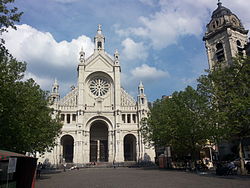
    Welcome to the Basilica of the Holy Apostles, known in German as Basilika Sankt Aposteln and in the Cologne dialect as Zint Apostele. You are in the center of Cologne, right beside the Neumarkt, one of the city's busiest squares. Shoppers, trams and city bustle swirl around you, and yet a Romanesque church has stood here through all of it. This is a former collegiate church dedicated to the twelve Apostles, and it is one of the 12 great Romanesque churches of Cologne, a family of medieval churches that still shapes the city's character. Over the next few minutes we will look at its long history, its remarkable trefoil east end, and how it lives on today as an active parish church. Think of it as a calm chapter of the Middle Ages tucked behind a modern shopping district.

  2. 02

    From Monastery to Collegiate Church

    The story of this site begins long before the church you see today. It is historically proven that a monastery was founded here in the 10th century. The first Apostle Church that can be securely traced was probably a relatively simple building, quite unlike the grand structure that followed. Its roots lie in the Salian era, and from there it has adapted again and again to the changing needs of Cologne. Over the centuries the church became a collegiate church, a community of clergy serving a major church, and it was dedicated to the twelve Apostles. That dedication is the origin of the name you see on the facade. The building you stand before is described as Romanesque, with its celebrated eastern end dating to around 1200. It is a history of tradition, transformation and continuity. Few buildings in a big modern city can claim to have served so many different eras while remaining a place of worship.

  3. 03

    The Trefoil Crown of the Church

    Now let us look at the architecture. The church follows a basilical plan, with a central nave flanked by aisles. But the real star is at the east end, where three apses open out to form a clover leaf, what architects call a trefoil plan or, in German, a Trikonchos. Two other great Cologne churches, Groß Sankt Martin and Sankt Maria im Kapitol, share this feature, which makes it a signature of Cologne's Romanesque style. The domed clover leaf chancel was built around 1200, and it is often called the glory of the church. Rising above, you will notice a soaring tower about 67 meters tall, and a Romanesque westwork at the opposite end of the church. Inside, the old and the new meet. The vault paintings in the trefoil choir were created by Hermann Gottfried between 1988 and 1993, giving this medieval space a fresh, modern spiritual energy. Look up and you will see how a contemporary artist answered a Romanesque canvas.

  4. 04

    A Basilica in Modern Cologne

    The church carries its history lightly, but its status is formal. On the eighteenth of September, 1965, Pope Paul VI raised Sankt Aposteln to the rank of a minor basilica with the apostolic letter Templis praeclaris. That is why you hear it called a basilica today, an honor recognizing its spiritual and historical importance for the city. Its story also includes the rebuilding after the Second World War. The post-war restoration is seen as a symbol of Cologne's architectural resilience and its determination to preserve Romanesque art and spirituality. Today it is an active parish church within the expanded Sankt Aposteln parish, which brings together several historic Cologne churches. It has also hosted moments of national importance. In 2016 it was the setting for an ecumenical memorial service for the former German Foreign Minister Guido Westerwelle, attended by prominent political figures and broadcast live on national television. On the south side, a contemporary hall called the Aula shows how modern architecture can sit alongside the historic frame.

  5. 05

    Before You Head Off

    As you leave, pause for a moment on the square outside and look back at the tower and the rounded forms of the east end. The contrast between the busy Neumarkt and this ancient church is part of what makes the place so rewarding. If this visit has caught your imagination, there is more to discover in the city. The Basilica of the Holy Apostles is only one of the twelve Romanesque churches of Cologne, and seeing how the others handle the same trefoil idea can reveal how a single architectural theme was shaped across the city. Which one will you follow it to next?

About this guide

AI-generated from 6 sources; reviewed for accuracy and last updated on October 26, 2026. Verify tickets and opening hours on the official site.

Run a travel site or blog? Embed this audio guide for free.

Walk on from here

This place is stop 1 of 5 of a self-guided walk: Cologne Christmas markets. About 3.4 km and 45 minutes on foot, plus about 30 minutes of listening.

Route map: walking on from Basilica of the Holy Apostles5 numbered stops in walking order. Stop 1: Basilica of the Holy Apostles; Stop 2: Cologne Cathedral; Stop 3: Cologne City Hall; Stop 4: Great St. Martin Church; Stop 5: Chocolate Museum.Stop 1: Basilica of the Holy Apostles1Stop 2: Cologne Cathedral2Stop 3: Cologne City Hall3Stop 4: Great St. Martin Church4Stop 5: Chocolate Museum5
Distances are estimates along the walking route, from OpenStreetMap.

Indicative route. While you walk, watch where you're going, mind the traffic and follow local signs and rules. The map is an aid, not a safety guide. Terms

  1. Basilica of the Holy ApostlesThis guide

    about 1.5 km · about 20 min on foot

  2. Cologne Cathedral

    about 0.6 km · about 8 min on foot

  3. Cologne City Hall

    about 0.3 km · about 4 min on foot

  4. Great St. Martin Church

    about 0.9 km · about 12 min on foot

  5. Chocolate Museum
Photo attribution

Walk Mode, in the free Mappu app: 2 hours for 50 credits (€4.99 Starter pack)

See the whole walk

Plan your trip on a map and get an audio guide for almost any place nearby: just tap it on the Mappu map.

Common questions

Basilica of the Holy Apostles: how long is the free audio guide?

About 6 minutes of listening in 5 sections: “Welcome to Basilica of the Holy Apostles”, “From Monastery to Collegiate Church”, “The Trefoil Crown of the Church”, “A Basilica in Modern Cologne”, and “Before You Head Off”.

What is the story behind the Basilica of the Holy Apostles?

The story of this site begins long before the church you see today. It is historically proven that a monastery was founded here in the 10th century. The first Apostle Church that can be securely traced was probably a relatively simple building, quite unlike the grand structure that followed. Its roots lie in the Salian era, and from there it has adapted again and again to the changing needs of Cologne.

Basilica of the Holy Apostles: what can I ask Mappu after the guide?

You can ask follow-up questions such as “What does it mean that this church is one of the twelve Romanesque churches of Cologne?” and keep asking in Mappu, with the guide connected to your map and trip plan.