Shukkei-en Audio Guide

A feudal lord's landscape garden in central Hiroshima

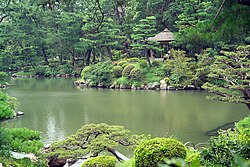
Shukkei Garden
Photo by No machine-readable author provided. Fg2 assumed (based on copyright claims).Wikimedia CommonsPublic domain

6 min of listening · Section 1 of 5: Welcome to Shukkei Garden

Prefer reading? The full guide is below

Here in person? Walk on with Mappu

This audio guide tells one place’s story. Walk Mode keeps going as you walk:

  • It knows where you are and talks about what’s in front of you, not only these chapters.
  • It takes you on to the next sight and follows what interests you.
  • Ask about anything you see, and it answers on the spot.
  • Your phone stays in your pocket.

A 2-hour live walk with Mappu, €4.99.

50 credits from the Starter pack. One-time purchase, no subscription.

Self-guided audio walk. No guide accompanies you. Not affiliated with the sites.

Keep exploring

Discover more places in Mappu.

Shukkei Garden • Section 1 of 5

Shukkei Garden: is there a free audio guide?

Quick answer. Yes. Mappu’s Shukkei-en audio guide (Hiroshima, Japan) is free in your browser: 5 sections and about 6 minutes of listening, in 8 languages. It covers “A Lord's Villa at Shukkei Garden”, “The Name Shukkei Garden Means a World in Miniature” and “Shukkei Garden Through Fire and Rebirth”. In the Mappu app, Walk Mode narrates the places around you as you move and answers your follow-up questions.

Shukkei-en map

Mappu's own map of the place, with the paths and entrances OpenStreetMap shows around it.

Shukkei-en mapThe place on the map, with the guide's point marked.

Shukkei Garden: what does the audio guide cover?

  1. 01

    Welcome to Shukkei Garden

    Welcome to Shukkei Garden, known in Japanese as 縮景園, a feudal lord's landscape garden in the middle of Hiroshima. It lies in the central district of Naka Ward, beside the Kyobashi River, one of the branches of the Ota River system, about 6.4 kilometers upstream from the river mouth. Hiroshima Castle stands to the west, and across the river to the east you will find Hiroshima Station. That means one of the calmest green spaces in the city sits within sight of its busiest crossroads. The garden was begun in 1620 and has been reshaped many times since. Over the next few stops we will walk through its founding, the meaning of its curious name, its place in the story of the city, and the way it was rebuilt after the atomic bombing of 1945. As you stroll, notice how the paths are arranged. The garden is built around a central pond, with hills, valleys, bridges, tea houses and open-sided pavilions placed so that every turn reveals a new little scene. It is a garden made for walking, so take your time.

  2. 02

    A Lord's Villa at Shukkei Garden

    Our story starts in 1620, the early Edo period. Asano Nagaakira, the first lord of the Hiroshima domain, had entered Hiroshima Castle the year before. Right away he began building a villa garden, which was first known as Osensui, the pond garden, or as Sentei, the Spring Residence. Powerful lords of this era liked to lay out grand gardens near their castles, often with tea houses, and this was Nagaakira's. The man who designed it was Ueda Soko, a senior retainer of the Asano house who was also famous as a tea master. A tea master's eye explains a lot about the garden. It is not a single grand view but a sequence of carefully framed scenes, linked by a path you follow around the grounds. At the heart of it is a pond called Takueichi. Dug there are more than 10 islands, large and small, and hills rise around the water. Valleys, bridges, tea houses and pavilions are slotted in with great skill. Later lords kept adding to the garden, and it came to look roughly as it does today.

  3. 03

    The Name Shukkei Garden Means a World in Miniature

    The name is a small poem in itself. Shukkei means gathering scenery and shrinking it down. The usual explanation goes back to the Confucian scholar Hayashi Razan, who wrote a preface to a poem at the request of the second lord, Mitsuakira. In it he spoke of shrinking seas and mountains into this one place and gathering scenery into this one tower. The garden's name is said to come from those words, and Razan is often credited as its namer. There is also a second tradition. Some say the garden was designed as a reduced version of West Lake, the famous lake of Hangzhou in Zhejiang, China. Either way, the idea is the same: the island-dotted pond, the hills and the valleys stand in for the great landscapes of the world, compressed into a space you can walk across in an afternoon. The garden's later history adds more layers. In 1713, the fifth lord, Yoshinaga, enshrined an Inari shrine on the hill north of the pond. He named that hill Kifukusan, and he gave names to 17 places within the garden. That same October, the scholar Hori Nanko wrote a description of the garden at Yoshinaga's command, called Shukkeien-ki.

  4. 04

    Shukkei Garden Through Fire and Rebirth

    The garden has lived through big moments in Japanese history. In 1894 and 1895, during the Sino-Japanese War, the Imperial headquarters moved from Tokyo to Hiroshima, and the castle site was used for it. This garden was designated as an annex to the headquarters, and a building called Seifukan became the residence of Emperor Meiji. Around the end of the Meiji era, a major renovation by a Kyoto gardener, Shimizu Shichirouemon, gave the garden the basic form it has today. In 1940 the Asano family donated it to Hiroshima Prefecture. Then came the morning of August 6, 1945. The garden lies about 1.35 kilometers from the hypocenter and was devastated. It had been designated as an evacuation place for citizens during air raids, so in the first hours after the bombing it filled with injured survivors. That scene is described in Hara Tamiki's novel Summer Flowers, and in the memoirs of Jesuit priests who had taken temporary refuge there from the Nobori-cho Catholic church. The Inari shrine on the hill was burned, and it has since been rebuilt across the river at Nigitsu Shrine. The garden was restored, and by the 1970s it had been rebuilt. In 2020 it marked 400 years since its creation.

  5. 05

    Before You Head Off from Shukkei Garden

    Today the garden is a place where people in Hiroshima come to breathe. Spring brings cherry and peach blossom. Summer is fresh green, autumn is red maple, and winter has plum and camellia. At cherry blossom and autumn leaf time there is also evening illumination. Trained volunteer guides lead visitors through the garden, and on Greenery Day, the fourth of May, entry to the garden is free. The garden used to be larger. Next door, the Hiroshima Prefectural Art Museum stands on land that was once part of the estate. In 1913 the Asano family's Kankokan was built there, billed as Japan's first private museum open to the public to show a family's collection of fine art, though it was lost in the bombing. Part of the Nobori-cho junior high school grounds also lie on former garden land. As you wander back out, look at how the old pond, the hills and the modern city share a boundary. See if you can pick out where the miniature world ends and the real one begins. You can also reach the garden by water taxi along the river, a quite different way to see its edges.

About this guide

AI-generated from 6 sources; reviewed for accuracy and last updated on October 31, 2026. Verify tickets and opening hours on the official site. Independent guide by Mappu. Not affiliated with or endorsed by the site or its managers.

Run a travel site or blog? Embed this audio guide for free.

Walk on from here

This place is stop 2 of 3 of a self-guided walk: Gokoku Shrine to the Peace Cathedral, Hiroshima. About 1.7 km and 25 minutes on foot, plus about 18 minutes of listening.

Route map: walking on from Shukkei Garden3 numbered stops in walking order. Stop 1: Hiroshima Gokoku Shrine; Stop 2: Shukkei Garden; Stop 3: Noboricho Catholic Church.Stop 1: Hiroshima Gokoku Shrine1Stop 2: Shukkei Garden2Stop 3: Noboricho Catholic Church3
Distances are estimates along the walking route, from OpenStreetMap.

Indicative route. While you walk, watch where you're going, mind the traffic and follow local signs and rules. The map is an aid, not a safety guide. Terms

Walk Mode, in the free Mappu app: 2 hours for 50 credits (€4.99 Starter pack)

See the whole walk

Planning a trip to Hiroshima?

Get your plan

Mappu sketches your days free in the chat, no account needed. Then take the full plan with you:

  • Weekend trip, €9.99: Your day-by-day plan plus 2 live walks
  • Save your trip’s free guides on your phone in the Mappu app: they play with no signal
See the trip packs

Already going? The 2-hour live walk in Hiroshima is €4.99

Plan your trip on a map and get an audio guide for almost any place nearby: just tap it on the Mappu map.

Common questions

Shukkei-en: how long is the free audio guide?

About 6 minutes of listening in 5 sections: “Welcome to Shukkei Garden”, “A Lord's Villa at Shukkei Garden”, “The Name Shukkei Garden Means a World in Miniature”, “Shukkei Garden Through Fire and Rebirth”, and “Before You Head Off from Shukkei Garden”.

Shukkei-en: what can I ask Mappu after the guide?

You can ask follow-up questions such as “How did Ueda Soko's background as a tea master shape the way the garden's scenes are arranged around the pond?” and keep asking in Mappu, with the guide connected to your map and trip plan.