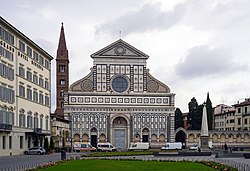
Medici Chapels Audio Guide

Michelangelo's New Sacristy and the Chapel of the Princes, Florence

Medici Chapels
Photo by Richardfabi / Wikimedia Commons / Public domain · Wikimedia Commons · Public domain

6 min of listening · Section 1 of 5: Welcome to the Medici Chapels

Prefer reading? The full guide is below

Keep exploring

Discover more places in Mappu, or start Walk Mode when you’re there.

Live Walk Mode: 2 hours for 50 credits (€4.99 Starter pack)
Medici Chapels • Section 1 of 5

Medici Chapels: is there a free audio guide?

Quick answer. Yes. Mappu’s Medici Chapels audio guide (Florence, Italy) is free in your browser: 5 sections and about 6 minutes of listening, in 6 languages. It covers “A Family's Ambition in Stone”, “Michelangelo's Unfinished Sacristy” and “The Chapel of the Princes and the Art of Hardstone”. In the Mappu app, Walk Mode narrates the places around you as you move and answers your follow-up questions.

Medici Chapels: what does the audio guide cover?

  1. 01

    Welcome to the Medici Chapels

    Welcome to the Medici Chapels, in the heart of Florence. They are the burial place of one of Europe's most famous families, and they form part of the monumental complex of the Basilica of San Lorenzo. Technically they are an extension of that church, built between the sixteenth and seventeenth centuries. You enter at the back of the complex rather than through the main church doors. The chapels have three parts. Below is the crypt. Above it rises the Cappella dei Principi, the Chapel of the Princes, a mausoleum for the Medici Grand Dukes. Then comes the Sagrestia Nuova, the New Sacristy, designed by Michelangelo. These spaces are strikingly different in mood. One is calm, pale and architectural. The other is dark with polished stone and dazzling colour. Today the chapels are a national monument and a state museum. In this guide we will look at why the Medici wanted a mausoleum, how Michelangelo shaped one of them, and how a whole workshop of stone craftsmen was founded to decorate the other. Let's begin with the ambition behind it all.

  2. 02

    A Family's Ambition in Stone

    The New Sacristy began with two Medici popes. Cardinal Giulio de' Medici, who later became Pope Clement the Seventh, and his cousin Pope Leo the Tenth wanted a mausoleum for members of their family. It was meant to hold the tombs of Lorenzo the Magnificent and his brother Giuliano, and also of their heirs, Lorenzo, Duke of Urbino, and Giuliano, Duke of Nemours. The deaths of those two young dukes brought the Magnificent's branch of the family to an end. The architecture was a statement as well as a tomb. The New Sacristy balances Filippo Brunelleschi's Old Sacristy, which sits beside the left transept of San Lorenzo, and it consciously competes with it. Both share the same format, a cubical space topped by a dome, with gray pietra serena stone set against whitewashed walls. Michelangelo took Brunelleschi's calm vocabulary and pushed it further. This was Michelangelo's first venture into architecture, and the building was designed and completed between 1519 and 1524. When you stand inside, remember that you are looking at a painter and sculptor's very first answer to the question of what a building could be.

  3. 03

    Michelangelo's Unfinished Sacristy

    Michelangelo designed the monuments in the New Sacristy as well as the architecture. The tombs of Giuliano and Lorenzo carry the figures known as Dawn, Dusk, Day and Night, personifications of the times of day. They recline on the sarcophagus lids, and that pose was destined to influence sculpted figures on architraves for generations afterward. Look at how the bodies seem to be sliding, almost with reluctance, along their curved surfaces. Yet the project was never completed. Although the room was vaulted over by 1524, history kept interrupting. The Medici were driven out of Florence for a time in 1527. Cardinal Giulio, by then Pope Clement the Seventh, died. And in 1534 Michelangelo left Florence for Rome permanently. The sculptural program was too ambitious to be finished in such turbulent years, so the New Sacristy remains unfinished. The commission that began with such confidence ended in a fragment, and yet the fragment is a masterpiece. The Bargello museums, which today care for the chapels, call the New Sacristy an absolute masterpiece of architecture and sculpture. Take a moment to see how the sculpture and the walls seem to belong to one idea.

  4. 04

    The Chapel of the Princes and the Art of Hardstone

    Now climb to the upper floor and the mood changes completely. The Chapel of the Princes is the mausoleum of the Medici Grand Dukes, and six of them are buried here. It is a rare example of the Baroque style in Florence, with a huge dome and a lavish interior conceived as a monument to Medici greatness. The designs came from Don Giovanni de' Medici, a natural son of Cosimo the First, who practiced architecture in a semi-professional way. Sketches were submitted to an informal competition in 1602, and the architect Matteo Nigetti oversaw the building from 1604 to 1640, with the aging Buontalenti altering the plans in execution. The walls are covered entirely in a marble revetment inlaid with colored marbles and semi-precious stones. The technique was called commessi in Florence. Craftsmen assembled jigsawn fragments of specimen stones and porphyry into designs, almost like painting with rock. This work was so demanding that the grand ducal hardstone workshop, the Opificio delle Pietre Dure, was established to carry it out. The dome shows how long the project lasted. Buontalenti's dome was begun in 1604 and not fully completed until the twentieth century. Its frescoes were painted by Pietro Benvenuti between 1828 and 1837, under the Habsburg-Lorraine family who took over from the Medici on the throne of Tuscany. Their own tombs lie in the Lorraine Crypt below.

  5. 05

    Before You Head Off

    The Medici Chapels were declared a national monument and transformed into a state museum in 1869. The recently united Italy recognized their fundamental artistic and historical meaning. That is a fitting fate for a place that was built to make a family's name last, and which now belongs to everyone. As you continue, notice the contrast between the two main spaces. One is Michelangelo's pale, disciplined room, with pietra serena against white walls and an unfinished air. The other is a mausoleum of polished stone, built and decorated over many decades. They were made a century apart, yet they belong to the same story of power, memory and craftsmanship. Before you go, look for the small decisions: where the gray stone meets the white wall, how a reclining figure rests on its tomb, and how a pattern of colored stone is made from tiny cut fragments. The Basilica of San Lorenzo stands right beside the chapels, so you can keep following the Medici story just next door.

About this guide

AI-generated from 6 sources; checked automatically and last updated on October 21, 2026. Verify tickets and opening hours on the official site.

Run a travel site or blog? Embed this audio guide for free.

Walk on from here

This place is stop 2 of 3 of a self-guided walk: Santa Maria Novella to the Accademia, Florence. About 1.2 km and 15 minutes on foot, plus about 19 minutes of listening.

Route map: walking on from Medici Chapels3 numbered stops in walking order. Stop 1: Santa Maria Novella; Stop 2: Medici Chapels; Stop 3: Galleria dell'Accademia.
Distances are estimates along the walking route, from OpenStreetMap.
  1. Santa Maria Novella

    about 0.5 km · about 6 min on foot

  2. Medici ChapelsThis guide

    about 0.7 km · about 9 min on foot

  3. Galleria dell'Accademia
Photo attribution

Live Walk Mode: 2 hours for 50 credits (€4.99 Starter pack)

See the whole walk

More churches and basilicas with a free audio guide

Photo attribution

Plan your trip on a map and get an audio guide for almost any place nearby: just tap it on the Mappu map.

Common questions

Medici Chapels: how long is the free audio guide?

About 6 minutes of listening in 5 sections: “Welcome to the Medici Chapels”, “A Family's Ambition in Stone”, “Michelangelo's Unfinished Sacristy”, “The Chapel of the Princes and the Art of Hardstone”, and “Before You Head Off”.

What is the story behind the Medici Chapels?

The New Sacristy began with two Medici popes. Cardinal Giulio de' Medici, who later became Pope Clement the Seventh, and his cousin Pope Leo the Tenth wanted a mausoleum for members of their family. It was meant to hold the tombs of Lorenzo the Magnificent and his brother Giuliano, and also of their heirs, Lorenzo, Duke of Urbino, and Giuliano, Duke of Nemours. The deaths of those two young dukes brought the Magnificent's branch of the family to an end.

Medici Chapels: what can I ask Mappu after the guide?

You can ask follow-up questions such as “How does Michelangelo's New Sacristy compare with Brunelleschi's Old Sacristy next to the church?” and keep asking in Mappu, with the guide connected to your map and trip plan.