Santa Maria Novella Audio Guide

Florence's Dominican church of marble, frescoes and big ideas

Santa Maria Novella
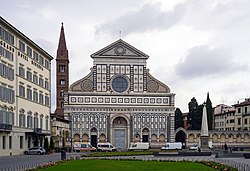
Photo by Commonists / Wikimedia Commons / CC BY-SA 4.0 · Wikimedia Commons · CC BY-SA 4.0

6 min of listening · Section 1 of 5: Welcome to Santa Maria Novella

Prefer reading? The full guide is below

Keep exploring

Discover more places in Mappu, or start Walk Mode when you’re there.

Live Walk Mode: 2 hours for 50 credits (€4.99 Starter pack)
Santa Maria Novella • Section 1 of 5

Santa Maria Novella: is there a free audio guide?

Quick answer. Yes. Mappu’s Santa Maria Novella audio guide (Florence, Italy) is free in your browser: 5 sections and about 6 minutes of listening, in 6 languages. It covers “From the Vineyards to a New Church”, “Alberti and the Marble Facade” and “Frescoes, Councils and Tombs”. In the Mappu app, Walk Mode narrates the places around you as you move and answers your follow-up questions.

Santa Maria Novella: what does the audio guide cover?

  1. 01

    Welcome to Santa Maria Novella

    Welcome to Santa Maria Novella, the Dominican church in Florence whose name means Saint Mary the New. If you arrived by train, you have already met it, because Florence's main railway station carries its name. The church is often the first great monument to greet visitors coming into the city. Look up at the facade and you will see a patchwork of centuries. The lower part is medieval and Gothic, with pointed arcades along the base. Above it rises a crisp geometry of white and green marble that belongs to the Renaissance. Few buildings let you read two ages of architecture in a single glance, and this one does it beautifully. Over the next few minutes we will follow the church from its humble beginnings by the vineyards, through the friars who planned it, to the designer who gave it its famous face. Think of this as a story about how a medieval monastery learned to speak the language of the Renaissance.

  2. 02

    From the Vineyards to a New Church

    The story begins in 1221, when the diocese of Florence assigned the Dominican friar John of Salerno a small oratory called Santa Maria delle Vigne, meaning Saint Mary by the vineyards. At that time it stood outside the city walls, surrounded by agricultural fields. Some accounts trace a first church on this ground back to the ninth century. The Dominicans decided to build something bigger: a new church, named Santa Maria Novella, and a cloister beside it. The plan is credited to Dominican brothers, above all Sisto and Ristoro, and some accounts add Jacopo Passavanti as a possible early architect. Two dates survive for the start of construction. One gives around 1278 and the other gives 1290. Either way, the work stretched across generations, and the church was consecrated in 1420. The building grew in stages. The Romanesque and Gothic bell tower and the sacristy were completed in 1360 under Friar Iacopo Talenti. Santa Maria Novella is the great Dominican church of Florence, just as Santa Croce belongs to the Franciscans, and each order left its mark on the city's skyline.

  3. 03

    Alberti and the Marble Facade

    Now to the part everyone photographs. The lower section of the facade was started in 1350, in the medieval spirit. Above it, the great Renaissance architect Leon Battista Alberti designed the upper part, dated to the years 1456 to 1470. He worked in inlaid green marble from Prato and white marble, creating a pattern of crisp squares and circles. Alberti's challenge was delicate. The church below him was already medieval, so he could not simply start fresh. He chose to harmonize the new with the old, applying classically inspired proportions to make one unified whole. The two great S-shaped scrolls on either side of the upper facade have no precedent in ancient classical architecture, so they are his own invention, linking the tall nave to the lower side aisles. Alberti was also a writer. His book On the Art of Building, inspired by the Roman architect Vitruvius, became the first major architectural treatise and a guide to Renaissance design. The facade has a final footnote: its right side, the last part left incomplete, was added only in 1920.

  4. 04

    Frescoes, Councils and Tombs

    Step inside and the church becomes a gallery of Florentine art. Over the centuries many of its original frescoes were destroyed in the wake of the Counter-Reformation, but you can still sense the old decoration. On the inner face of the facade wall is an Annunciation by Pietro Miniato, a painter and miniaturist said to have taken over a workshop once belonging to Giotto. His style is elegantly Gothic and richly decorated, in the manner of courtly art. In the Strozzi Chapel stands the Altarpiece of the Redeemer, a polyptych painted by Andrea Orcagna in 1357. And back outside, the Gothic arcades along the facade were intended to hold sarcophagi. One of them is the resting place of the Renaissance painter Domenico Ghirlandaio. The church has also played a part in world affairs. In 1439 it was chosen as the site of the first council that sought to reunite the Orthodox and Catholic churches, and it became a favorite site of the popes. Beside the church, the cloisters and the refectory now house paintings, sacred vestments, goldsmith work and relics, and the connected Santa Maria Novella Pharmacy is celebrated as the oldest in Europe.

  5. 05

    Before You Head Off

    Before you move on, take one more slow look at the facade and try to separate the two ages. Where does the medieval arcade end and the Renaissance geometry begin? Notice how Alberti's scrolls tie the tall center to the lower sides, and how the green and white marble catches the light at different hours of the day. Then let your eyes wander along the pointed arches at the base, the ones made for tombs, and think of the Dominican friars who spent generations building here, from a small chapel by the vineyards to one of the most admired churches in Florence. There is plenty more to discover around the church: the cloisters, the refectory with its sacred treasures, and the old pharmacy attached to the complex. Each one adds another chapter to the story of this place, and each rewards a curious visitor who keeps looking.

About this guide

AI-generated from 6 sources; checked automatically and last updated on October 21, 2026. Verify tickets and opening hours on the official site.

Run a travel site or blog? Embed this audio guide for free.

Walk on from here

This place is stop 1 of 3 of a self-guided walk: Santa Maria Novella to the Accademia, Florence. About 1.2 km and 15 minutes on foot, plus about 19 minutes of listening.

Route map: walking on from Santa Maria Novella3 numbered stops in walking order. Stop 1: Santa Maria Novella; Stop 2: Medici Chapels; Stop 3: Galleria dell'Accademia.
Distances are estimates along the walking route, from OpenStreetMap.
  1. Santa Maria NovellaThis guide

    about 0.5 km · about 6 min on foot

  2. Medici Chapels

    about 0.7 km · about 9 min on foot

  3. Galleria dell'Accademia
Photo attribution

Live Walk Mode: 2 hours for 50 credits (€4.99 Starter pack)

See the whole walk

Plan your trip on a map and get an audio guide for almost any place nearby: just tap it on the Mappu map.

Common questions

Santa Maria Novella: how long is the free audio guide?

About 6 minutes of listening in 5 sections: “Welcome to Santa Maria Novella”, “From the Vineyards to a New Church”, “Alberti and the Marble Facade”, “Frescoes, Councils and Tombs”, and “Before You Head Off”.

What is the story behind Santa Maria Novella?

The story begins in 1221, when the diocese of Florence assigned the Dominican friar John of Salerno a small oratory called Santa Maria delle Vigne, meaning Saint Mary by the vineyards. At that time it stood outside the city walls, surrounded by agricultural fields. Some accounts trace a first church on this ground back to the ninth century. The Dominicans decided to build something bigger: a new church, named Santa Maria Novella, and a cloister beside it.

Santa Maria Novella: what can I ask Mappu after the guide?

You can ask follow-up questions such as “How did Santa Maria Novella grow from the small oratory of Santa Maria delle Vigne into a great Dominican church?” and keep asking in Mappu, with the guide connected to your map and trip plan.