Rector's Palace Audio Guide

The Gothic heart of the Republic of Ragusa

Rector's Palace
Photo by Neoneo13 / Wikimedia Commons / Public domain · Wikimedia Commons · Public domain

5 min of listening · Section 1 of 5: Welcome to Rector's Palace

Prefer reading? The full guide is below

Keep exploring

Discover more places in Mappu, or start Walk Mode when you’re there.

Live Walk Mode: 2 hours for 50 credits (€4.99 Starter pack)
Rector's Palace • Section 1 of 5

Rector's Palace: is there a free audio guide?

Quick answer. Yes. Mappu’s Rector's Palace audio guide (Dubrovnik, Croatia) is free in your browser: 5 sections and about 5 minutes of listening, in 6 languages. It covers “From Fortress to Palace”, “A Ruler on a Short Leash” and “Earthquake, Baroque and a Layered Courtyard”. In the Mappu app, Walk Mode narrates the places around you as you move and answers your follow-up questions.

Rector's Palace: what does the audio guide cover?

  1. 01

    Welcome to Rector's Palace

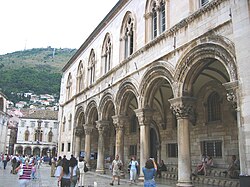
    Welcome to the Rector's Palace, known in Croatian as Knežev dvor, and in Italian as Palazzo dei Rettori. You are in the heart of Dubrovnik's walled Old Town, at the end of Stradun, the city's main street. The palace sits right beside the Church of Saint Blaise and the Town Hall, in some of the best real estate the city has to offer. For centuries this was the seat of the Rector of the Republic of Ragusa. It also housed the Minor Council and the state administration. It is often described as one of the most significant monuments of secular architecture on the Croatian coast. Take a moment to look at the facade. It is basically Gothic, but you will also spot Renaissance and Baroque touches, blended so smoothly that they seem to belong together. Over the next few minutes we will follow the palace from its modest beginnings as a defensive building, through fire and earthquake, to the day it became a museum. We will also meet a very unusual kind of ruler, one who barely got to leave the building.

  2. 02

    From Fortress to Palace

    Before this graceful building, there was something much plainer. The site was originally home to a defensive building in the early Middle Ages. The first incarnation of the palace is dated to the twelfth century, and it was likely a modest structure. The changing words used to describe it tell the story of its growth. In the city statutes of 1272 it was called a castrum. By 1296 it had grown into a larger castellum, a camp or fortified residence. By 1349 it was called a palatium, a palace, and eventually it earned the title of palazzo maggiore, the major palace. Then came disaster. A fire in 1435 destroyed the building, and the city-state decided to build a new palace rather than simply patch up the old one. The result was a harmonious two-storey Gothic building. In effect, you are looking at the product of a city that, faced with ruin, chose to rebuild on a grander scale.

  3. 03

    A Ruler on a Short Leash

    Here is what makes this palace's story truly unusual. The Rector of the Republic of Ragusa did not hold office for years. He served for just one month, a rule designed to stop any single person from gathering too much power. During that month the Rector lived entirely within the palace. He could not leave it, could not receive guests privately, and could not accept gifts. After his term ended, he could not be re-elected for two years. This arrangement has been described as an early example of systematic anti-corruption design in European history. So when you picture a monarch's residence, set that image aside. This was a workplace and a gilded cage for a rotating series of officeholders. The system lasted until 1806, when Napoleonic forces ended the republic's sovereignty. The palace served as the Rector's seat until 1808. Imagine the quiet churn of that arrangement: month after month, a new person stepping through these doors to carry the weight of the state.

  4. 04

    Earthquake, Baroque and a Layered Courtyard

    The palace's look is a layered one, because the building has been repaired and added to many times. The 1667 earthquake damaged it significantly. The structure you see today is largely a post-earthquake restoration. It preserved much of the fifteenth-century fabric, while damaged sections were rebuilt in the Baroque style that was dominant at the time. Scholars have studied this episode as the Baroque reconstruction of the palace. The courtyard and its arcade survived largely intact. Look closely at the capitals on the arcade columns. They are unusual, because some are Gothic and some are Renaissance, and together they reveal how the building grew in stages. If you can, step into the courtyard and look at the staircase too. Its architecture is much admired, and it makes a wonderful frame for photographs. The result is a building that does not belong to a single moment. It is Gothic at heart, with Renaissance and Baroque chapters added, and each one tells you something about the era that shaped it.

  5. 05

    Before You Head Off

    Today the palace houses the Cultural History Museum, part of Dubrovnik Museums. Its history department has operated here since 1872. Inside, the collection includes coats of arms of many noble families, paintings by old masters, and coins minted by the Republic. You can also see the original keys to the city gates and a number of important state documents. As you explore, try to imagine how all of this once served a government that changed its leader every month. Ask yourself which rooms or objects best capture that unusual system. Notice, too, how the arcade, the staircase and the facade each seem to speak in a slightly different architectural voice. And when you step back out toward Stradun, glance once more at the palace beside the Church of Saint Blaise. What other layers might still be waiting to be noticed?

About this guide

AI-generated from 6 sources; checked automatically and last updated on October 21, 2026. Verify tickets and opening hours on the official site.

Run a travel site or blog? Embed this audio guide for free.

Walk on from here

This place is stop 2 of 3 of a self-guided walk: Old Town and City Walls, Dubrovnik. About 0.7 km and 10 minutes on foot, plus about 17 minutes of listening.

Route map: walking on from Rector's Palace3 numbered stops in walking order. Stop 1: Franciscan Monastery; Stop 2: Rector's Palace; Stop 3: Dubrovnik City Walls.
Distances are estimates along the walking route, from OpenStreetMap.
  1. Franciscan Monastery

    about 0.4 km · about 5 min on foot

  2. Rector's PalaceThis guide

    about 0.3 km · about 4 min on foot

  3. Dubrovnik City Walls
Photo attribution

Live Walk Mode: 2 hours for 50 credits (€4.99 Starter pack)

See the whole walk

More palaces with a free audio guide

Photo attribution

Plan your trip on a map and get an audio guide for almost any place nearby: just tap it on the Mappu map.

Common questions

Rector's Palace: how long is the free audio guide?

About 5 minutes of listening in 5 sections: “Welcome to Rector's Palace”, “From Fortress to Palace”, “A Ruler on a Short Leash”, “Earthquake, Baroque and a Layered Courtyard”, and “Before You Head Off”.

What is the story behind the Rector's Palace?

Before this graceful building, there was something much plainer. The site was originally home to a defensive building in the early Middle Ages. The first incarnation of the palace is dated to the twelfth century, and it was likely a modest structure. The changing words used to describe it tell the story of its growth. In the city statutes of 1272 it was called a castrum. By 1296 it had grown into a larger castellum, a camp or fortified residence.

Rector's Palace: what can I ask Mappu after the guide?

You can ask follow-up questions such as “How did the palace grow from a castrum to a castellum to a palatium over the centuries?” and keep asking in Mappu, with the guide connected to your map and trip plan.