Franciscan Monastery Audio Guide

A cloister, a pharmacy and a doorway that survived the earthquake, on Dubrovnik's main street

Franciscan Monastery
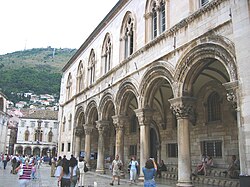
Photo by Bernard Gagnon / Wikimedia Commons / CC BY-SA 4.0 · Wikimedia Commons · CC BY-SA 4.0

5 min of listening · Section 1 of 5: Welcome to Franciscan Monastery

Prefer reading? The full guide is below

Keep exploring

Discover more places in Mappu, or start Walk Mode when you’re there.

Live Walk Mode: 2 hours for 50 credits (€4.99 Starter pack)
Franciscan Monastery • Section 1 of 5

Franciscan Monastery: is there a free audio guide?

Quick answer. Yes. Mappu’s Franciscan Monastery audio guide (Dubrovnik, Croatia) is free in your browser: 5 sections and about 5 minutes of listening, in 6 languages. It covers “From Outside the Walls to Stradun”, “The Doorway That Survived 1667” and “The Cloister and the Pharmacy”. In the Mappu app, Walk Mode narrates the places around you as you move and answers your follow-up questions.

Franciscan Monastery: what does the audio guide cover?

  1. 01

    Welcome to Franciscan Monastery

    Welcome to the Franciscan Monastery, right on Stradun, the main street of Dubrovnik. You are at the western end of the Old Town, a short walk from the Pile Gate, and the complex is easy to find because it faces the very start of the street, which locals call the Placa. This is a large complex that belongs to the Order of the Friars Minor. It holds a church, a friary, a library, a museum and a pharmacy, all in one place. In the next few minutes we will look at how the Franciscans arrived in Dubrovnik, why so little of the original building survives, and why a small shop at the entrance has earned a reputation among the oldest pharmacies in the world. So take a moment on the street. Look for the carved stone doorway at the church front. It is the oldest piece of the story, and we will come back to it.

  2. 02

    From Outside the Walls to Stradun

    The Franciscans have a long history in Dubrovnik. The first document to mention them dates from 1235. It speaks of their monastery of Saint Thomas, which stood in the Pile suburb, outside the city walls. That placement turned out to matter. The friars did not stay outside. The tourist board's account tells us that the early monastery was demolished when war was announced with King Uroš the Second Milutin of Serbia, and the community moved inside the walls to the site where you are standing now. A building outside a city's defenses was simply too exposed when an army might arrive. So the story of this place begins with a practical decision, made in a tense moment. The community that settled on the spot beside the main street has stayed here ever since, and the pharmacy that grew up with it is traditionally dated to 1317.

  3. 03

    The Doorway That Survived 1667

    Dubrovnik's great earthquake of 1667 changed the city, and it hit the Franciscan complex hard. The church, once counted among the richest in the city, was largely destroyed. Over the centuries a series of disasters and wars took more, so that very little of the medieval monastery remains. What did survive is the decorated portal that overlooks the beginning of the Placa. It was carved in 1498, in the Gothic style, by the workshop of the brothers Leonard and Petar Petrović. Take a good look at it. It is the main original feature you can still see from the street, and it is more than 500 years old. After the earthquake the complex was rebuilt in the Baroque period, in the seventeenth century. A large library was added to the monastery at that time. So the building you see is layered: a Gothic doorway at the front, and Baroque rebuilding behind it.

  4. 04

    The Cloister and the Pharmacy

    Inside, the monastery's treasure is its cloister, described by the Dubrovnik tourist board as the finest Romanesque-Gothic cloister, full of valuable works of art. Cloisters were designed for quiet. If you step into this one, you will see how a courtyard framed by arcades can feel like a pause from the street outside. The museum and library hold more than 1200 old manuscripts, along with liturgical objects such as a gilt-silver crucifix from the fifteenth century and paintings by old masters. Then there is the pharmacy. It is traditionally dated to 1317, which makes it one of the oldest continuously working pharmacies in Europe. It served both the friars and the wider public. Today it still sells products made to historic Franciscan recipes, including rose water and herb creams, and a pharmacy museum shows mortars, glass and ceramic vessels and medicine chests. The garden behind the monastery has long supplied herbs such as sage and mint, along with roses and orange trees.

  5. 05

    Before You Head Off

    There is a name for these friars that locals use: Mala braća, meaning the Friars Minor, the little brothers. A local legend explains the name with a story of four brothers, sons of a ship's captain, though it remains a tale rather than a documented fact. You may enjoy deciding what you make of it. Before you go, look back at the doorway from the street, then at the pharmacy beside it, and ask yourself which has seen more of the city. The doorway has watched Stradun since 1498. The pharmacy's own tradition reaches back even further, to 1317. If you have time, step into the cloister and notice how quickly the noise of the street fades. Every arcade and every carved detail is a reason to linger a little longer.

About this guide

AI-generated from 6 sources; checked automatically and last updated on October 21, 2026. Verify tickets and opening hours on the official site.

Run a travel site or blog? Embed this audio guide for free.

Walk on from here

This place is stop 1 of 3 of a self-guided walk: Old Town and City Walls, Dubrovnik. About 0.7 km and 10 minutes on foot, plus about 17 minutes of listening.

Route map: walking on from Franciscan Monastery3 numbered stops in walking order. Stop 1: Franciscan Monastery; Stop 2: Rector's Palace; Stop 3: Dubrovnik City Walls.
Distances are estimates along the walking route, from OpenStreetMap.
  1. Franciscan MonasteryThis guide

    about 0.4 km · about 5 min on foot

  2. Rector's Palace

    about 0.3 km · about 4 min on foot

  3. Dubrovnik City Walls
Photo attribution

Live Walk Mode: 2 hours for 50 credits (€4.99 Starter pack)

See the whole walk

Plan your trip on a map and get an audio guide for almost any place nearby: just tap it on the Mappu map.

Common questions

Franciscan Monastery: how long is the free audio guide?

About 5 minutes of listening in 5 sections: “Welcome to Franciscan Monastery”, “From Outside the Walls to Stradun”, “The Doorway That Survived 1667”, “The Cloister and the Pharmacy”, and “Before You Head Off”.

What is the story behind the Franciscan Monastery?

The Franciscans have a long history in Dubrovnik. The first document to mention them dates from 1235. It speaks of their monastery of Saint Thomas, which stood in the Pile suburb, outside the city walls. That placement turned out to matter. The friars did not stay outside. The tourist board's account tells us that the early monastery was demolished when war was announced with King Uroš the Second Milutin of Serbia, and the community moved inside the walls to the site where you are standing now.

Franciscan Monastery: what can I ask Mappu after the guide?

You can ask follow-up questions such as “Why did the Franciscans move from the Pile suburb to their present site inside the walls?” and keep asking in Mappu, with the guide connected to your map and trip plan.