La Monnaie Audio Guide

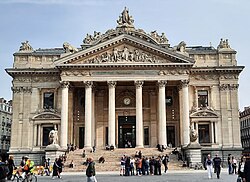
Brussels' opera house on the Mint Square

La Monnaie
Photo by Lou Salomé / Wikimedia Commons / CC BY-SA 3.0 · Wikimedia Commons · CC BY-SA 3.0

7 min of listening · Section 1 of 5: Welcome to La Monnaie

Prefer reading? The full guide is below

Here in person? Walk on with Mappu

This audio guide tells one place’s story. Walk Mode keeps going as you walk:

  • It knows where you are and talks about what’s in front of you, not only these chapters.
  • It takes you on to the next sight and follows what interests you.
  • Ask about anything you see, and it answers on the spot.
  • Your phone stays in your pocket.

A 2-hour live walk with Mappu, €4.99.

50 credits from the Starter pack. One-time purchase, no subscription.

Self-guided audio walk. No guide accompanies you. Not affiliated with the sites.

Keep exploring

Discover more places in Mappu.

La Monnaie • Section 1 of 5

La Monnaie: is there a free audio guide?

Quick answer. Yes. Mappu’s La Monnaie audio guide (Brussels, Belgium) is free in your browser: 5 sections and about 7 minutes of listening, in 6 languages. It covers “From Minting Coins to Staging Opera”, “Napoleon, Fire and Joseph Poelaert” and “Modern Art Inside a Historic Theatre”. In the Mappu app, Walk Mode narrates the places around you as you move and answers your follow-up questions.

La Monnaie map

Mappu's own map of the place, with the paths and entrances OpenStreetMap shows around it.

La Monnaie mapThe place on the map, with the guide's point marked.

La Monnaie: what does the audio guide cover?

  1. 01

    Welcome to La Monnaie

    Welcome to La Monnaie, the Royal Theatre of the Mint, standing on a major square in the heart of Brussels. In French it is La Monnaie, in Dutch De Munt, and both names simply mean the Mint. That is a clue to a story we will unpack together: the name of an opera house that began as a place where coins were made. This is the home of the National Opera of Belgium. The institution takes its name from the building, so when someone in Brussels says La Monnaie, they might mean the walls, the stage or the company that performs here. Belgium's leading opera house is also one of the few cultural institutions that receive financial support from the federal government. Over the next few stops, we will go back to the days when the square held a minting hall, meet the architect behind the building you see today, step inside to some surprising modern art, and look at the machinery and the people that make an opera happen. Take a moment to look at the facade and the square around you, and let's begin.

  2. 02

    From Minting Coins to Staging Opera

    Rewind to the middle of the sixteenth century. Between 1551 and 1565, the funnel-shaped square here replaced an older mansion, and on its eastern side stood the city's first full-fledged minting hall. It was decommissioned in 1649. That is why a theatre ended up carrying the word Mint in its name for centuries. Then came disaster. In 1695 the French army bombarded Brussels, leaving a large empty space in the city. The ruler of the Habsburg Netherlands at the time, Maximilian II Emanuel, Elector of Bavaria, saw an opportunity. A permanent public opera house for the court and the city was built here between 1695 and 1700, as part of the rebuilding. Accounts differ on who designed it. One names Gio Paolo Bombarda, the Elector's Italian treasurer and architect, and another credits the Venetian architects Paolo and Pietro Bezzi. Either way, the name of the old mint stuck to the theatre. French opera dominated the Brussels stage through the following century, though Venetian operas and other repertoire appeared regularly too. And until the middle of the nineteenth century, plays were performed here alongside opera, so this was a theatre of many voices.

  3. 03

    Napoleon, Fire and Joseph Poelaert

    The theatre has had more than one life. When Napoleon rose to power after the French Revolution, he considered Brussels a very important city in his future empire, and he found the original theatre too humble for his grand plans. So a new version was commissioned. That second theatre was later lost to fire, which brings us to the building in front of you. The new Théâtre Royal de la Monnaie opened its doors on the twenty-fifth of March, 1856. Its architect was Joseph Poelaert, who also designed the monumental Palace of Justice in Brussels. Poelaert did not start entirely from scratch. He kept the portico from the second version, then surrounded it with an eclectic mix of Neoclassical, Baroque and Rococo elements. Inside, the auditorium combines French and Italian features and seats 1,130 people. Look up when you get the chance: in 1999 the restored canvas on the cupola, painted by the Parisian set designers François-Joseph Nolau and Alfred Rubé, was reinstalled. It is a living piece of nineteenth-century stagecraft hanging above the audience.

  4. 04

    Modern Art Inside a Historic Theatre

    La Monnaie is not a museum piece frozen in time. In 1985 and 1986, the Liège architect Charles Vandenhove created a new concept for the entrance and invited two American artists to carry out his ideas. Sol LeWitt designed a fan-shaped floor in black and white, and Sam Francis painted the triptych on the ceiling. The result is a bold meeting of a nineteenth-century theatre and late twentieth-century art. There is a smaller surprise too. A little salon, about 8 meters by 4.2 meters and covered entirely in marble, was redesigned in a post-modern style during the same restoration. Daniel Buren's floor and Giulio Paolini's sculptures enhance Vandenhove's architecture. Today sponsors and special guests use it as a reception room. The contemporary spirit extends beyond the stage. In 2000, La Monnaie opened new rehearsal studios and workshops in a modernist building just behind the theatre. Craftsmanship and bold creativity go hand in hand here, and the house keeps its own workshops. Dance has always had its place as well: the theatre once housed its own corps de ballet, members of the Petipa family left their mark in the nineteenth century, and under Bernard Foccroulle, Anne Teresa De Keersmaeker's company Rosas became the dance company in residence.

  5. 05

    Before You Head Off

    Before you go, look at the whole stage, not just the facade. Behind every performance is a team of four directors, five stage managers, 26 stage hands, nine light technicians, four sound technicians, six dressers, and five make-up artists and hairdressers. The orchestra pit sits 3 meters below the stage and can be raised to stage level, and the La Monnaie Symphony Orchestra has about 90 permanent musicians. The story of the institution has its own turning points too. In 1963 La Monnaie became a national institution, after first being run as a private concession and then by the City of Brussels. The square itself is worth a slow walk. It is one of the most central public spaces in Brussels, on one of the busiest pedestrian axes in Europe. On its western side stands the Monnaie Center, which replaced the Grand Central Post Office in 1971 and rises 63 meters. Compare its modern bulk with the theatre's portico, and you can read three centuries of the city in a single glance. What would you like to explore next?

About this guide

AI-generated from 6 sources; reviewed for accuracy and last updated on October 25, 2026. Verify tickets and opening hours on the official site.

Run a travel site or blog? Embed this audio guide for free.

Walk on from here

This place is stop 3 of 4 of a self-guided walk: Brussels Christmas markets. About 1.4 km and 20 minutes on foot, plus about 25 minutes of listening.

Route map: walking on from La Monnaie4 numbered stops in walking order. Stop 1: St Catherine's Church; Stop 2: Brussels Stock Exchange; Stop 3: La Monnaie; Stop 4: Grand-Place.Stop 1: St Catherine's Church1Stop 2: Brussels Stock Exchange2Stop 3: La Monnaie3Stop 4: Grand-Place4
Distances are estimates along the walking route, from OpenStreetMap.

Indicative route. While you walk, watch where you're going, mind the traffic and follow local signs and rules. The map is an aid, not a safety guide. Terms

  1. St Catherine's Church

    about 0.5 km · about 7 min on foot

  2. Brussels Stock Exchange

    about 0.5 km · about 6 min on foot

  3. La MonnaieThis guide

    about 0.5 km · about 6 min on foot

  4. Grand-Place
Photo attribution

Walk Mode, in the free Mappu app: 2 hours for 50 credits (€4.99 Starter pack)

See the whole walk

Plan your trip on a map and get an audio guide for almost any place nearby: just tap it on the Mappu map.

Common questions

La Monnaie: how long is the free audio guide?

About 7 minutes of listening in 5 sections: “Welcome to La Monnaie”, “From Minting Coins to Staging Opera”, “Napoleon, Fire and Joseph Poelaert”, “Modern Art Inside a Historic Theatre”, and “Before You Head Off”.

La Monnaie: what can I ask Mappu after the guide?

You can ask follow-up questions such as “How did a minting hall on this square lead to a theatre carrying the name of the Mint?” and keep asking in Mappu, with the guide connected to your map and trip plan.