Brussels Stock Exchange Audio Guide

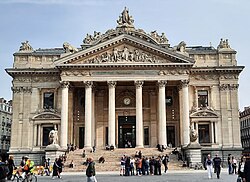
The Bourse Palace on Boulevard Anspach

Brussels Stock Exchange
Photo by Guy Delsaut / Wikimedia Commons / CC BY-SA 4.0 · Wikimedia Commons · CC BY-SA 4.0

6 min of listening · Section 1 of 5: Welcome to the Brussels Stock Exchange

Prefer reading? The full guide is below

Here in person? Walk on with Mappu

This audio guide tells one place’s story. Walk Mode keeps going as you walk:

  • It knows where you are and talks about what’s in front of you, not only these chapters.
  • It takes you on to the next sight and follows what interests you.
  • Ask about anything you see, and it answers on the spot.
  • Your phone stays in your pocket.

A 2-hour live walk with Mappu, €4.99.

50 credits from the Starter pack. One-time purchase, no subscription.

Self-guided audio walk. No guide accompanies you. Not affiliated with the sites.

Keep exploring

Discover more places in Mappu.

Brussels Stock Exchange • Section 1 of 5

Brussels Stock Exchange: is there a free audio guide?

Quick answer. Yes. Mappu’s Brussels Stock Exchange audio guide (Brussels, Belgium) is free in your browser: 5 sections and about 6 minutes of listening, in 6 languages. It covers “From Napoleon's Decree to a Palace”, “A River Buried, a Boulevard Born” and “Reading the Facade: Style and Sculpture”. In the Mappu app, Walk Mode narrates the places around you as you move and answers your follow-up questions.

Brussels Stock Exchange map

Mappu's own map of the place, with the paths and entrances OpenStreetMap shows around it.

Brussels Stock Exchange mapThe place on the map, with the guide's point marked.

Brussels Stock Exchange: what does the audio guide cover?

  1. 01

    Welcome to the Brussels Stock Exchange

    Welcome to the Bourse, the grand building that sits right on Boulevard Anspach in the heart of Brussels. Locals call it la Bourse in French or de Beurs in Dutch. Its full name is the Palais de la Bourse, or Beurspaleis, which simply means Stock Exchange Palace. Look around you: the square in front of it, the Place de la Bourse, takes its name from this building. After the Grand-Place, it is considered the second most important square in the city. This is a place where money, politics and city planning all collided. The exchange itself was created in 1801 by decree of Napoleon, and the building you see was raised in the following century as part of a dramatic makeover of central Brussels. Today the trading is long gone from here, and the palace has found a second life as a cultural venue. Over the next few stops, we will look at how the building came to exist, what its facade is made of, and what you can do with it now. Take a slow look at the rooflines and the sculpted details as we go.

  2. 02

    From Napoleon's Decree to a Palace

    The story starts in 1801, when Napoleon decreed that a stock exchange should exist in Brussels. At the time the French government gave it a home in a former Augustinian monastery on the Rue Fossé aux Loups, which in Dutch is Wolvengracht. Over the following decades the exchange moved between different premises. That was fine until Belgium's economy and industry took off. By 1858 business was booming, and the cramped, unsanitary conditions of those makeshift venues had brokers and merchants demanding a proper new building from the city authorities. The idea of a stock exchange in general has an older, almost folkloric origin. The word bourse is traditionally traced back to the 13th century in Bruges, where international merchants gathered at an inn called Van der Buerse to do their deals. So when you look at this palace, you are looking at the end of a very long journey: from merchants meeting at an inn, to a decree from an emperor, to a purpose-built monument to commerce.

  3. 03

    A River Buried, a Boulevard Born

    Here is a fact that changes how you see this street: Boulevard Anspach sits where a river used to flow. Between 1867 and 1871, the river Senne was covered over for health and aesthetic reasons, and a massive program of beautification followed in the city centre. Grand boulevards were planned in the river's place. The architect Léon-Pierre Suys proposed a series of those boulevards, and as part of his plan he designed a stock exchange to become the centre of the fast-growing business district. Supported by several petitions, his proposal won the backing of the municipal council. The building was erected from 1868 to 1873. It rose on the site of the former Butter Market, which itself had been built over the remains of a 13th-century Franciscan convent, the Recollets. So this one spot has been a convent, a market and a temple of finance. If you want to go deeper into the medieval layer, the Bruxella 1238 underground archaeological site is close by.

  4. 04

    Reading the Facade: Style and Sculpture

    Now look up and take in the architecture. Suys created an eclectic building, inspired by Palladian architecture, that mixes borrowings from the neo-Renaissance with the Second Empire style, the lavish look associated with Paris in the mid-nineteenth century. The result is a building that is anything but restrained. Ornaments and sculptures cover it. They were made by famous artists, including the brothers Jacques and Jean-Joseph Jacquet and the French sculptor Albert-Ernest Carrier-Belleuse. Carrier-Belleuse worked here with his then-assistant, a young man named Auguste Rodin, who would go on to become one of the most celebrated sculptors in history. It is a little thrilling to think that his early hand may be somewhere in this decoration. Walk around the building if you can. The rear faces the Rue du Midi, also called Zuidstraat, and it offers a different view from the grand front on the boulevard. Notice how the building commands the whole square, just as its builders intended.

  5. 05

    Before You Head Off

    The financial exchange eventually joined Euronext, together with the Amsterdam, Lisbon and Paris exchanges, and the best-known index on the Brussels market was the BEL twenty. The building, though, kept going. In September 2023 it opened its doors in a new role, as the home of Belgian Beer World, an immersive journey through Belgian brewing culture spread over 12,000 square meters. If you are mainly here for the architecture, the exterior and the public hall can be enjoyed without buying a museum ticket. Opening arrangements can change, so it is worth checking current details before you plan around them. Before you move on, step back into the square one more time. Try to picture brokers crowding the steps, then the river that once ran beneath this street, then the convent that came before it all. Then see where your curiosity pulls you next, perhaps down toward the medieval layers of the city or up toward the sculpted details of the roofline.

About this guide

AI-generated from 6 sources; reviewed for accuracy and last updated on October 25, 2026. Verify tickets and opening hours on the official site.

Run a travel site or blog? Embed this audio guide for free.

Walk on from here

This place is stop 2 of 4 of a self-guided walk: Brussels Christmas markets. About 1.4 km and 20 minutes on foot, plus about 25 minutes of listening.

Route map: walking on from Brussels Stock Exchange4 numbered stops in walking order. Stop 1: St Catherine's Church; Stop 2: Brussels Stock Exchange; Stop 3: La Monnaie; Stop 4: Grand-Place.Stop 1: St Catherine's Church1Stop 2: Brussels Stock Exchange2Stop 3: La Monnaie3Stop 4: Grand-Place4
Distances are estimates along the walking route, from OpenStreetMap.

Indicative route. While you walk, watch where you're going, mind the traffic and follow local signs and rules. The map is an aid, not a safety guide. Terms

  1. St Catherine's Church

    about 0.5 km · about 7 min on foot

  2. Brussels Stock ExchangeThis guide

    about 0.5 km · about 6 min on foot

  3. La Monnaie

    about 0.5 km · about 6 min on foot

  4. Grand-Place
Photo attribution

Walk Mode, in the free Mappu app: 2 hours for 50 credits (€4.99 Starter pack)

See the whole walk

Plan your trip on a map and get an audio guide for almost any place nearby: just tap it on the Mappu map.

Common questions

Brussels Stock Exchange: how long is the free audio guide?

About 6 minutes of listening in 5 sections: “Welcome to the Brussels Stock Exchange”, “From Napoleon's Decree to a Palace”, “A River Buried, a Boulevard Born”, “Reading the Facade: Style and Sculpture”, and “Before You Head Off”.

Brussels Stock Exchange: what can I ask Mappu after the guide?

You can ask follow-up questions such as “How did the Brussels Stock Exchange come to be created, and where did it first operate before this palace was built?” and keep asking in Mappu, with the guide connected to your map and trip plan.