Grand-Place Audio Guide

The golden heart of Brussels

Grand-Place
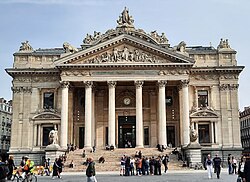
Photo by Celuici / Wikimedia Commons / CC BY-SA 4.0 · Wikimedia Commons · CC BY-SA 4.0

6 min of listening · Section 1 of 5: Welcome to Grand-Place

Prefer reading? The full guide is below

Here in person? Walk on with Mappu

This audio guide tells one place’s story. Walk Mode keeps going as you walk:

  • It knows where you are and talks about what’s in front of you, not only these chapters.
  • It takes you on to the next sight and follows what interests you.
  • Ask about anything you see, and it answers on the spot.
  • Your phone stays in your pocket.

A 2-hour live walk with Mappu, €4.99.

50 credits from the Starter pack. One-time purchase, no subscription.

Self-guided audio walk. No guide accompanies you. Not affiliated with the sites.

Keep exploring

Discover more places in Mappu.

Grand-Place • Section 1 of 5

Grand-Place: is there a free audio guide?

Quick answer. Yes. Mappu’s Grand-Place audio guide (Brussels, Belgium) is free in your browser: 5 sections and about 6 minutes of listening, in 6 languages. It covers “From Market Stalls to Ruins and Rebirth”, “Guildhalls, Gold and the Pride of the Trades” and “Town Hall, King's House and the Man Who Saved Old Brussels”. In the Mappu app, Walk Mode narrates the places around you as you move and answers your follow-up questions.

Grand-Place map

Mappu's own map of the place, with the paths and entrances OpenStreetMap shows around it.

Grand-Place mapThe place on the map, with the guide's point marked.

Grand-Place: what does the audio guide cover?

  1. 01

    Welcome to Grand-Place

    Welcome to the Grand-Place, the central square of Brussels. You are standing in a cobbled rectangle that measures 68 by 110 meters. The Dutch name is Grote Markt, which simply means Big Market, and that tells you what this place was for. It was the commercial heart of the city, and it is also the seat of the Town Hall, so it has long been the political center too. Take a slow turn on the spot. Around you, opulent guildhalls crowd shoulder to shoulder with the grand civic buildings. The earliest written reference to the square goes back to the twelfth century, yet most of what you see dates from the late seventeenth century. That is one of the great surprises of this place. It looks like a single, harmonious composition, but it grew from the rivalry and pride of merchants, craftsmen and city authorities. In the next few minutes we will look at how the square was destroyed and reborn, who built these houses and why, what the buildings say in stone and gold, and how this market square became a World Heritage Site in 1998. Let your eyes wander upward as we go. Most of the stories are written above head height.

  2. 02

    From Market Stalls to Ruins and Rebirth

    The Grand-Place began as a market. It was laid out after the construction of the town hall, in the middle of the city's commercial district, and the neighboring streets still carry the memory of that trading life. They are named after the sellers of butter, cheese, herring, coal and more. Walk a few steps away from the square and you are reading a shopping list from centuries ago. Then comes the dramatic chapter. In 1695 the square was destroyed by French artillery. What you see today is a faithful representation of that square, rebuilt in its earlier form. This is why most of the surrounding buildings date mainly from the late seventeenth century. The whole ensemble was raised in a relatively compact burst of rebuilding. That gives the place its unity. Public and private buildings that belong to one period stand together, and the result reads as a statement of resilience. The city's pride and power, in the words of the World Heritage record, are symbolized right here. A square wrecked by cannon fire became, in time, one of the most admired in Europe.

  3. 03

    Guildhalls, Gold and the Pride of the Trades

    Look closely at the facades along the sides of the square. Over time, wealthy merchants and the increasingly powerful guilds of Brussels built houses around the Grand-Place. Many of these were guildhalls, the headquarters of the trades that shaped the city. Their facades carry sculpted details depicting the symbols and tools of the crafts that once played a major role in Brussels life. Each house was a public advertisement for its trade. Then there is the gold. The decorations glint on the stonework, giving the square a golden glimmer that you will not find in many other places. At nightfall, when the square lights up, the gilding stands out more than ever and the whole space seems to glow. The mix of styles is part of the charm. Baroque guildhalls dominate the square, while Gothic and neo-Gothic buildings stand among them. The World Heritage record calls the square an eclectic and highly successful blending of architectural and artistic styles. It is also an outstanding public open space, which tells the story of a thriving mercantile city of northern Europe at the height of its prosperity.

  4. 04

    Town Hall, King's House and the Man Who Saved Old Brussels

    Two civic landmarks command the square. One is the Town Hall, the seat of Brussels municipal government. Opposite it stands the neo-Gothic Maison du Roi, which means the King's House in French. In Dutch it is still called the Broodhuis, the Bread House, after the market whose place it took. Since 1887 it has been home to the City Museum of Brussels, where you can find original statues from the Town Hall, paintings, wall tapestries and artifacts that tell the city's story. The survival of this old quarter owes something to one man. Charles Buls became Mayor of Brussels in 1881 and remained in office until 1899. He emerged as a champion of historic preservation, and his most lasting achievement was his opposition to the grandiose architectural schemes of King Leopold the Second. Thanks to that resistance, old parts of Brussels were preserved. When you look at the square today, you are looking at a city that chose, at a decisive moment, to keep its past rather than sweep it away. That choice is part of why the Grand-Place is now considered one of the most beautiful town squares in Europe.

  5. 05

    Before You Head Off

    The Grand-Place has been a World Heritage Site since 1998, recognized as an outstanding example of blended architectural styles and as a public space that illustrates the achievements of a flourishing merchant city. It is still a living stage rather than a museum piece. Festive and cultural events fill it throughout the year. The Ommegang medieval pageant takes place in June. In August of every even year, an immense flower carpet is laid in the center of the square. Christmas festivities arrive in December. Before you wander on, try a few small experiments. Pick one guildhall and search its facade for the tools and symbols of a trade. Look at how the gold catches the light at different times of day. Then step into one of the side streets and see which old market trade has left its name on the street sign. The square rewards a second look, and then a third, because every facade hides another story. Where will your eyes land first?

About this guide

AI-generated from 6 sources; reviewed for accuracy and last updated on October 25, 2026. Verify tickets and opening hours on the official site.

Run a travel site or blog? Embed this audio guide for free.

Walk on from here

This place is stop 4 of 4 of a self-guided walk: Brussels Christmas markets. About 1.4 km and 20 minutes on foot, plus about 25 minutes of listening.

Route map: walking on from Grand-Place4 numbered stops in walking order. Stop 1: St Catherine's Church; Stop 2: Brussels Stock Exchange; Stop 3: La Monnaie; Stop 4: Grand-Place.Stop 1: St Catherine's Church1Stop 2: Brussels Stock Exchange2Stop 3: La Monnaie3Stop 4: Grand-Place4
Distances are estimates along the walking route, from OpenStreetMap.

Indicative route. While you walk, watch where you're going, mind the traffic and follow local signs and rules. The map is an aid, not a safety guide. Terms

  1. St Catherine's Church

    about 0.5 km · about 7 min on foot

  2. Brussels Stock Exchange

    about 0.5 km · about 6 min on foot

  3. La Monnaie

    about 0.5 km · about 6 min on foot

  4. Grand-PlaceThis guide

Photo attribution

Walk Mode, in the free Mappu app: 2 hours for 50 credits (€4.99 Starter pack)

See the whole walk

Plan your trip on a map and get an audio guide for almost any place nearby: just tap it on the Mappu map.

Common questions

Grand-Place: how long is the free audio guide?

About 6 minutes of listening in 5 sections: “Welcome to Grand-Place”, “From Market Stalls to Ruins and Rebirth”, “Guildhalls, Gold and the Pride of the Trades”, “Town Hall, King's House and the Man Who Saved Old Brussels”, and “Before You Head Off”.

Grand-Place: what can I ask Mappu after the guide?

You can ask follow-up questions such as “How did the square come to look so unified when it grew from merchants, guilds and civic authorities?” and keep asking in Mappu, with the guide connected to your map and trip plan.