

Troy: how long is the free audio guide?
About 6 minutes of listening in 5 sections: “Welcome to Troy”, “A Gateway Between Seas”, “Nine Cities in One Hill”, “Digging for Troy”, and “Before You Head Off”.
Hisarlık, the mound where myth and archaeology meet
Guides for sites with little or no information on site
Quick answer. Yes. Mappu’s Troy audio guide (Çanakkale, Turkey) is free in your browser: 5 sections and about 6 minutes of listening, in 6 languages. It covers “A Gateway Between Seas”, “Nine Cities in One Hill” and “Digging for Troy”. In the Mappu app, Walk Mode narrates the places around you as you move and answers your follow-up questions.
Mappu's own map of the place, with the paths and entrances OpenStreetMap shows around it.
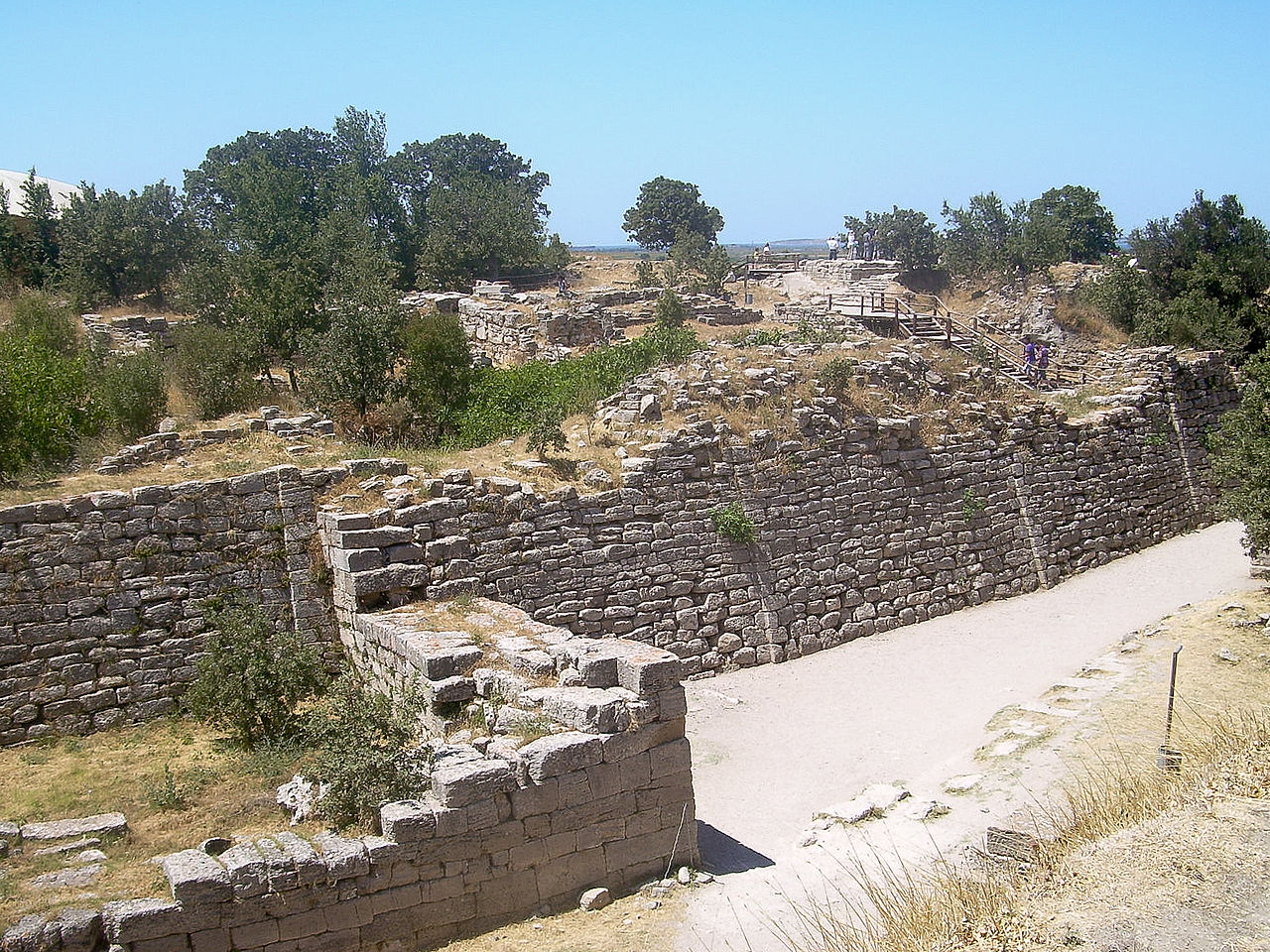
Welcome to Troy, one of the few places on Earth where a poem and a patch of ground share the same name. This is the archaeological site known as Hisarlık, in the Çanakkale region of Turkey. It sits close to Tevfikiye village, about 30 kilometers from the center of Çanakkale and about four and a half kilometers from the coast. The ancient city was called Troy, and also Ilion. It is best known as the setting of the Greek myth of the Trojan War, the story told in Homer's Iliad. Today the site is open to visitors and is a UNESCO World Heritage property. It was declared a Historical National Park in 1996, and in 1998 it joined the World Heritage List. As you listen, keep two things in mind. One is the legend, with its heroes, its stolen queen and its famous wooden horse. The other is the mound itself, a stack of settlements built one upon another, which has been studied for generations. This guide tells you which is which as we go.
To understand why a city grew here, look at the map. Troy stood near the entrance of the Dardanelles, where routes linking the Aegean, Anatolia, the Balkans and the Black Sea came together. As a port city, it took part in maritime trade and became a strategic settlement controlling the passage from the Aegean Sea to the Black Sea. That position shaped its character. Troy served as a meeting point for the civilizations that ruled here and their neighbors, in trade and in culture. Archaeologists have argued that its place at the mouth of the Dardanelles may have given it the function of a regional capital, with its status protected by treaties. The city also served as a reference point for other archaeological sites in Europe and the Aegean, because its sequence of layers is so continuous. The settlement you are standing in belonged to a distinct Northwest Anatolian culture. It had extensive foreign contacts, including with Mycenaean Greece. So when you feel the wind here, remember that it blows across one of the busiest crossroads of the ancient world.
What looks like a single ruin is really a stack of settlements, traditionally numbered Troy I through Troy IX. They record thousands of years of urban life, destruction, rebuilding, trade, warfare and cultural change. People rebuilt on top of earlier remains again and again, and that is how the mound grew. Troy VI is a fascinating chapter. Its builders were architectural innovators, and it holds the first evidence of horses at the site. Its material culture belongs to a Northwest Anatolian group with influences from the Aegean and the Balkans. Even though the city seems to have lain within the Hittite sphere of influence, no Hittite artifacts have been found in this layer. Sculptures and wall paintings, common in Bronze Age cities, are also notably absent. Then there is the question everyone asks: is this Homer's Troy? Some aspects of the architecture are consistent with the Iliad's description of the mythic city. Two sublayers, called VIh and VIIa, show potential signs of violent destruction. Historians read these clues with interest, but the poem remains a poem, and the layers speak in their own quieter language.
The modern story of Troy's excavation begins with Heinrich Schliemann in the 1870s. His enthusiasm was legendary, and so were his mistakes. He gave the name Priam's Treasure to a hoard that actually belonged to an earlier era of the city, a reminder of how easily a good story can race ahead of the evidence. Excavation has continued, with new teams and new techniques. Between 2006 and 2012 the work was directed by Ernst Pernicka, a colleague of the earlier excavator Korfmann. In 2013 an international, cross-disciplinary team led by William Aylward of the University of Wisconsin-Madison was set to use a technique called molecular archaeology. Since 2014 a team from Çanakkale Onsekiz Mart University, led by Rüstem Aslan, has been digging here. The excavators claim to have found a Level 0 near the entrance of Troy II, which would push the city's history back by 600 years. Much is still waiting to be learned. As of 2013, only 2 to 3 percent of the lower city had been excavated, and almost 2 meters of the surface has eroded away, probably removing much of the evidence. Every season of digging is therefore still adding to the picture.
Allow roughly an hour and a half to two and a half hours to explore the archaeological site itself. If you combine it with the Troy Museum, plan for three to four hours. The museum's top level is mainly about the history of the Troy excavations. It also has exhibitions on Troy in the Gallipoli battles, Troy in popular culture and art, Ottoman Çanakkale, and the Lost Heritage. If you want more of the legend, Çanakkale's seaside promenade displays the wooden horse from the 2004 film Troy. And if the landscape draws you further, the province is also known for the Gallipoli battlefield sites and the ancient city of Assos. As you walk back, look at the ground and the layers once more. Ask yourself which parts you are reading as history, which as legend, and which as questions that still lie buried under the mound.
AI-generated from 6 sources; reviewed for accuracy and last updated on October 26, 2026. Verify tickets and opening hours on the official site.
Planning a trip to Çanakkale?
Mappu sketches your days free in the chat, no account needed. Then take the full plan with you:
Tickets, tours and practical extras for this trip, from Mappu's partners.
Partner links (Airalo, Amazon, Booking.com, GetYourGuide, Klook, Tiqets, Trip.com, Viator, Welcome Pickups): if you book or buy through them, Mappu may earn a commission, at no extra cost to you.
 PergamonBergama
 Emir Sultan MosqueBursa
 Ephesus Basilica StoaSelcuk
 Aksaray Valide Sultan CamiiIstanbul
 Laleli MosqueIstanbul
 Grand Bazaar IstanbulIstanbul
Plan your trip on a map and get an audio guide for almost any place nearby: just tap it on the Mappu map.
About 6 minutes of listening in 5 sections: “Welcome to Troy”, “A Gateway Between Seas”, “Nine Cities in One Hill”, “Digging for Troy”, and “Before You Head Off”.
You can ask follow-up questions such as “Why did Troy's position near the entrance of the Dardanelles make it so important for trade and travel?” and keep asking in Mappu, with the guide connected to your map and trip plan.