National Palace Museum Audio Guide

Audio guide for National Palace Museum

National Palace Museum
Photo by PeelldenWikimedia CommonsCC BY 3.0

7 min of listening · Section 1 of 5: Welcome to National Palace Museum

Prefer reading? The full guide is below

Here in person? Walk on with Mappu

This audio guide tells one place’s story. Walk Mode keeps going as you walk:

  • It knows where you are and talks about what’s in front of you, not only these chapters.
  • It takes you on to the next sight and follows what interests you.
  • Ask about anything you see, and it answers on the spot.
  • Your phone stays in your pocket.

A 2-hour live walk with Mappu, €4.99.

50 credits from the Starter pack. One-time purchase, no subscription.

Self-guided audio walk. No guide accompanies you. Not affiliated with the sites.

Keep exploring

Discover more places in Mappu.

National Palace Museum • Section 1 of 5

National Palace Museum: is there a free audio guide?

Quick answer. Yes. Mappu’s National Palace Museum audio guide (Taipei, Taiwan) is free in your browser: 5 sections and about 7 minutes of listening, in 8 languages. It covers “National Palace Museum: A Journey Across the Water”, “National Palace Museum: Why Taipei Needed a New Home” and “National Palace Museum: Treasures, Gardens and a Disputed Legacy”. In the Mappu app, Walk Mode narrates the places around you as you move and answers your follow-up questions.

National Palace Museum map

Mappu's own map of the place, with the paths and entrances OpenStreetMap shows around it.

National Palace Museum mapThe place on the map, with the guide's point marked.

National Palace Museum: what does the audio guide cover?

  1. 01

    Welcome to National Palace Museum

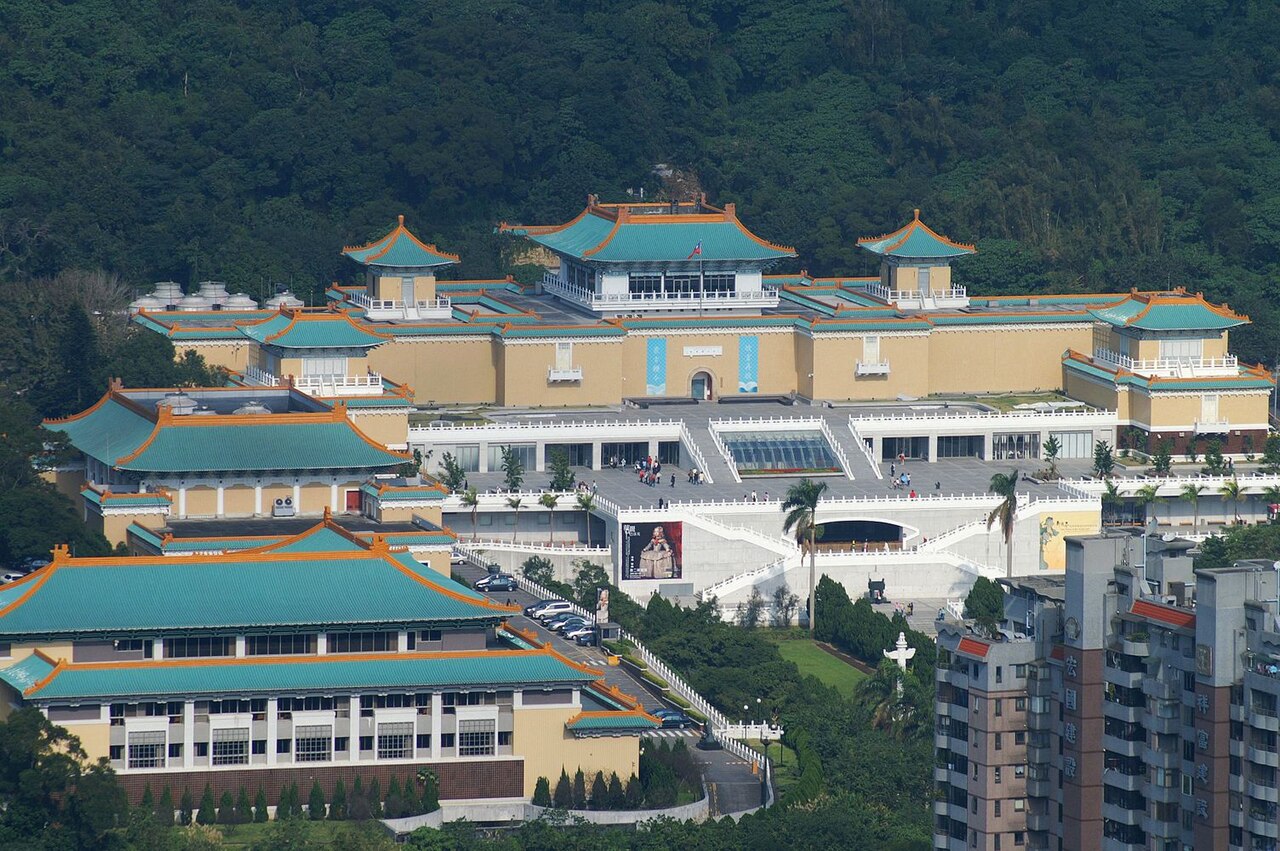
    Welcome to the National Palace Museum, known in Chinese as 國立故宮博物院. You are standing on Zhishan Road, Section 2, in Taipei's Shilin District, in the Waishuangxi area. This is the main campus, the northern branch, of the largest museum in Taiwan, and it is counted among the Eight Scenic Spots of Taiwan. The numbers give you a sense of the scale. Nearly 700,000 pieces fall into three great families: objects, paintings and calligraphy, and books and documents. Many of them descend from the collections of the Song, Yuan, Ming and Qing courts. The museum has welcomed more than 6 million visitors in a year, and in 2015 it ranked sixth in the world for visitors to an art museum. Over the next few stops, we will follow the collection's long journey, from Beijing to a Taiwanese sugar warehouse to this hillside. Then we will look at the building that was designed to hold it, and finish with the gardens and the practical side of a visit.

  2. 02

    National Palace Museum: A Journey Across the Water

    The story of this museum begins in Beijing in 1925, long before anyone imagined a building in Shilin. The museum was re-established here in Taipei in 1965. The journey between those two dates is one of the most dramatic chapters in museum history. A first shipment of 772 crates left Nanjing's Xiaguan docks aboard the ship Zhongding. Nine escorts, including Li Ji, Zhuang Yan and Tan Danjiong, went with it. The crates reached the port of Keelung on December 26, and the next morning they were loaded onto a train to a warehouse in Yangmei. A second shipment of 3,502 crates followed on the ship Haihu, accompanied by 12 people, among them Na Zhiliang, Wu Yuzhang, Liang Tingwei, Chang Bide, Li Lin-ts'an and Suo Yuming. On January 9, 1949, the crates went on to two warehouses of the sugar factory in Taichung, near Zhenxing Road. Today the museum holds about 22 percent of the crates originally sent south from the Forbidden City, 2,972 out of 13,491. Add 852 crates from the National Central Museum and you reach a collection of 608,985 cultural relics.

  3. 03

    National Palace Museum: Why Taipei Needed a New Home

    For years the treasures lived in modest quarters in the Beigou area. The exhibition room there was cramped and remote, so the public could hardly be served. Worse, rain found its way into the storerooms. Those problems led the joint board of the two museums, on December 7, 1959, to propose a modern museum in Taipei. Board chairman Wang Yunwu secured the approval of Premier Chen Cheng, and a budget of 62 million New Taiwan dollars was allocated. In September of the following year, a relocation group was set up to start preparing the new museum. In August 1965, regulations were issued for a management committee to run the National Palace Museum. The building itself came from a closed competition in 1961. Wang Shijie invited five architects, and Wang Dahong's design won. It blended the simple look of Mies van der Rohe with a roof built as an upturned umbrella, a hyperbolic curve. Premier Chen Cheng was not entirely happy with the result. The site now covers more than 212,000 square meters, with a total floor area of 58,145 square meters.

  4. 04

    National Palace Museum: Treasures, Gardens and a Disputed Legacy

    The collection reaches back a very long way. The imperial collecting tradition began in the Song dynasty, more than a thousand years ago, and the holdings span roughly 8,000 years of Chinese civilization. The museum has also been collecting the cultural objects of Asian peoples, to widen its range beyond its imperial inheritance. A three-year renovation of the main hall was completed in February 2007. It brought new exhibition techniques and added digital learning spaces, including a digital guide hall, multimedia screening rooms and a children's multimedia learning area. The idea was a museum without walls. The grounds include two traditional gardens, Zhishan Garden and Zhide Garden. Within the compound lies a classical garden in the Song and Ming style, covering 1.88 hectares, designed around feng shui, water management, landscape design and Chinese folklore. The collection's ownership is also a matter of contention. The government of the People's Republic of China holds that the treasures were removed illegally during the Chinese Civil War, while Taiwan asserts ownership. Some within Taiwan argue the collection does not belong to Taiwanese culture. It is a story that sits behind the glass cases.

  5. 05

    Before You Head Off

    A few practical pointers before you go in. The museum is listed as closed on Mondays and open from 9 a.m. to 5 p.m. from Tuesday to Sunday. Admission is free for visitors under 18, and for Taiwanese citizens aged 65 and over on weekdays. Free admission is also offered on January 1, on the Lantern Festival, on May 18 for International Museum Day, on September 27 for World Tourism Day, and on October 10 for National Day. Combined tickets also exist, pairing the museum with the Shung Ye Museum of Formosan Aborigines or with the Miramar Entertainment Park ferris wheel. Nearby, you will find bicycle-sharing stations a short distance away. A future Circular Line station called Palace Museum is also planned nearby, though it is still under construction. As you walk through the galleries, ask yourself what it means for a collection that began in imperial palaces to now be shared with everyone. Look at the curve of the roof, think of the crates on a train from Keelung, and see what catches your eye.

About this guide

AI-generated from 6 sources; checked automatically and last updated on October 31, 2026. Verify tickets and opening hours on the official site. Independent guide by Mappu. Not affiliated with or endorsed by the site or its managers.

Run a travel site or blog? Embed this audio guide for free.

Planning a trip to Taipei?

Get your plan

Mappu sketches your days free in the chat, no account needed. Then take the full plan with you:

  • Weekend trip, €9.99: Your day-by-day plan plus 2 live walks
  • Save your trip’s free guides on your phone in the Mappu app: they play with no signal
See the trip packs

Already going? The 2-hour live walk in Taipei is €4.99

Plan your trip on a map and get an audio guide for almost any place nearby: just tap it on the Mappu map.

Common questions

National Palace Museum: how long is the free audio guide?

About 7 minutes of listening in 5 sections: “Welcome to National Palace Museum”, “National Palace Museum: A Journey Across the Water”, “National Palace Museum: Why Taipei Needed a New Home”, “National Palace Museum: Treasures, Gardens and a Disputed Legacy”, and “Before You Head Off”.

National Palace Museum: what can I ask Mappu after the guide?

You can ask follow-up questions such as “How did the crates of treasures travel from Nanjing to Keelung and on to Taichung?” and keep asking in Mappu, with the guide connected to your map and trip plan.