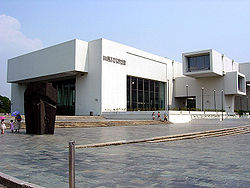
The architect was Kao Er-Pan, and his design is one of the most distinctive in Taipei. It has been described as a local interpretation of the Japanese Metabolist Movement, a school of thought that treats buildings as living, growing structures. Now look for the Chinese roots. The design borrows from traditional Chinese architecture through the structure of piled brackets, translated into suspended corridors. Together these corridors form a tube-shaped composition. That tube is identical to the Chinese character for fountain, which gives the museum a poetic idea to live up to: a living source of culture, always flowing. Inside, symmetrical, suspended gallery spaces spread across each floor. Grand windows frame views over Yuan Shan, the fine arts park area and the surrounding city. The plan also combines the building with a natural courtyard, which matched the museum's original blueprint. Outside, Zhongshan North Road runs alongside. It is generally known as the national road, the usual route taken by foreign leaders entering and leaving the country, so the museum sits beside one of Taipei's ceremonial routes.