Alcazar of Cordoba Audio Guide

A Journey Through Seven Centuries of Power

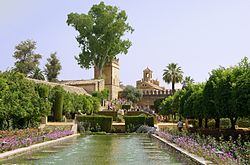
Alcazar of Cordoba
Photo by JebulonWikimedia CommonsPublic domain

7 min of listening · Section 1 of 5: Welcome to the Fortress of the Christian Monarchs

Prefer reading? The full guide is below

Walk on from here

Alcázar, Mezquita and Malmuerta, Córdoba, live with Mappu: the stories of what’s in front of you, stop by stop. 50 credits (€4.99).

Alcazar of Cordoba • Section 1 of 5

Alcazar of Cordoba: is there a free audio guide?

Quick answer. Yes. Mappu’s Alcazar of Cordoba audio guide (Cordoba, Spain) is free in your browser: 5 sections and about 7 minutes of listening, in 8 languages. It covers “Royalty and the Discovery of the New World”, “The Towers and the Shadows of the Inquisition” and “A Sanctuary of Water and Roman Mosaics”. In the Mappu app, Walk Mode narrates the places around you as you move and answers your follow-up questions.

Before you visit

The official ticket shop currently sells entry to the Alcázar gardens only; check the official site for which areas are open before you go.

Last verified October 11, 2026. Sources: cultura.cordoba.es, alcazardelosreyescristianos.cordoba.es, museosdecordoba.sacatuentrada.es, alcazardelosreyescristianos.sacatuentrada.es

Alcazar of Cordoba map

Mappu's own map of the place, with the paths and entrances OpenStreetMap shows around it.

Alcazar of Cordoba mapThe place on the map, with the guide's point marked.

Alcazar of Cordoba: what does the audio guide cover?

  1. 01

    Welcome to the Fortress of the Christian Monarchs

    Welcome to the Alcazar of Cordoba, formally known as the Alcázar de los Reyes Cristianos. As you stand here on the Avenue del Alcázar, you are stepping onto ground that has served as a seat of power for nearly 2,000 years. This site is a perfect example of what historians call the layers of Cordoban history. Long before the stone walls you see today were raised, this very spot housed the residence of the Roman governor and later served as the grand palace for the Umayyad Caliphate until the Christian conquest in twelve thirty-six. The present structure was largely ordered by King Alfonso the Eleventh in 1328, built with a design that reflects both military strength and the exquisite beauty of the Mudéjar style, which blends Christian and Islamic artistic traditions. This fortress-palace is not just a building; it is a testament to the complex identity of Andalusia. As you begin your walk, take a moment to look at the thick exterior walls. They were built for defense, yet inside, they protect some of the most serene and historically significant spaces in all of Spain.

  2. 02

    Royalty and the Discovery of the New World

    One of the most defining eras of this palace began in 1482, when it became the primary residence and headquarters for the Catholic Monarchs, Queen Isabella the First and King Ferdinand the Second. For eight years, they lived within these walls, using the Alcazar as a strategic base to plan their final campaigns against the Nasrid dynasty in Granada. However, the most world-changing event occurred in 1486, right here in these very grounds. A little-known navigator named Christopher Columbus arrived to meet the monarchs for the first time. He came with a bold and uncertain proposal: to reach the Indies by sailing west across the Atlantic Ocean. While the monarchs initially kept him on their payroll without full support, it was here that the foundations for the Discovery of America were laid. As you explore, look for the statues in the garden that commemorate this pivotal meeting. You can almost imagine the tension and hope in the air as Columbus stood before the kings, clutching his maps and pleading for a chance to change the course of history.

  3. 03

    The Towers and the Shadows of the Inquisition

    The architecture of the Alcazar is defined by its four corner towers, each with a unique story and purpose. To the northwest is the Tower of the Lions, the oldest of the four, which dates back to the thirteenth century and is named after the weathered lion-shaped gargoyles that still look down from its summit. To the northeast stands the octagonal Tower of Homage, where soldiers once swore their loyalty to the crown and royal proclamations were read aloud. However, the building also holds a darker past. In 1482, the monarchs established one of the first permanent tribunals of the Spanish Inquisition here. The Tower of the Inquisition, situated in the southwest corner, served as the archive for the Holy Office's records for over three centuries. During this time, the once-harmonious royal baths were transformed into interrogation chambers as the palace became a place of fear. After the Inquisition ended in the early nineteenth century, the Alcazar transitioned into a civil and military prison, a function it held until 1951. These stones have witnessed both the heights of royal luxury and the depths of human suffering.

  4. 04

    A Sanctuary of Water and Roman Mosaics

    After passing through the fortress walls, you will discover the Hall of Mosaics, which is perhaps the most surprising room in the palace. It is filled with stunning Roman mosaics dating from the second and third centuries, which were unearthed at the nearby Corredera Square in the late 1950s. These intricate artworks, featuring mythological figures like Medusa and Polyphemus, are a direct link to Cordoba’s ancient life as a grand Roman colony. From the hall, you can transition into the 55,000 square meters of terraced gardens. These gardens are the real soul of the Alcazar, featuring symmetrical pools, sculpted cypresses, and fragrant orange and lemon trees. Here is a practical pointer for your visit: the best time to experience the gardens is in the late afternoon. As the sun begins to set, the light hits the long reflections in the rectangular pools at a perfect angle, creating a stunning and quiet atmosphere for photography after the mid-morning tour groups have departed. It is here, among the water channels and fountains, that you truly feel the lasting influence of the city’s Islamic heritage on garden design.

  5. 05

    Before You Head Off

    As you continue your walk through these gardens or climb the battlements for a panoramic view of the Guadalquivir River, take a moment to reflect on the immense weight of time this site carries. Since 1994, the Alcazar has been recognized as a United Nations Educational, Scientific and Cultural Organization World Heritage Site, not just as a fortress, but as a crucial part of the historic heart of Cordoba. Whether you are looking at the Roman sarcophagus in the gallery, the Gothic vaults of the towers, or the gentle movement of the fish in the garden ponds, you are interacting with pieces of a puzzle that spans seven centuries. Don't feel rushed to leave; there are many quiet corners and hidden courtyards, like the Courtyard of the Moriscos, where you can sit and absorb the history around you. The statues of the kings in the Promenade of the Kings seem to watch over the grounds even today, inviting you to wonder what other stories remain buried beneath the orange trees and stone paths. Keep your curiosity alive as you explore—there is always another layer to discover.

About this guide

AI-generated from 13 sources; checked automatically and last updated on May 29, 2026. Verify tickets and opening hours on the official site. Independent guide by Mappu. Not affiliated with or endorsed by the site or its managers.

Run a travel site or blog? Embed this audio guide for free.

Walk on from here

This place is stop 1 of 3 of a self-guided walk: Alcázar, Mezquita and Malmuerta, Córdoba. About 2.4 km and 30 minutes on foot, plus about 20 minutes of listening.

Route map: walking on from Alcazar of Cordoba3 numbered stops in walking order. Stop 1: Alcazar of Cordoba; Stop 2: The Mosque-Cathedral of Cordoba; Stop 3: Torre de la Malmuerta.Stop 1: Alcazar of Cordoba1Stop 2: The Mosque-Cathedral of Cordoba2Stop 3: Torre de la Malmuerta3
Distances are estimates along the walking route, from OpenStreetMap.

Indicative route. While you walk, watch where you're going, mind the traffic and follow local signs and rules. The map is an aid, not a safety guide. Terms

  1. Alcazar of CordobaThis guide

    about 0.8 km · about 10 min on foot

  2. The Mosque-Cathedral of Cordoba

    about 1.6 km · about 22 min on foot

  3. Torre de la Malmuerta
Photo attribution

Walk Mode, in the free Mappu app: 2 hours for 50 credits (€4.99 Starter pack)

See the whole walk

Planning a trip to Cordoba?

Get your plan

Mappu sketches your days free in the chat, no account needed. Then take the full plan with you:

  • Weekend trip, €9.99: Your day-by-day plan plus 2 live walks
  • Save your trip’s free guides on your phone in the Mappu app: they play with no signal
See the trip packs

Already going? The 2-hour live walk in Cordoba is €4.99

Plan your trip

Photo attribution

Useful for your visit

Tickets, tours and practical extras for this trip, from Mappu's partners.

Partner links (Airalo, Amazon, Booking.com, GetYourGuide, Klook, Tiqets, Trip.com, Viator, Welcome Pickups): if you book or buy through them, Mappu may earn a commission, at no extra cost to you.

Plan your trip on a map and get an audio guide for almost any place nearby: just tap it on the Mappu map.

Common questions

Alcazar of Cordoba: how long is the free audio guide?

About 7 minutes of listening in 5 sections: “Welcome to the Fortress of the Christian Monarchs”, “Royalty and the Discovery of the New World”, “The Towers and the Shadows of the Inquisition”, “A Sanctuary of Water and Roman Mosaics”, and “Before You Head Off”.

Alcazar of Cordoba: what can I ask Mappu after the guide?

You can ask follow-up questions such as “What does the military design of the towers reveal about the Alcazar's dual role as a palace and a fortress?” and keep asking in Mappu, with the guide connected to your map and trip plan.