Palácio da Bolsa Audio Guide

Porto's merchant palace, built on the ruins of a convent

Palácio da Bolsa
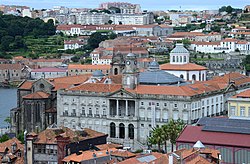
Photo by Alvesgaspar / Wikimedia Commons / CC BY-SA 4.0 · Wikimedia Commons · CC BY-SA 4.0

6 min of listening · Section 1 of 5: Welcome to Palácio da Bolsa

Prefer reading? The full guide is below

Keep exploring

Discover more places in Mappu, or start Walk Mode when you’re there.

Live Walk Mode: 2 hours for 50 credits (€4.99 Starter pack)
Palácio da Bolsa • Section 1 of 5

Palácio da Bolsa: is there a free audio guide?

Quick answer. Yes. Mappu’s Palácio da Bolsa audio guide (Porto, Portugal) is free in your browser: 5 sections and about 6 minutes of listening, in 6 languages. It covers “From Convent Ruins to Merchant Palace”, “An Architect and a Neopalladian Idea” and “Rooms of Splendor: Nations and Alhambra Dreams”. In the Mappu app, Walk Mode narrates the places around you as you move and answers your follow-up questions.

Palácio da Bolsa: what does the audio guide cover?

  1. 01

    Welcome to Palácio da Bolsa

    Welcome to the Palácio da Bolsa, the Stock Exchange Palace, in the historic centre of Porto. You are on Rua de Ferreira Borges, at the edge of the Infante Dom Henrique square, in a part of the city that is a UNESCO World Heritage Site. Right beside the palace stands the Church of Saint Francis, and that neighbour is the key to the whole story. The palace was built by the city's Commercial Association, the Associação Comercial do Porto. It is a neoclassical building, and it was never a royal residence. Porto never had a royal palace. What the city has instead is the most monumental palace its merchants could afford to build. It has been a National Monument since 1982, and the Commercial Association still has its headquarters here. Over the next few minutes we will look at how a fire, a closed trading hall and a determined merchant class produced this building. Then we will step into its famous rooms, and finally into the turbulent years when the palace changed hands.

  2. 02

    From Convent Ruins to Merchant Palace

    Every great building has a beginning, and this one begins with a disaster. On the night of the twenty-fourth of July, 1832, during the siege of Porto in the Liberal Wars, a huge fire swept through the Convent of Saint Francis. The convent had been founded in the thirteenth century. The fire destroyed its cloisters, but the church survived, and that is the church you see standing next to the palace today. The ruins were later donated by Queen Maria the Second. The city's merchants built their new home on that ground, a place for the trading floor of the exchange and for a court of first instance. They had an urgent reason. The previous stock exchange building had closed, and Porto's traders were left discussing their business in the open air. The Commercial Association laid the first stone on the sixth of October, 1842, under the presidency of José Henriques Soares, the Baron of Ancede. Some modern accounts read the building as a symbol of the Porto merchant class asserting itself over the clergy, since a palace of commerce now stood where a convent once had.

  3. 03

    An Architect and a Neopalladian Idea

    The architect chosen for the project was Joaquim da Costa Lima Júnior, from Porto. He submitted the plans, the budget and the details of the project, and he led the work from 1840 until 1860. His design is neoclassical, with Palladian influence, and it follows a fashion that had already shaped Porto since the late eighteenth century. You can see that lineage in other buildings around the city. One is the Hospital of Saint Anthony, by the English architect John Carr. Another is the English Factory, by John Whitehead. A third group is the projects of the Portuguese architect Carlos Amarante. Costa Lima took that elegant, orderly language and gave it to the city's merchants. The clear sense of order outside is easy to notice from the square. It was meant to say that the people inside were serious and cosmopolitan. The idea was to link the merchant class with culture and knowledge, not only to follow a fashion.

  4. 04

    Rooms of Splendor: Nations and Alhambra Dreams

    The outside is restrained, but the interior is a different story. The main structure was mostly finished by 1850, but the decoration of the interiors took far longer. That work picked up from the 1860s and was only completed in 1910, with many different artists taking part. It is also linked to the construction of the old Crystal Palace in Porto, which was happening at the same time. Two rooms are famous. One is the Pátio das Nações, the Courtyard of the Nations. The other is the Salão Árabe, the Arab Room, inspired by the Alhambra palace in Granada. It is decorated in the exotic Moorish Revival style that was fashionable in the nineteenth century, and it is used as a reception hall for personalities and heads of state visiting Porto. The result is a very eclectic taste, typical of the turn of the twentieth century. It is also why the Commercial Association is still called the drawing room of the city, the place where Porto receives its guests.

  5. 05

    Before You Head Off

    The palace's story did not end with the last decorations. When the Republic was proclaimed on the fifth of October, 1910, the building was inventoried and vacated, and public ownership was recorded on the eleventh of February, 1911. One of the portraits of a monarch inside, the one of Dom Carlos the First, was vandalized with two pistol shots. The Commercial Association regained possession in 1918, during the rule of Sidónio Pais. Unlike many buildings of its era, it never fell into decline. Today it is still the home of the Commercial Association, and it hosts cultural, social and political events for the city. Before you go, take a slow look at the palace beside the Church of Saint Francis. Notice how the two buildings sit side by side, one that survived the fire and one that grew from its ruins. Then look around the neighbouring streets, where several other historic monuments are just a short walk away.

About this guide

AI-generated from 6 sources; reviewed for accuracy and last updated on October 23, 2026. Verify tickets and opening hours on the official site.

Run a travel site or blog? Embed this audio guide for free.

Walk on from here

This place is stop 4 of 4 of a self-guided walk: Cathedral to the Palácio da Bolsa, Porto. About 1.3 km and 15 minutes on foot, plus about 26 minutes of listening.

Route map: walking on from Palácio da Bolsa4 numbered stops in walking order. Stop 1: Porto Cathedral; Stop 2: Igreja de Santa Clara; Stop 3: Ribeira; Stop 4: Palácio da Bolsa.
Distances are estimates along the walking route, from OpenStreetMap.
  1. Porto Cathedral

    about 0.3 km · about 4 min on foot

  2. Igreja de Santa Clara

    about 0.6 km · about 8 min on foot

  3. Ribeira

    about 0.4 km · about 5 min on foot

  4. Palácio da BolsaThis guide

Photo attribution

Live Walk Mode: 2 hours for 50 credits (€4.99 Starter pack)

See the whole walk

Plan your trip on a map and get an audio guide for almost any place nearby: just tap it on the Mappu map.

Common questions

Palácio da Bolsa: how long is the free audio guide?

About 6 minutes of listening in 5 sections: “Welcome to Palácio da Bolsa”, “From Convent Ruins to Merchant Palace”, “An Architect and a Neopalladian Idea”, “Rooms of Splendor: Nations and Alhambra Dreams”, and “Before You Head Off”.

What is the story behind the Palácio da Bolsa?

Every great building has a beginning, and this one begins with a disaster. On the night of the twenty-fourth of July, 1832, during the siege of Porto in the Liberal Wars, a huge fire swept through the Convent of Saint Francis. The convent had been founded in the thirteenth century. The fire destroyed its cloisters, but the church survived, and that is the church you see standing next to the palace today.

Palácio da Bolsa: what can I ask Mappu after the guide?

You can ask follow-up questions such as “How did the 1832 fire at the Convent of Saint Francis lead to the creation of the Palácio da Bolsa?” and keep asking in Mappu, with the guide connected to your map and trip plan.