


Taj Mahal: how long is the free audio guide?
About 7 minutes of listening in 5 sections: “Welcome to the Taj Mahal”, “An Emperor's Grief”, “A Palace in Paradise”, “Legends, Rivalry and Preservation”, and “Before You Head Off”.
The ivory-white mausoleum on the Yamuna
Quick answer. Yes. Mappu’s Taj Mahal audio guide (Agra, India) is free in your browser: 5 sections and about 7 minutes of listening, in 6 languages. It covers “An Emperor's Grief”, “A Palace in Paradise” and “Legends, Rivalry and Preservation”. In the Mappu app, Walk Mode narrates the places around you as you move and answers your follow-up questions.
Mappu's own map of the place, with the paths and entrances OpenStreetMap shows around it.
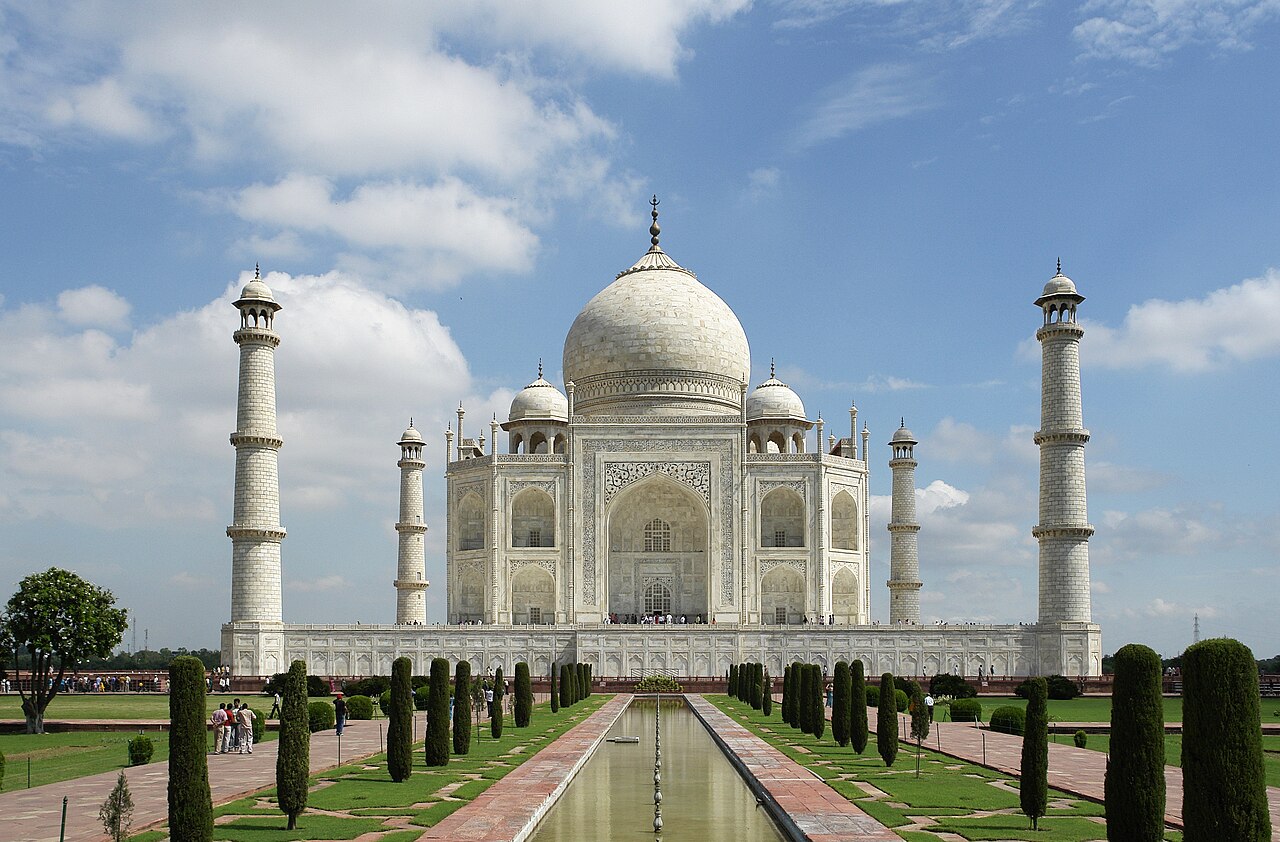
Welcome to Agra, in Uttar Pradesh, and to one of the most recognizable buildings on Earth. The Taj Mahal is an ivory-white marble mausoleum standing on the bank of the river Yamuna, just south of what was once the walled city of Agra. Its name is usually translated as Crown of the Palace. Here is what we will explore together. First, the human story behind it: an emperor, his beloved wife, and a journey of grief. Then the design, a building conceived as something far bigger than a tomb. Finally, the afterlife of the monument: legends, a long-lasting family drama, and the challenge of keeping all that white marble gleaming today. As you take in the symmetry and the gardens, notice how everything seems to point your eye toward the central tomb. The people who made it wanted exactly that effect, and they worked for more than two decades to achieve it.
The story begins with a betrothal. In 1607, the Mughal prince Khurram, who would later be known as Shah Jahan, was promised to Arjumand Banu Begum, the granddaughter of a Persian noble. History remembers her as Mumtaz Mahal. After his father Jahangir died in 1627, Shah Jahan won a bitter struggle with his brothers and crowned himself emperor at Agra in 1628. When Mumtaz Mahal died, her body was first buried far from Agra. In December 1631, once a rebellion had been put down, Shah Jahan asked that she be brought home. Her remains travelled about 435 miles, or 700 kilometers, in a grand procession, with thousands of soldiers escorting her and mourners lining the route. They reached Agra on the eighth of January, 1632, and were laid in temporary burial on land near where the Taj Mahal would rise. That land came from Raja Jai Singh, who agreed to give it to the emperor in exchange for a large palace in the centre of Agra. So before a single block of marble was cut, a palace had changed hands to secure this riverside spot.
Construction began in 1632 and the main building was substantially complete by 1648, with the wider complex reaching completion in 1653. Around 20,000 workers are said to have taken part. The result is celebrated as one of the finest examples of Mughal architecture, blending Indian, Persian and Islamic influences. The idea behind it goes beyond a tomb. The complex was conceived as an earthly replica of the house of Mumtaz Mahal in paradise, inspired by a verse from the imperial goldsmith and poet Bebadal Khan. Look at the far end of the complex, where two similar buildings of red sandstone stand. One is a mosque. The other is called a jawab, which means an answer, and it was built to balance the mosque and keep the symmetry perfect. It has inlaid patterns on its floors but no mihrab, the prayer niche you would find in a working mosque. Oddly, we do not know precisely who designed the Taj Mahal. At the time, credit for a building usually went to its patron, not its architects, though a team of architects clearly designed and supervised the work. Two names do survive: Abdul Haqq, chosen as calligrapher, and Ustad Ahmad Lahauri, named as an architect. Earlier Agra tombs, like that of Itmad-ud-Daulah, built between 1622 and 1628, show the ideas that the Taj Mahal carried to their peak.
Every great monument gathers stories. One tells that Shah Jahan planned a second grand mausoleum across the Yamuna for his own burial, with a bridge linking the two. Some historians have noted that ruins excavated at Mehtab Bagh, on the opposite bank, echo the Taj Mahal's symmetrical layout, but the full black mausoleum idea remains a story told rather than a documented plan. A different claim, that the Taj Mahal stands on the site of a Hindu temple, was dismissed by the Supreme Court of India despite petitions for excavations. The documented drama is just as gripping. In 1658, Shah Jahan's son Aurangzeb deposed his ailing father and took power himself. Shah Jahan spent his last years confined in Agra Fort, with a view of the resting place he had built. When he died in 1666, he was buried next to his wife. Today millions of people visit it every year. Air pollution from nearby factories and vehicles threatens the gleaming white marble, and in the late 1990s India's Supreme Court ordered anti-pollution measures to protect it. Around the turn of the twentieth century, Lord Curzon, then British viceroy, ordered a major restoration of the complex. Each generation, it seems, has had to decide how to care for it.
The English poet Sir Edwin Arnold said the Taj Mahal is not a piece of architecture as other buildings are, but the proud passions of an emperor's love wrought in living stones. Whether or not you share that romantic reading, you can test it for yourself with your own eyes. Take one more slow look at the symmetry. Find the red sandstone mosque and its balancing jawab, and let your gaze follow the line toward the central tomb. Then picture Shah Jahan's view of all this from a distance, across the river bend, during his final years. The Taj Mahal rewards a second look and a third. Each angle and each hour of light might show you something the last one hid. What will you notice next?
AI-generated from 6 sources; reviewed for accuracy and last updated on October 25, 2026. Verify tickets and opening hours on the official site.
Planning a trip to Agra?
Mappu sketches your days free in the chat, no account needed. Then take the full plan with you:
Tickets, tours and practical extras for this trip, from Mappu's partners.
Partner links (Airalo, Amazon, Booking.com, GetYourGuide, Klook, Tiqets, Trip.com, Viator, Welcome Pickups): if you book or buy through them, Mappu may earn a commission, at no extra cost to you.
Plan your trip on a map and get an audio guide for almost any place nearby: just tap it on the Mappu map.
About 7 minutes of listening in 5 sections: “Welcome to the Taj Mahal”, “An Emperor's Grief”, “A Palace in Paradise”, “Legends, Rivalry and Preservation”, and “Before You Head Off”.
The story begins with a betrothal. In 1607, the Mughal prince Khurram, who would later be known as Shah Jahan, was promised to Arjumand Banu Begum, the granddaughter of a Persian noble. History remembers her as Mumtaz Mahal. After his father Jahangir died in 1627, Shah Jahan won a bitter struggle with his brothers and crowned himself emperor at Agra in 1628. When Mumtaz Mahal died, her body was first buried far from Agra.
You can ask follow-up questions such as “How did Raja Jai Singh's land end up in Shah Jahan's hands, and what did he receive in return?” and keep asking in Mappu, with the guide connected to your map and trip plan.